An SSRI antidepressant
Paroxetine
An SSRI for depression and anxiety, effective but known for more troublesome discontinuation symptoms, so it is reduced especially slowly.
What is Paroxetine?
Paroxetine is a selective serotonin reuptake inhibitor (SSRI) used for depression and several anxiety conditions. It is effective, but it is the SSRI most associated with withdrawal symptoms if stopped too quickly.
Education and reference only. This is a plain-language guide to Paroxetine — it deliberately contains no doses. Doses depend on the person, the brand and the reason for treatment, and belong with your prescriber. Always check the BNF, the product labelling (SmPC) and follow medical advice.
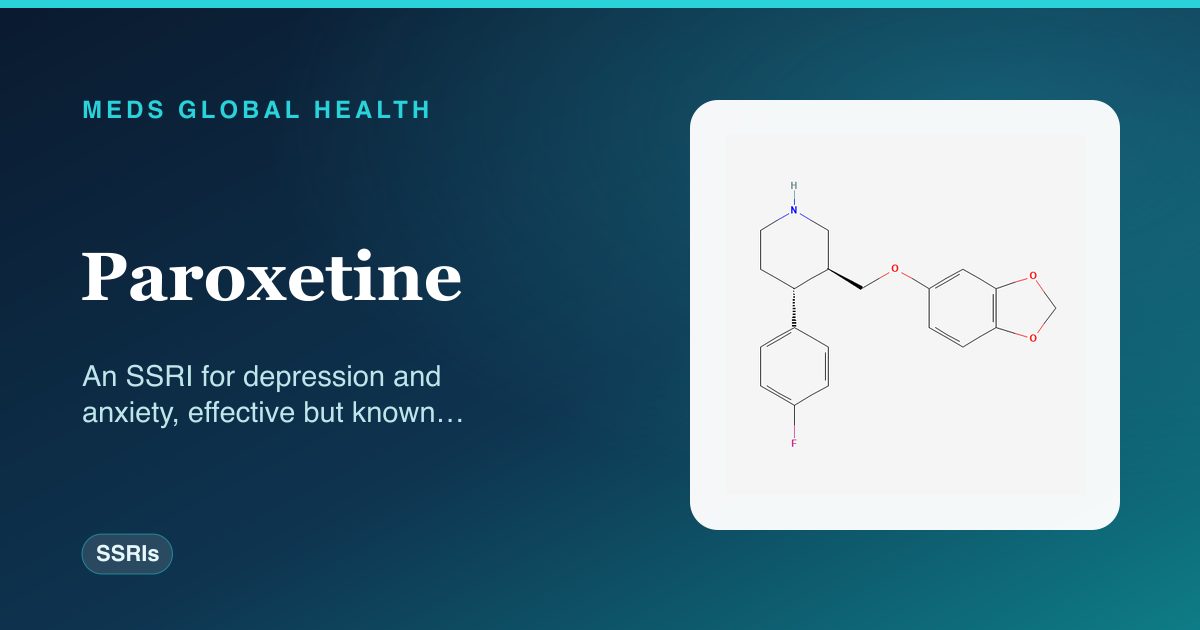
What it is
Paroxetine is a selective serotonin reuptake inhibitor (SSRI) used for depression and for several anxiety conditions. It is effective, but it is the SSRI most associated with troublesome discontinuation ("withdrawal") symptoms, because it leaves the body relatively quickly — so it needs to be reduced especially slowly when stopping. It tends to have slightly more "anticholinergic" effects (such as dry mouth and constipation) than some other SSRIs. It is a long-term, once-daily tablet, sold as Seroxat in the UK and Paxil in the US.
How it works
Paroxetine increases the activity of serotonin, a natural chemical messenger in the brain, by slowing its reabsorption back into nerve cells so that more remains available to pass signals. Over a few weeks this is thought to help restore the balance involved in mood and anxiety, lifting low mood and calming anxiety. Because paroxetine is shorter-acting than some other SSRIs, levels fall quickly if doses are missed or it is stopped abruptly, which is why discontinuation symptoms are more noticeable with it.
Company & origin
Originated / developed by: Beecham (now GlaxoSmithKline).
Paroxetine, an SSRI, was originally developed by Ferrosan and licensed to Beecham (later SmithKline Beecham, now GSK). It was first approved by the US FDA in 1992, marketed as Paxil/Seroxat.
What it treats
Conditions Paroxetine is used for
Practical use
How to take Paroxetine
General, dose-free guidance — always follow your prescriber's and the leaflet's specific instructions.
- Usually taken once a day, often in the morning, with or without food.
- It often takes a few weeks to feel the full benefit, so keep taking it consistently.
- Do not stop abruptly; paroxetine is particularly prone to discontinuation symptoms, so your doctor will taper it slowly.
- Tell your doctor if your mood worsens or you have distressing thoughts, especially early on.
- Avoid drinking much alcohol while taking it.
- Check before starting new medicines, as paroxetine interacts with several others.
Weighing it up
Advantages & disadvantages of Paroxetine
Advantages
- Effective for depression and a range of anxiety disorders.
- Taken once daily.
- Long-established medicine with extensive clinical experience.
Disadvantages
- More likely than other SSRIs to cause discontinuation symptoms, so careful tapering is essential.
- Can cause nausea, drowsiness, weight changes and reduced sex drive.
- Takes several weeks to reach full effect.
- Not generally recommended in pregnancy unless the benefits clearly outweigh the risks.
Practical use
Good to know
It usually takes a couple of weeks to begin helping and several weeks for the full effect. The single most important practical point is that it must be reduced very gradually when stopping — more slowly than most SSRIs — because abrupt stopping commonly causes dizziness, "electric-shock" sensations, nausea and irritability. It can cause anticholinergic effects such as dry mouth, constipation and drowsiness. It is generally avoided in pregnancy where possible. In adults under twenty-five, mood and any thoughts of self-harm are watched more closely early on.
Who should not take it / use with caution
- People taking certain older antidepressants (MAOIs) — these must not be combined with it.
- Used with caution, and usually avoided where possible, in pregnancy.
- Care where there is a raised bleeding risk, and alongside other serotonin-boosting medicines.
Monitoring
- Mood and, in younger adults, any thoughts of self-harm early on
- Tolerability and discontinuation symptoms when reducing
- Blood salts (sodium) where relevant
Side effects
- Feeling sick, dry mouth, constipation, drowsiness, sweating or sexual difficulties.
- Dizziness, sleep changes, or weight change.
- Discontinuation symptoms if doses are missed or it is stopped suddenly; rarely, low blood sodium or serotonin syndrome (agitation, shivering, sweating, a racing heart) — seek urgent advice if these occur.
Key interactions
- It must not be combined with certain older antidepressants (MAOIs), and care is needed with other serotonin-boosting medicines, including some painkillers, triptans and St John's wort.
- Combining it with aspirin, antiplatelets, anticoagulants or some NSAID painkillers raises bleeding risk.
- It can affect the levels of some other medicines (such as certain heart and pain medicines) — have combinations checked.
Available as: Tablets and a liquid form.
Answers
Paroxetine: frequently asked questions
Why does paroxetine cause worse withdrawal symptoms than other SSRIs?
Paroxetine leaves the body relatively quickly compared with other SSRIs, so if a dose is missed or it is stopped abruptly, levels fall fast and discontinuation symptoms — dizziness, "electric-shock" sensations, nausea, irritability — are more likely. This is why it must be reduced especially slowly, and why taking it consistently matters.
How should I come off paroxetine?
Always come off it gradually and under guidance, usually more slowly than with other SSRIs and over a longer period, to minimise discontinuation symptoms. Never stop it suddenly on your own — agree a step-down plan with your prescriber, who can slow it further if you get symptoms.
How long does paroxetine take to work?
It usually takes about two weeks to start helping and several weeks for the full benefit, so it is worth continuing even if you notice no change at first. If there is no improvement after a fair trial, your prescriber can review the choice of medicine.
Can I take paroxetine if I am pregnant or planning a pregnancy?
Paroxetine is generally avoided in pregnancy where possible, and other options may be preferred. If you are pregnant, planning a pregnancy or breastfeeding, do not stop suddenly but speak to your prescriber, who will weigh up the benefits of treatment against any risks and choose the safest approach for you.
What is the difference between paroxetine, Seroxat and Paxil?
They are the same medicine — paroxetine is the generic (active-ingredient) name, Seroxat is the UK brand name and Paxil is the US brand name. The active ingredient is identical.
The wider class
About SSRIs
Paroxetine belongs to the ssris class. For how the class as a whole works, its shared safety principles and monitoring, see the full guide.
Browse by body system
Authoritative sources
- BNF: Paroxetine.
- electronic Medicines Compendium (SmPC): Seroxat.
- NICE CKS: Paroxetine.
Building a medicines information resource?
We create evidence-led, dose-free drug and formulary references for teams.