An SSRI antidepressant
Sertraline
A commonly first-chosen SSRI antidepressant for depression and anxiety, taken once a day.
What is Sertraline?
Sertraline is a selective serotonin reuptake inhibitor (SSRI) and is one of the most commonly chosen first-line antidepressants in the UK. It is used for depression and for several anxiety conditions, including panic disorder, obsessive-compulsive disorder and post-traumatic stress disorder.
Education and reference only. This is a plain-language guide to Sertraline — it deliberately contains no doses. Doses depend on the person, the brand and the reason for treatment, and belong with your prescriber. Always check the BNF, the product labelling (SmPC) and follow medical advice.
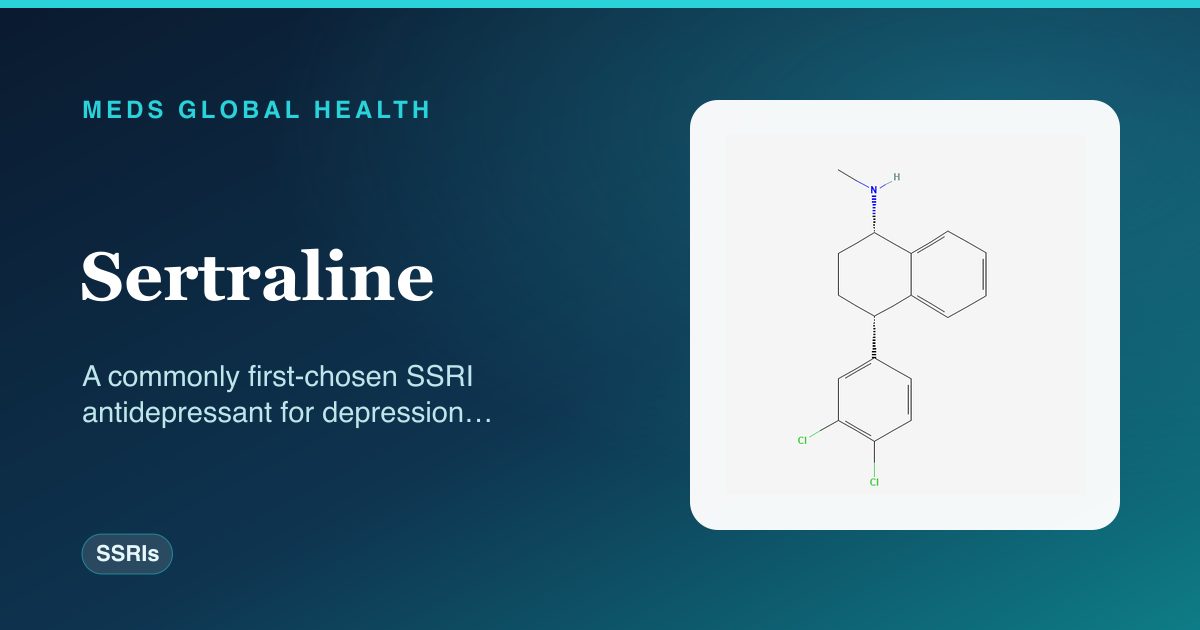
What it is
Sertraline is one of the most commonly chosen first-line SSRI (selective serotonin reuptake inhibitor) antidepressants in the UK. It is used for depression and for a range of anxiety conditions, including generalised anxiety, panic, social anxiety, obsessive-compulsive disorder and post-traumatic stress. It is taken as a once-daily tablet and is generally well tolerated, which is part of why it is often the first SSRI tried.
How it works
Sertraline increases the amount of serotonin — a chemical messenger involved in mood and anxiety — available between nerve cells in the brain, by blocking its reabsorption ("reuptake") back into the cells. Boosting serotonin signalling in this way gradually helps lift mood and dampen anxiety, although the underlying changes take time to build, which is why the benefit is not immediate.
Company & origin
Originated / developed by: Pfizer.
Sertraline is an SSRI antidepressant discovered and developed by Pfizer in the United States in the 1980s. It was approved by the FDA in 1991 and marketed as Zoloft, and as Lustral in the UK.
What it treats
Conditions Sertraline is used for
Practical use
How to take Sertraline
General, dose-free guidance — always follow your prescriber's and the leaflet's specific instructions.
- Usually taken once a day, at a time that suits you; if it disturbs sleep, taking it in the morning can help.
- Swallow the tablet with water, with or without food.
- It often takes several weeks to work, and early side effects may settle before the benefit builds.
- If you miss a dose, skip it and take the next one as usual — do not double up.
- Do not stop suddenly; it should be reduced gradually to avoid withdrawal-type symptoms.
- Tell your doctor promptly if your mood worsens or you have distressing thoughts, especially early on.
Weighing it up
Advantages & disadvantages of Sertraline
Advantages
- A well-tolerated first-line SSRI suitable for many people.
- Effective for both depression and a range of anxiety disorders.
- Once-daily dosing.
- Considered a sensible choice in people with heart problems and has relatively few interactions.
Disadvantages
- Can cause nausea, diarrhoea, sleep changes and sexual side effects.
- May take several weeks to take full effect.
- Must be tapered rather than stopped abruptly to limit withdrawal symptoms.
- Like all antidepressants, mood or anxiety can briefly worsen when first starting.
Practical use
Good to know
Sertraline usually takes a couple of weeks to begin working, and longer for the full effect — so it is worth persevering. In the first weeks it can sometimes make anxiety, restlessness or sleep feel worse before they get better, and cause some stomach upset; these early effects commonly settle. It should not be stopped abruptly, as this can cause discontinuation symptoms (dizziness, flu-like feelings, "electric-shock" sensations) — it is tapered gradually when the time comes. Under-25s and anyone at the start of treatment are monitored a little more closely early on, as mood and thoughts can fluctuate before improvement.
Who should not take it / use with caution
- People taking, or who have recently taken, a monoamine-oxidase inhibitor (MAOI) antidepressant — these are not combined.
- Used with caution in people with epilepsy, bipolar disorder, a bleeding tendency, or significant liver problems.
- In pregnancy and breastfeeding it is used after weighing up benefits and risks — discuss with your prescriber rather than stopping on your own.
Monitoring
- Mood, anxiety and any thoughts of self-harm, especially early on and in under-25s
- Tolerability in the first weeks, and during any dose change
- Signs of bleeding or low sodium where relevant
Side effects
- Nausea, digestive upset, headache and sleep changes — most common in the first weeks and often settling.
- More anxiety, restlessness or jitteriness early on; sexual side effects such as reduced desire or delayed orgasm.
- Rarely, serotonin syndrome (agitation, sweating, tremor, fast heartbeat) when combined with other serotonergic drugs, or a low blood sodium level — report marked or unusual symptoms.
Key interactions
- Other serotonergic medicines (other antidepressants, triptans for migraine, tramadol, St John's Wort) can combine to cause serotonin syndrome.
- NSAID painkillers, aspirin and anticoagulants increase the risk of bleeding when taken with an SSRI.
- MAOIs are not combined with sertraline; check new medicines, including herbal ones, with a pharmacist.
Available as: Tablets (several strengths); a liquid is available for those who cannot swallow tablets.
Answers
Sertraline: frequently asked questions
How long does sertraline take to work?
It usually takes a couple of weeks before you notice a difference, and several weeks more for the full effect, so it is worth sticking with it. If there is no improvement after a reasonable trial, your prescriber can review the plan.
Why do I feel more anxious in the first week or two?
SSRIs can briefly increase anxiety, restlessness or jitteriness when first started, before they begin to help. This commonly settles within a couple of weeks. Tell your prescriber if it is marked, and do not stop suddenly on your own.
Can I stop sertraline once I feel better?
Not abruptly — stopping suddenly can cause discontinuation symptoms such as dizziness, flu-like feelings and "electric-shock" sensations, and treatment is usually continued for a period after you feel well to reduce relapse. When the time comes, it is tapered down gradually under guidance.
Can I take ibuprofen or other painkillers with sertraline?
SSRIs and anti-inflammatory painkillers (NSAIDs) such as ibuprofen, as well as aspirin and anticoagulants, together raise the risk of bleeding. Paracetamol is generally a safer choice for pain; check with your pharmacist before regular use of NSAIDs.
Is Lustral the same as sertraline?
Yes — sertraline is the generic (active-ingredient) name and Lustral is a brand name; both contain the same active ingredient.
The wider class
About SSRIs
Sertraline belongs to the ssris class. For how the class as a whole works, its shared safety principles and monitoring, see the full guide.
Browse by body system
Authoritative sources
- BNF: Sertraline.
- electronic Medicines Compendium (SmPC): Sertraline.
- NICE CKS: Sertraline.
Keep reading
Related articles
Building a medicines information resource?
We create evidence-led, dose-free drug and formulary references for teams.