A bisphosphonate for bone strength
Risedronate
A weekly or monthly bisphosphonate tablet for osteoporosis, taken with a strict swallowing routine to protect the gullet and reduce fracture risk.
What is Risedronate?
Risedronate is a bisphosphonate used to treat and prevent osteoporosis, where bones become thin and break too easily, including bone loss linked to the menopause and to steroid treatment. It works by slowing the breakdown of bone.
Education and reference only. This is a plain-language guide to Risedronate — it deliberately contains no doses. Doses depend on the person, the brand and the reason for treatment, and belong with your prescriber. Always check the BNF, the product labelling (SmPC) and follow medical advice.
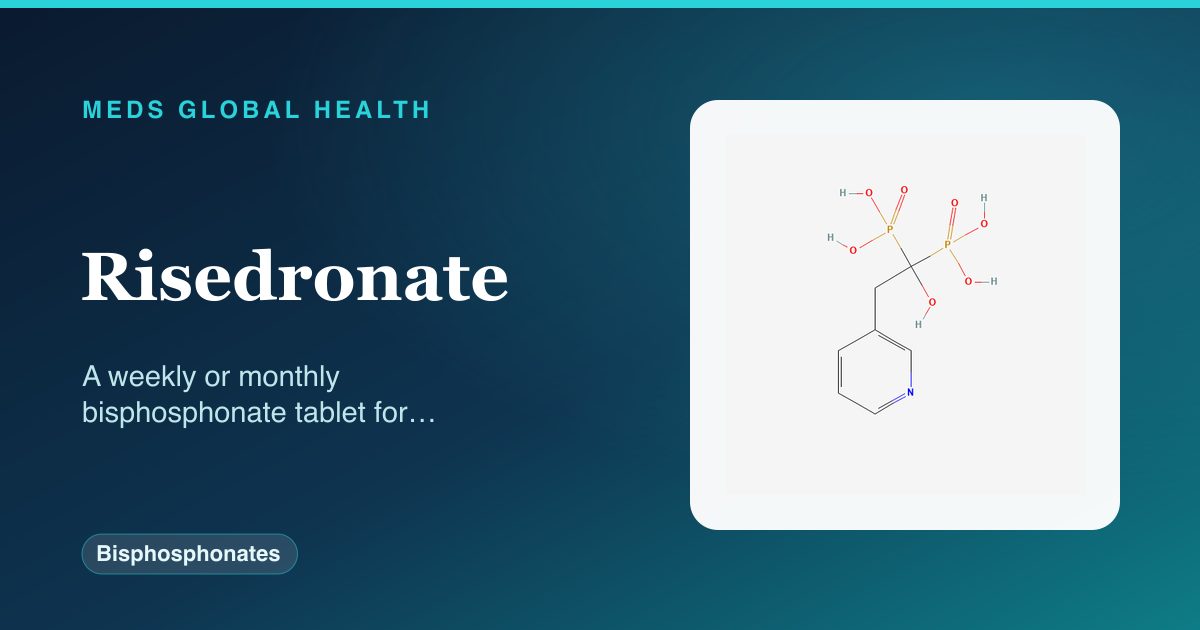
What it is
Risedronate is a bisphosphonate used to treat and prevent osteoporosis — thinning, weakened bones that break too easily — including bone loss linked to the menopause or to long-term steroid treatment. It works alongside enough calcium and vitamin D to strengthen bone and reduce the chance of fractures, particularly of the spine and hip. It is usually taken as a tablet on a weekly or monthly schedule rather than every day, and follows the same careful gullet-protecting swallowing routine as alendronic acid. In the UK and US the active ingredient and the original brand (Actonel) are the same; generic risedronate is identical.
How it works
Bone is constantly being broken down and rebuilt by two opposing teams of cells. In osteoporosis the breakdown outpaces the rebuilding, so bone gradually weakens. Risedronate settles into the bone surface and dampens the cells that dissolve bone (osteoclasts), tipping the balance back so that less bone is lost and existing bone is preserved. Over time this raises bone strength and lowers the risk of fractures. Because it binds tightly to bone, its protective effect lingers in the skeleton well after a dose is taken.
Company & origin
Originated / developed by: Procter & Gamble.
Risedronate, a nitrogen-containing bisphosphonate, was developed by scientists at Procter & Gamble's laboratories in the US and was first approved by the FDA in 1998, marketed as Actonel.
What it treats
Conditions Risedronate is used for
Practical use
How to take Risedronate
General, dose-free guidance — always follow your prescriber's and the leaflet's specific instructions.
- Take risedronate first thing in the morning on an empty stomach, swallowed whole with a full glass of plain water only, like alendronate.
- Stay sitting or standing upright and do not lie down for the period stated on the label after taking it, to protect the food pipe.
- Wait the recommended time before having any food, other drinks or medicines, as these can stop it being absorbed.
- Stop and seek advice if you get difficulty or pain on swallowing, or new heartburn, as these can signal irritation of the food pipe.
- Keep up adequate calcium and vitamin D as advised, and attend any dental check-ups, since jaw problems are a rare risk.
Weighing it up
Advantages & disadvantages of Risedronate
Advantages
- Reduces the risk of fractures in people with osteoporosis.
- Available as a weekly or daily option, which can aid adherence.
- Long-established and widely used treatment.
- Helps protect bone in people taking long-term steroids.
Disadvantages
- Must be taken with strict instructions, upright and on an empty stomach, which some find inconvenient.
- Can irritate the food pipe, causing heartburn or swallowing problems.
- Rarely linked to jaw bone problems and unusual thigh-bone fractures with long-term use.
- Not suitable for people who cannot sit or stand upright or who have certain swallowing problems.
Practical use
Good to know
The swallowing routine is the most important practical point and is the same idea as with alendronic acid: the tablet is taken first thing, on a completely empty stomach, swallowed whole with a full glass of plain water (not other drinks), and you then stay fully upright — sitting or standing, not lying down — and have nothing else to eat, drink or take for a set time afterwards. This protects the gullet from irritation and helps the medicine absorb, as food, other drinks and other medicines greatly reduce its uptake. Tell your dentist you take it, as a dental check is sensible: rarely it is linked to a problem with healing in the jawbone (osteonecrosis), and very rarely to an unusual thigh-bone fracture — report new thigh, hip or groin pain.
Who should not take it / use with caution
- People who cannot sit or stand fully upright for the required time, or who have certain problems of the gullet (such as narrowing or delayed emptying), should not take the oral tablets.
- People with a low blood calcium level need this corrected first, and the medicine is used with caution in significant kidney impairment.
- A dental check is advised before starting where possible, especially with poor dental health, and it is avoided in pregnancy and breastfeeding.
Monitoring
- Bone health and fracture risk over time, sometimes with bone-density scans
- Calcium and vitamin D status, and kidney function where relevant
- Dental health, and any new thigh, hip or groin pain or jaw problems
Side effects
- Indigestion, heartburn, tummy pain or difficulty swallowing — much reduced by following the swallowing routine carefully.
- Muscle, joint or bone aches, and a short-lived flu-like feeling that can follow early doses in some people.
- Rarely, irritation or ulceration of the gullet; very rarely, jaw osteonecrosis (a problem with jawbone healing) or an unusual thigh-bone fracture — report persistent thigh, hip or groin pain.
Key interactions
- Calcium, antacids, iron and many mineral supplements bind it and stop it being absorbed, so they must be separated from it.
- Food and drinks other than plain water greatly reduce its absorption, which is why it is taken on an empty stomach.
- Care alongside anti-inflammatory painkillers (NSAIDs), which can add to irritation of the gullet and stomach.
Available as: Tablets taken on a weekly or monthly schedule; some products come with calcium and vitamin D to take on the other days.
Answers
Risedronate: frequently asked questions
Why do I have to stay upright after taking risedronate?
The tablet can irritate the gullet if it lingers there, so you take it with a full glass of plain water and stay fully upright — sitting or standing — for a set time afterwards, without lying down. This keeps the tablet moving down into the stomach and protects the gullet, while also helping the medicine absorb.
Why must it be taken on an empty stomach with plain water?
Risedronate is poorly absorbed if there is any food, or any drink other than plain water, in the stomach — even milk, coffee, juice or a calcium tablet can stop it working. Taking it first thing on a completely empty stomach, with plain water only, lets enough of it be absorbed to protect your bones.
Should I see my dentist before or during treatment?
Yes, it is sensible to keep up with dental check-ups and tell your dentist you take a bisphosphonate. Rarely, these medicines are linked to a problem with healing in the jawbone (osteonecrosis), and a healthy mouth and planned dental work lower that small risk. Report any jaw pain, swelling or loose teeth.
What is the unusual thigh fracture I have read about?
Very rarely, long-term bisphosphonate use is linked to an unusual fracture of the thigh bone, sometimes preceded by aching in the thigh, hip or groin. It is uncommon and the fracture-prevention benefit usually far outweighs it, but report any new, persistent thigh, hip or groin pain so it can be checked.
What is the difference between risedronate and Actonel?
They are the same medicine — risedronate is the generic (active-ingredient) name and Actonel is the original brand name, used in both the UK and US. Generic risedronate contains the identical active ingredient.
The wider class
About Bisphosphonates
Risedronate belongs to the bisphosphonates class. For how the class as a whole works, its shared safety principles and monitoring, see the full guide.
Browse by body system
Authoritative sources
- BNF: Risedronate sodium.
- electronic Medicines Compendium (SmPC): Risedronate (Actonel).
- NICE CKS: Risedronate.
Building a medicines information resource?
We create evidence-led, dose-free drug and formulary references for teams.