A medicine for Alzheimer's and Parkinson's dementia
Rivastigmine
A cholinesterase inhibitor used for the symptoms of Alzheimer's dementia and dementia in Parkinson's disease.
What is Rivastigmine?
Rivastigmine is a cholinesterase inhibitor used for dementia in Alzheimer's disease and in Parkinson's disease. It raises levels of acetylcholine, a brain chemical involved in memory and thinking, which can ease symptoms for a time. It comes as capsules or a once-daily skin patch, and does not cure dementia.
Education and reference only. This is a plain-language guide to Rivastigmine — it deliberately contains no doses. Doses depend on the person, the brand and the reason for treatment, and belong with your prescriber. Always check the BNF, the product labelling (SmPC) and follow medical advice.
What it is
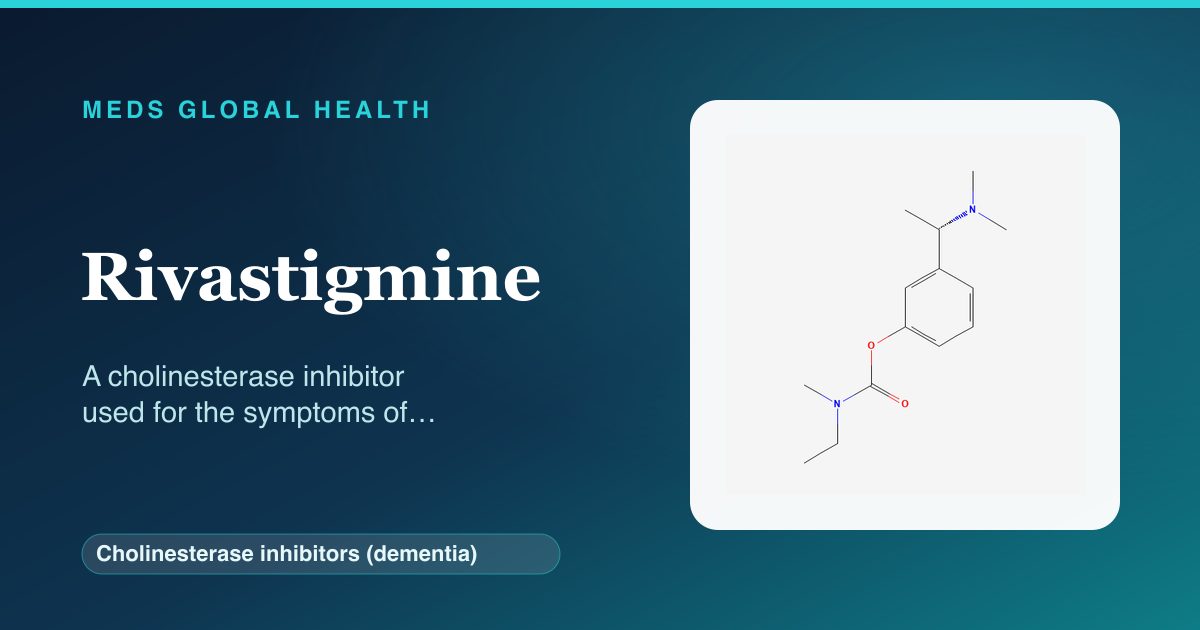
Rivastigmine is used to help with the symptoms of mild to moderate Alzheimer's dementia and dementia linked to Parkinson's disease. Like other medicines in its group, it treats symptoms rather than curing the condition. It is available as capsules taken by mouth or as a skin patch worn once a day. The patch can be useful for people who find swallowing tablets difficult or who get stomach side effects.
How it works
Dementia is linked to a fall in a brain messenger called acetylcholine, which is important for memory and thinking. Rivastigmine blocks the enzymes that break this messenger down, so more of it stays available in the brain. This can help symptoms for a period of time but does not change the course of the disease.
Company & origin
Originated / developed by: Novartis (originator).
A cholinesterase inhibitor introduced for dementia, available as capsules and skin patches.
What it treats
Conditions Rivastigmine is used for
Practical use
How to take Rivastigmine
General, dose-free guidance — always follow your prescriber's and the leaflet's specific instructions.
- Capsules are usually taken twice a day with food to reduce stomach upset.
- The skin patch is applied once a day to clean, dry, hairless skin and changed at about the same time each day.
- Always remove the old patch before applying a new one, and never wear more than one patch at a time.
- Rotate the patch site (for example upper back or upper arm) and avoid the same spot for several days.
- If you miss a capsule dose skip it; if a patch comes off or a day is missed, apply a new one and tell your doctor if doses are missed for several days.
Weighing it up
Advantages & disadvantages of Rivastigmine
Advantages
- Helps symptoms of dementia in both Alzheimer's and Parkinson's disease.
- The once-daily patch avoids swallowing capsules and causes less nausea for many people.
- Started low and increased slowly, which helps the body get used to it.
Disadvantages
- Does not cure dementia and the benefit fades over time.
- Capsules commonly cause nausea, vomiting, poor appetite and weight loss, especially during dose increases.
- Patches can irritate the skin, and using more than one at a time risks serious overdose.
Practical use
Good to know
Rivastigmine is started low and increased slowly, because nausea, vomiting and weight loss are more likely if the dose goes up too quickly. The skin patch causes fewer stomach side effects for many people. A very important safety rule with patches is to remove the old patch before putting on a new one, and to apply only one patch at a time, because using more than one can cause a serious overdose. Patches should be placed on clean, dry, hairless skin and the site rotated to reduce irritation. Treatment is reviewed regularly to check it is still helping.
Who should not take it / use with caution
- People with certain slow or irregular heart rhythms, heart block or fainting episodes need caution or may be unsuitable.
- People with asthma or COPD, or a history of stomach ulcers, need careful assessment.
- People who have had an allergic reaction to rivastigmine, or severe skin reactions to the patch, should not use it.
Monitoring
- Weight, appetite and stomach symptoms are checked regularly, particularly during dose increases.
- Heart rate, dizziness and any fainting are monitored.
- The skin where patches are applied is checked for irritation, and benefit is reviewed at follow-up.
Side effects
- Common: nausea, vomiting, diarrhoea, loss of appetite, weight loss, dizziness and headache.
- Patches can cause redness or itching at the site; spreading rash or blistering needs medical advice.
- Seek urgent help for severe or persistent vomiting, a very slow heartbeat, fainting or signs of stomach bleeding.
Key interactions
- Other medicines that slow the heart, such as beta-blockers, add to its effect on heart rate.
- Anticholinergic medicines (some bladder, allergy or sleep medicines) can work against it and worsen confusion.
- Combining it with other cholinesterase inhibitors or similar Parkinson's medicines should be avoided unless advised.
Available as: Capsules and once-daily skin patches.
Answers
Rivastigmine: frequently asked questions
What happens if I forget to remove an old patch?
Wearing more than one patch at a time can cause a serious overdose. Always remove the previous patch before applying a new one, and seek advice if you find more than one in place.
Is the patch better than the capsules?
The patch causes less nausea and vomiting for many people and avoids swallowing capsules, but it can irritate the skin. Your doctor will help you choose.
Does rivastigmine cure dementia?
No. It helps symptoms for a time in Alzheimer's and Parkinson's dementia but does not cure the condition or stop it progressing.
Why am I losing weight on it?
Reduced appetite, nausea and weight loss are recognised effects. Tell your doctor, who may adjust treatment or check your weight more closely.
Where should I put the patch?
On clean, dry, hairless skin such as the upper back, upper arm or chest, changing the site each day to reduce skin irritation.
The wider class
About Cholinesterase inhibitors (dementia)
Rivastigmine belongs to the cholinesterase inhibitors (dementia) class. For how the class as a whole works, its shared safety principles and monitoring, see the full guide.
Browse by body system
Authoritative sources
- BNF
- NICE CKS
Building a medicines information resource?
We create evidence-led, dose-free drug and formulary references for teams.