Valproate / semisodium valproate
Valproic acid
A valproate medicine used to treat epilepsy and to stabilise mood in bipolar disorder, with strict pregnancy precautions.
What is Valproic acid?
Valproic acid is a form of valproate used to control epilepsy and, as semisodium valproate (Depakote), to stabilise mood in bipolar disorder; it is closely related to sodium valproate. The dominant safety point is that valproate is highly harmful to an unborn baby: it must not be used in pregnancy, or by anyone able to become pregnant, unless they are in a Pregnancy Prevention Programme with highly effective contraception, because it can cause serious birth defects and developmental problems. You should never stop it suddenly, as this can trigger seizures, and your liver and blood may need monitoring.
Education and reference only. This is a plain-language guide to Valproic acid — it deliberately contains no doses. Doses depend on the person, the brand and the reason for treatment, and belong with your prescriber. Always check the BNF, the product labelling (SmPC) and follow medical advice.
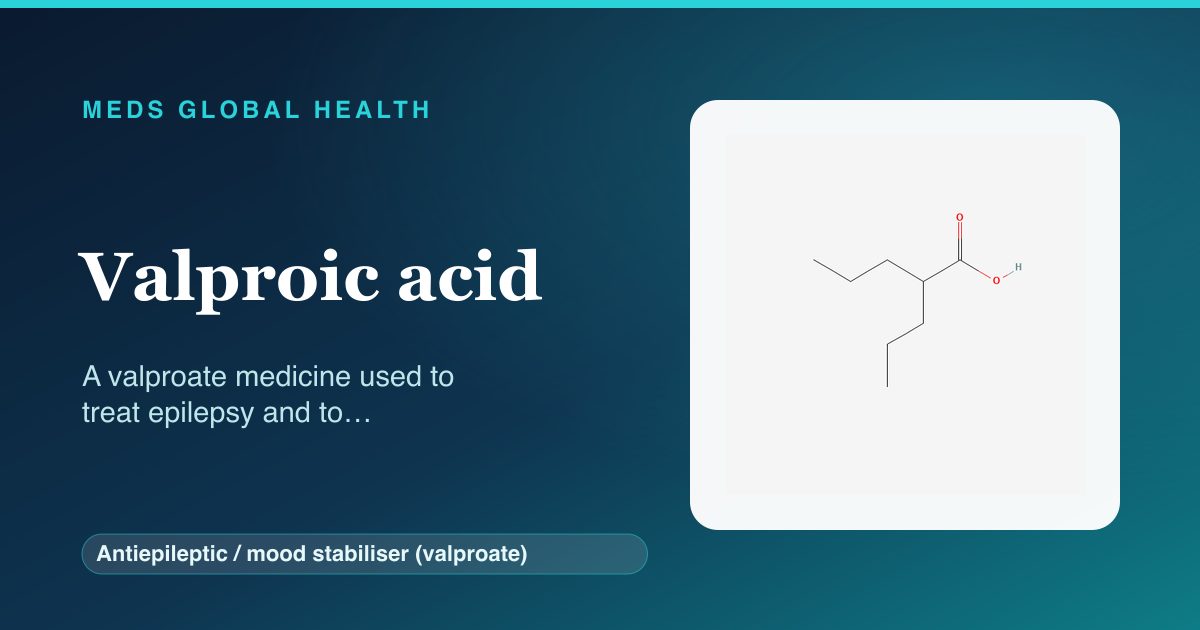
What it is
Valproic acid is one of the valproate medicines. It is used mainly to prevent seizures in epilepsy and, in the form known as semisodium valproate (Depakote), to treat episodes of mania and stabilise mood in bipolar disorder. It is closely related to sodium valproate — all are forms of valproate and share the same crucial safety warnings, particularly around pregnancy. It is taken long-term and works to keep the brain's electrical activity and mood more stable.
How it works
Valproate is thought to calm overactive electrical signalling in the brain. It increases the activity of a natural calming chemical messenger called GABA and affects the way nerve cells fire, which together make seizures less likely and help to even out the extremes of mood seen in bipolar disorder. The full effect builds up over time rather than working instantly.
Company & origin
A valproate medicine used in the UK as an anti-epileptic and mood stabiliser; closely related to sodium valproate.
What it treats
Conditions Valproic acid is used for
Practical use
How to take Valproic acid
General, dose-free guidance — always follow your prescriber's and the leaflet's specific instructions.
- Take it exactly as prescribed and at the same times each day; do not stop or change it suddenly, as this can trigger seizures.
- If you are able to become pregnant, you must use highly effective contraception and stay within a Pregnancy Prevention Programme while taking it.
- Swallow the tablets or capsules whole with water unless told otherwise; some forms should not be crushed or chewed.
- Report any severe tummy pain, persistent vomiting, yellowing of the skin or eyes, or unusual tiredness or bruising straight away.
- Attend any blood tests your doctor arranges, and do not run out — order repeat prescriptions in good time.
Weighing it up
Advantages & disadvantages of Valproic acid
Advantages
- An effective, long-established treatment for several types of epilepsy and for bipolar disorder.
- Can control seizures that other medicines have not, and helps stabilise mood.
- Available in several forms, making it easier to find one a person can take.
Disadvantages
- Highly harmful in pregnancy, so it cannot be used freely by anyone able to become pregnant.
- Requires monitoring of the liver and blood, and carries rare but serious liver and pancreas risks.
- Can cause weight gain, tremor, hair changes and drowsiness, and must never be stopped abruptly.
Practical use
Good to know
The most important thing to understand about valproate is that it is highly harmful to a developing baby. It must not be taken during pregnancy, and it must not be used by anyone able to become pregnant unless they are enrolled in a Pregnancy Prevention Programme using highly effective contraception, because valproate can cause serious birth defects and lasting problems with a child's development. Beyond this, never stop valproate suddenly — doing so can trigger seizures — and tell your doctor promptly about signs of liver or pancreas problems (such as severe tummy pain, vomiting, yellowing of the skin or eyes, or unusual tiredness). Blood tests are sometimes used to check your liver and blood counts. Reflecting these risks, UK rules now mean valproate is generally not started in any new patient (female or male) under 55 unless two specialists agree there is no suitable alternative.
Who should not take it / use with caution
- People who are pregnant, and anyone able to become pregnant unless they are within a Pregnancy Prevention Programme using highly effective contraception — valproate can cause serious birth defects and developmental problems.
- People with significant liver disease, or a personal or family history of severe liver problems, and those with certain metabolic disorders.
- People with active pancreas problems or certain blood disorders should be assessed carefully before use.
Monitoring
- Pregnancy status and contraception for anyone able to become pregnant, within the Pregnancy Prevention Programme.
- Liver function and blood counts, especially when starting and during the early months.
- Seizure or mood control, side effects, weight, and signs of liver or pancreas problems.
Side effects
- Feeling sick, weight gain, tremor, hair thinning, tiredness and drowsiness can occur.
- Rarely, serious liver injury or inflammation of the pancreas — report severe tummy pain, persistent vomiting, yellowing of the skin or eyes, or marked tiredness urgently.
- Bruising or bleeding more easily, or low blood counts, can occur and may be picked up on blood tests.
Key interactions
- Other anti-epileptic medicines, some of which raise or lower valproate levels or are affected by it.
- Aspirin and certain other medicines that can increase the risk of bleeding or affect valproate levels.
- Alcohol and other medicines that cause drowsiness, which add to its sedating effect.
Available as: Tablets and capsules taken by mouth, including some slow-release and gastro-resistant forms.
Answers
Valproic acid: frequently asked questions
What is valproic acid used for?
Valproic acid is a form of valproate used to prevent seizures in epilepsy and, as semisodium valproate, to treat mania and stabilise mood in bipolar disorder. It is closely related to sodium valproate.
Can I take valproic acid if I might become pregnant?
Valproate is highly harmful to an unborn baby and can cause serious birth defects and developmental problems. It must not be used in pregnancy, and anyone able to become pregnant should only take it within a Pregnancy Prevention Programme using highly effective contraception. Speak to your specialist before trying to conceive or if there is any chance you could be pregnant.
Can I stop taking valproic acid if I feel well?
No — you should never stop valproate suddenly. Doing so can trigger seizures or destabilise mood. If you want to stop or change it, this must be done gradually under your doctor's guidance.
What serious side effects should I watch for?
Tell your doctor straight away about severe tummy pain, persistent vomiting, yellowing of the skin or eyes, unusual tiredness, or easy bruising or bleeding. These can be signs of rare but serious liver, pancreas or blood problems, which is why blood tests are sometimes done.
How is valproic acid related to sodium valproate?
Both are forms of valproate and work in the same way, sharing the same crucial safety warnings — especially the strict pregnancy precautions. Valproic acid, sodium valproate and semisodium valproate (Depakote) are closely related members of the same medicine family.
The wider class
About Antiepileptic / mood stabiliser (valproate)
Valproic acid belongs to the antiepileptic / mood stabiliser (valproate) class. For how the class as a whole works, its shared safety principles and monitoring, see the full guide.
Browse by body system
Authoritative sources
- BNF
- NICE CKS
Building a medicines information resource?
We create evidence-led, dose-free drug and formulary references for teams.