An alcohol-dependence treatment
Acamprosate
A medicine that helps people stay off alcohol after they have stopped drinking, used alongside counselling.
What is Acamprosate?
Acamprosate is a medicine that helps people who are alcohol-dependent stay off alcohol after they have stopped drinking. It does not treat the withdrawal symptoms of stopping and is not a cure on its own — it works best alongside counselling and support, and is usually started soon after you become alcohol-free.
Education and reference only. This is a plain-language guide to Acamprosate — it deliberately contains no doses. Doses depend on the person, the brand and the reason for treatment, and belong with your prescriber. Always check the BNF, the product labelling (SmPC) and follow medical advice.
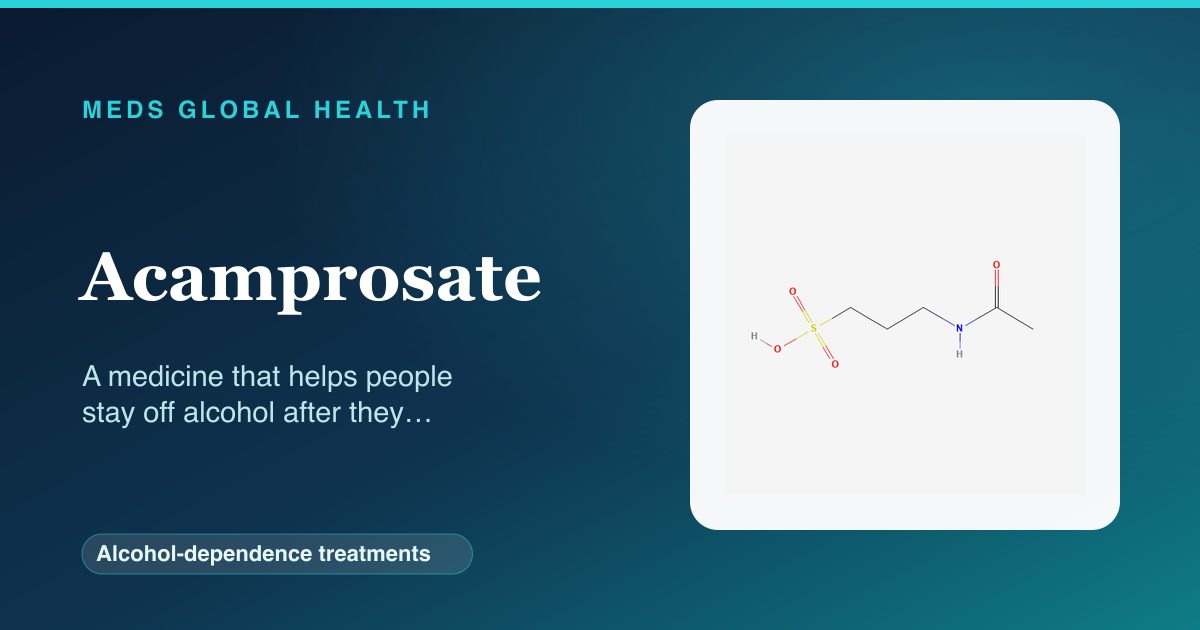
What it is
Acamprosate is a medicine used to help people who are dependent on alcohol stay abstinent once they have stopped drinking. It does not treat alcohol withdrawal and it is not a deterrent that makes you ill if you drink — instead it helps reduce the urge to drink again. It is taken regularly as a tablet, as part of a wider programme of support.
How it works
After heavy, long-term drinking, the brain's chemistry stays unbalanced for some time even after alcohol is stopped, which contributes to ongoing cravings. Acamprosate is thought to help restore the balance between the brain's excitatory and calming signals, easing that craving. By dampening the urge to drink, it helps people maintain abstinence in the months after stopping.
Company & origin
Originated / developed by: Merck Santé (originator).
A medicine used to help people stay off alcohol after stopping drinking.
Practical use
How to take Acamprosate
General, dose-free guidance — always follow your prescriber's and the leaflet's specific instructions.
- It is usually started soon after you have stopped drinking and become alcohol-free.
- It is taken regularly several times a day; keeping to a routine helps you remember it.
- Continue taking it even if you have a lapse and drink — do not stop it on your own; get advice instead.
- Use it as part of a counselling or support programme rather than relying on the tablets alone.
- If you miss a dose, take it when you remember unless it is nearly time for the next one, then skip it — do not double up.
Weighing it up
Advantages & disadvantages of Acamprosate
Advantages
- Helps reduce cravings and supports staying off alcohol after stopping.
- Does not cause an unpleasant reaction if you drink, unlike disulfiram.
- Can be continued even after a lapse, as part of ongoing treatment.
Disadvantages
- Does not treat alcohol withdrawal, which has to be managed separately.
- Needs to be taken several times a day, which takes commitment.
- Works best only as part of counselling and support, not on its own.
Practical use
Good to know
It is started soon after you have stopped drinking and become alcohol-free, and is taken regularly for several months to a year. It does not stop withdrawal symptoms, so detox is managed separately, and it is not a substitute for counselling — it works best as part of a support programme. It is usually taken as tablets several times a day, which takes some commitment to remember. Diarrhoea is the most common side effect; it does not cause a reaction with alcohol the way disulfiram does, but the aim is still to stay off alcohol.
Who should not take it / use with caution
- People who have had an allergic reaction to acamprosate.
- People with severe kidney problems, in whom it is generally avoided.
- Used with caution in severe liver disease, and the risks and benefits should be discussed in pregnancy and breastfeeding.
Monitoring
- How you are getting on with staying off alcohol and any cravings.
- Kidney function, since it is cleared by the kidneys, and any troublesome side effects.
- Mood and overall wellbeing as part of your support programme.
Side effects
- Diarrhoea is the most common effect; nausea, stomach pain and wind can also occur.
- Itching or a rash, and changes in sex drive, are sometimes reported.
- Rarely, a more severe allergic reaction or low mood — seek advice if you feel persistently low or have thoughts of self-harm.
Key interactions
- It has few significant drug interactions and does not react with alcohol the way some other treatments do.
- It is used as part of a wider programme, so other treatments and support should be coordinated with your team.
- Tell your pharmacist about all your medicines, including anything bought over the counter.
Available as: Tablets.
Answers
Acamprosate: frequently asked questions
Does acamprosate stop alcohol withdrawal?
No. It does not treat withdrawal symptoms — detox is managed separately. Acamprosate is used afterwards to help you stay off alcohol.
Will it make me ill if I drink?
No. Unlike disulfiram, it does not cause an unpleasant reaction with alcohol. It works by reducing the urge to drink, and the aim is still to stay abstinent.
How long do I take it for?
It is usually taken for several months up to about a year as part of a support programme. Your team will advise on how long to continue.
Is acamprosate the same as Campral?
Yes. Acamprosate is the active-ingredient name and Campral is a brand name for the same medicine.
What if I have a drink while taking it?
Don't stop the medicine — a lapse does not mean it has failed. Get advice from your support team and continue treatment unless told otherwise.
The wider class
About Alcohol-dependence treatments
Acamprosate belongs to the alcohol-dependence treatments class. For how the class as a whole works, its shared safety principles and monitoring, see the full guide.
Browse by body system
Authoritative sources
- BNF: Acamprosate calcium.
- NICE CKS: Alcohol misuse treatment.
Building a medicines information resource?
We create evidence-led, dose-free drug and formulary references for teams.