An antiviral medicine for herpes infections
Aciclovir
An antiviral for cold sores, genital herpes, shingles and chickenpox that works best when started early — known in the US as acyclovir.
What is Aciclovir?
Aciclovir is an antiviral medicine used to treat infections caused by the herpes family of viruses, including cold sores, genital herpes and shingles. It does not cure these infections but reduces their severity and helps them heal faster, working best when started early.
Education and reference only. This is a plain-language guide to Aciclovir — it deliberately contains no doses. Doses depend on the person, the brand and the reason for treatment, and belong with your prescriber. Always check the BNF, the product labelling (SmPC) and follow medical advice.
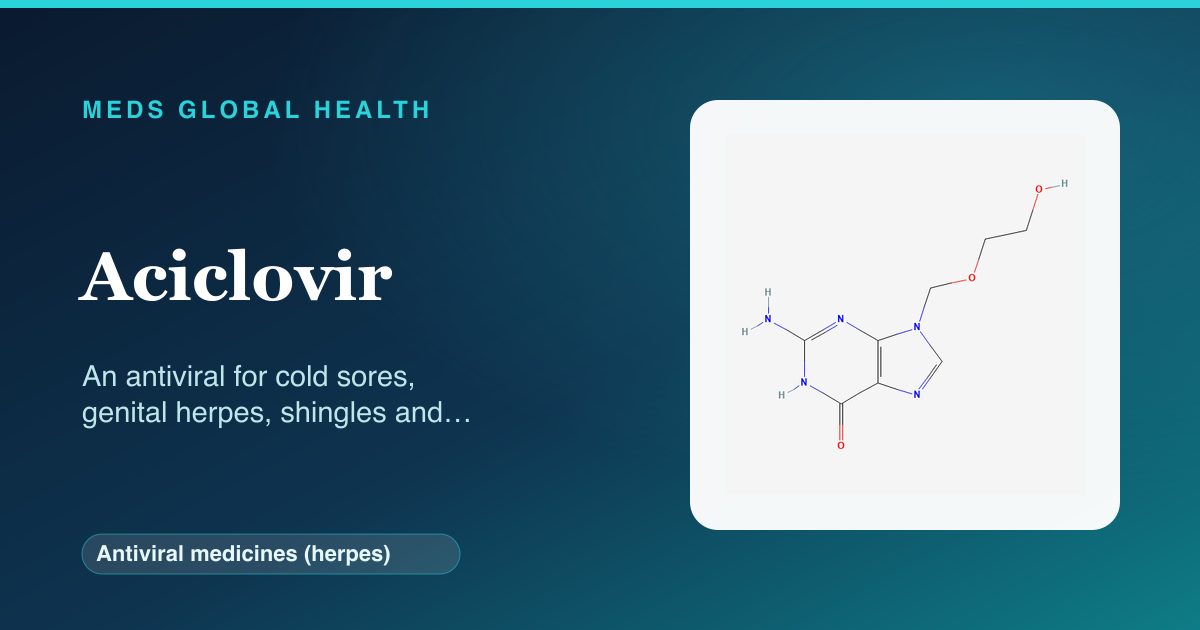
What it is
Aciclovir is an antiviral medicine used to treat infections caused by the herpes family of viruses: cold sores and genital herpes (herpes simplex), and shingles and chickenpox (varicella-zoster). It does not cure these viruses, which stay in the body, but it shortens and eases outbreaks and can be taken to prevent frequent recurrences. One point worth knowing is the spelling: in the UK the medicine is spelled aciclovir, while in the US it is spelled acyclovir — they are the same drug. A common brand in both countries is Zovirax.
How it works
Aciclovir is switched on inside virus-infected cells, where it is converted into an active form by an enzyme the herpes virus itself makes. This active form then blocks the viral enzyme (DNA polymerase) the virus uses to copy its own DNA, so the virus cannot multiply. Because it is mainly activated where the virus is, it targets infected cells and has little effect on healthy ones — which is why it is generally well tolerated. It calms an outbreak rather than removing the virus from the body.
Company & origin
Originated / developed by: Burroughs Wellcome (now GSK).
Aciclovir (acyclovir) was synthesized in 1974 by Howard Schaeffer at Burroughs Wellcome, with its selective anti-herpes activity elucidated by Gertrude Elion's team (published 1977); it was approved in 1982 and marketed as Zovirax.
Practical use
How to take Aciclovir
General, dose-free guidance — always follow your prescriber's and the leaflet's specific instructions.
- Start it as soon as possible after symptoms begin, ideally at the first tingling, for the best effect.
- Take the oral form at evenly spaced times and complete the full course as prescribed.
- Drink plenty of fluids while taking it, especially the higher-strength courses used for shingles.
- For cold-sore cream, apply it to the affected area frequently as directed and wash your hands afterwards.
- Tell your doctor about kidney problems, as the dose may need adjusting.
- Seek advice if the infection is severe, your immune system is weakened, or symptoms do not improve.
Weighing it up
Advantages & disadvantages of Aciclovir
Advantages
- Reduces the severity and duration of herpes infections when started early.
- Helps relieve pain and speed healing in shingles.
- Available as creams, tablets and stronger hospital forms.
- Generally well tolerated.
Disadvantages
- Works best only if started promptly and does not cure the underlying infection.
- Can cause nausea, headache and, with the cream, local stinging.
- May need dose adjustment and good fluid intake to protect the kidneys.
- Oral courses need to be completed and taken regularly to work.
Practical use
Good to know
Aciclovir works best when started as early as possible in an outbreak — ideally at the first tingling or warning signs of a cold sore or shingles rather than once it is fully developed. For mild cold sores a cream applied to the skin is often enough; tablets are used for genital herpes, shingles, chickenpox and more troublesome or frequent outbreaks. It is important to drink plenty of fluids while taking the tablets, as staying well hydrated protects the kidneys, and the approach is gentler in people with reduced kidney function or in older people.
Who should not take it / use with caution
- People who have had an allergic reaction to aciclovir or the closely related valaciclovir.
- Used with caution and extra attention to fluids in people with reduced kidney function and in older people.
- Care in pregnancy and breastfeeding, where it is used when the benefit is judged to outweigh any risk.
Monitoring
- Response of the outbreak
- Hydration and kidney function, especially in older people or reduced kidney function
- For any confusion or unusual drowsiness
Side effects
- Nausea, diarrhoea, headache or feeling generally off-colour with the tablets; mild stinging or dryness with the cream.
- Dizziness or tiredness in some people.
- Rarely, kidney problems (more likely if dehydrated) or confusion and other nervous-system effects — more of a concern in older people and reduced kidney function, and a reason to seek advice.
Key interactions
- It has relatively few interactions, but other medicines that can affect the kidneys may add to that risk, especially if you become dehydrated.
- Certain medicines (such as probenecid) can raise its levels in the body.
- Tell your pharmacist about other medicines, particularly if you have kidney problems, so any extra caution can be taken.
Available as: Cream for cold sores and skin, tablets and a liquid (suspension) for swallowing, an eye ointment for eye infections, and a form given by drip in hospital for severe infections.
Answers
Aciclovir: frequently asked questions
Is aciclovir the same as acyclovir?
Yes — they are exactly the same medicine. "Aciclovir" is the UK and international spelling, while "acyclovir" is the spelling used in the US. If you see either name, including on US packaging, it is the identical antiviral.
When should I start taking it for a cold sore or shingles?
As early as possible. Aciclovir works best when started at the very first signs — such as the tingling before a cold sore appears, or the early stages of a shingles rash — because it slows the virus while it is multiplying. Starting late gives much less benefit.
Does aciclovir cure herpes?
No. The herpes viruses stay in the body for life, and aciclovir does not remove them. What it does is shorten and ease outbreaks and, when taken regularly, reduce how often frequent recurrences happen — so it controls the condition rather than curing it.
Should I use the cream or the tablets?
For mild, occasional cold sores, the cream applied to the skin is often enough. Tablets are used for genital herpes, shingles, chickenpox, and for cold sores that are frequent or severe. Your pharmacist or prescriber can advise which is right for your situation.
What is the difference between aciclovir and Zovirax?
They are the same medicine — aciclovir is the generic (active-ingredient) name and Zovirax is a brand name. Generic aciclovir contains the identical active ingredient.
The wider class
About Antiviral medicines (herpes)
Aciclovir belongs to the antiviral medicines (herpes) class. For how the class as a whole works, its shared safety principles and monitoring, see the full guide.
Browse by body system
Authoritative sources
- BNF: Aciclovir.
- electronic Medicines Compendium (SmPC): Aciclovir (Zovirax).
- NICE CKS: Aciclovir.
Building a medicines information resource?
We create evidence-led, dose-free drug and formulary references for teams.