An antiviral for shingles (herpes zoster) in adults
Brivudine
An antiviral medicine used to treat shingles in adults, carrying a serious interaction with certain cancer medicines.
What is Brivudine?
Brivudine is an antiviral medicine used in some countries to treat shingles (herpes zoster) in otherwise healthy adults. It works against the virus that causes shingles and, in the places where it is used, is taken by mouth as a short course started as early as possible after the rash appears. The single most important thing to know is that it must never be taken with, or close to, certain cancer and immune medicines called fluoropyrimidines (such as fluorouracil and capecitabine), because the combination can be fatal and a gap of at least four weeks is needed. It is not used in people whose immune system is weakened, and in the UK other antivirals are used instead.
Education and reference only. This is a plain-language guide to Brivudine — it deliberately contains no doses. Doses depend on the person, the brand and the reason for treatment, and belong with your prescriber. Always check the BNF, the product labelling (SmPC) and follow medical advice.
What it is
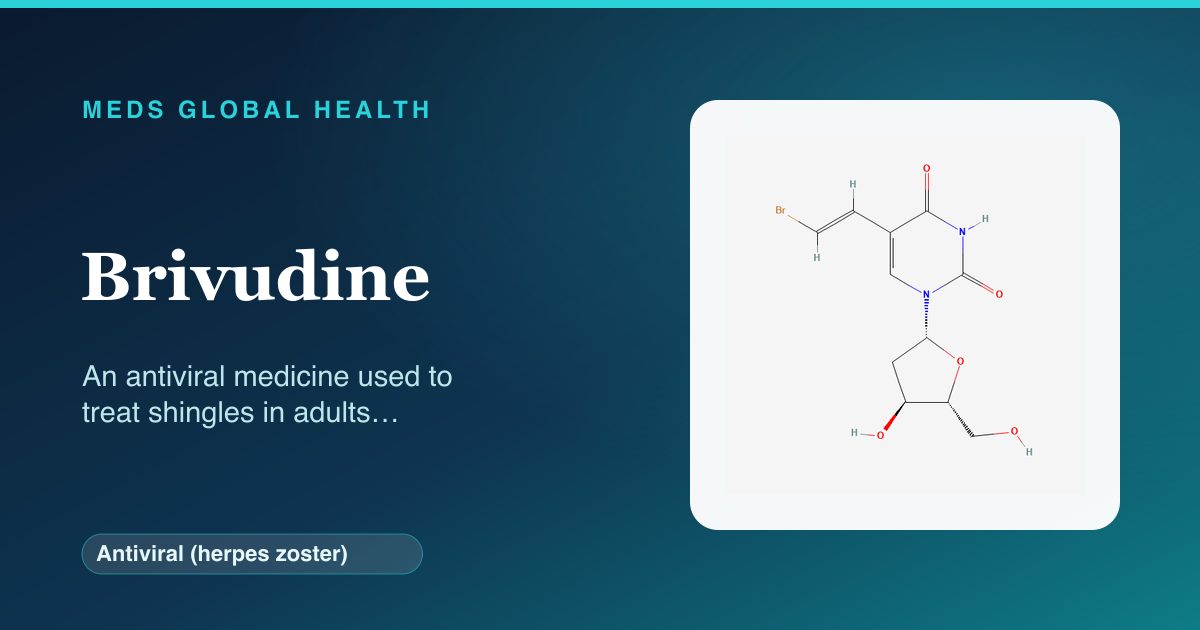
Brivudine is an antiviral medicine used to treat shingles, the painful blistering rash caused by reactivation of the chickenpox virus (varicella-zoster) in adults. It is used in some European countries as a short oral course in otherwise healthy adults, but it is not a routine treatment in the UK, where antivirals such as aciclovir, valaciclovir and famciclovir are the standard options. Its defining feature is a dangerous, potentially fatal interaction with a group of cancer and immune medicines called fluoropyrimidines, which shapes how and when it can ever be used.
How it works
Brivudine is taken up by cells infected with the shingles virus and turned into an active form that blocks the virus from copying its genetic material, so the infection cannot spread as easily and the rash settles sooner. Because it works best early, it is started as soon as possible after the rash appears. The same chemistry that makes it effective also explains its most serious danger: a breakdown product of brivudine strongly blocks an enzyme the body needs to handle fluoropyrimidine cancer medicines, which is why the two must never be taken together or close in time.
Company & origin
An antiviral medicine used in some countries to treat shingles (herpes zoster) in otherwise healthy adults; it is not a standard treatment in the UK, where other antivirals are used.
Practical use
How to take Brivudine
General, dose-free guidance — always follow your prescriber's and the leaflet's specific instructions.
- Start it as early as possible after the shingles rash appears, as antivirals work best when begun promptly.
- Take it by mouth exactly as prescribed and complete the short course you are given.
- Tell your prescriber straight away if you have had, or may need, cancer or immune medicines called fluoropyrimidines (such as fluorouracil or capecitabine), as these must never be combined with brivudine.
- Do not start any fluoropyrimidine medicine until at least four weeks have passed since your last brivudine dose.
- Tell your prescriber if your immune system is weakened, as brivudine is not suitable and a different antiviral is needed.
Weighing it up
Advantages & disadvantages of Brivudine
Advantages
- An effective antiviral for shingles in otherwise healthy adults where it is available.
- Taken by mouth as a short, simple course.
- Can ease the rash and may help reduce lingering nerve pain when started early.
Disadvantages
- Carries a serious, potentially fatal interaction with fluoropyrimidine cancer and immune medicines that requires a gap of weeks.
- Not suitable for people whose immune system is weakened.
- Not a standard treatment in the UK, where other antivirals are used.
Practical use
Good to know
The overwhelmingly important point about brivudine is its interaction with fluoropyrimidine medicines. These include fluorouracil (also given as creams), capecitabine, tegafur and the antifungal flucytosine, which are used in cancer and some other conditions. Taking brivudine alongside them, or within at least four weeks of them, can cause a severe and potentially fatal build-up of the cancer medicine in the body. Anyone who has had any of these medicines recently, or may need them, must not take brivudine, and treatment with these medicines must not be started until at least four weeks after the last brivudine dose. Brivudine is also only for adults with a normal immune system; it is not used in people who are immunocompromised, where shingles can be more dangerous and needs different treatment. As with all shingles treatment, starting early gives the best chance of easing the rash and reducing the risk of lingering nerve pain.
Who should not take it / use with caution
- People taking, or who have recently taken, fluoropyrimidine medicines such as fluorouracil, capecitabine, tegafur or flucytosine must not take it, because the combination can be fatal.
- People whose immune system is weakened (immunocompromised) should not take it; a different antiviral is used.
- People who have had a serious allergic reaction to brivudine should not take it.
- It is not used in children or during pregnancy and breastfeeding.
Monitoring
- Confirming the person has not had, and will not soon need, fluoropyrimidine medicines before starting.
- Checking how the shingles rash and pain respond to treatment.
- Watching for signs of severe toxicity if there is any concern about recent fluoropyrimidine use.
Side effects
- Nausea or other mild stomach upset.
- Headache or dizziness in some people.
- Rarely, more serious reactions; the most dangerous problem is the interaction with fluoropyrimidine medicines rather than a routine side effect.
Key interactions
- Fluoropyrimidine medicines (fluorouracil, capecitabine, tegafur) and the antifungal flucytosine must never be taken with brivudine, and a gap of at least four weeks is required.
- Anyone receiving cancer treatment should make sure their full medicine list is known before brivudine is even considered.
- Always tell your prescriber about every medicine you take, including creams and recently stopped treatments.
Available as: Tablets taken by mouth.
Answers
Brivudine: frequently asked questions
What is brivudine used for?
It is an antiviral used in some countries to treat shingles (herpes zoster) in otherwise healthy adults; in the UK other antivirals are usually used instead.
Why is the interaction with cancer medicines so important?
Brivudine can cause a severe, potentially fatal build-up of fluoropyrimidine cancer medicines such as fluorouracil and capecitabine, so they must never be taken together and must be separated by at least four weeks.
Can people with a weak immune system take it?
No. Brivudine is only for adults with a normal immune system; people who are immunocompromised need a different antiviral under specialist care.
When should it be started?
As early as possible after the shingles rash appears, because antivirals work best when begun promptly.
How long must I wait before starting a fluoropyrimidine medicine?
At least four weeks after your last brivudine dose, to avoid a dangerous build-up of the cancer medicine.
The wider class
About Antiviral (herpes zoster)
Brivudine belongs to the antiviral (herpes zoster) class. For how the class as a whole works, its shared safety principles and monitoring, see the full guide.
Browse by body system
Authoritative sources
- BNF
- NICE CKS
Building a medicines information resource?
We create evidence-led, dose-free drug and formulary references for teams.