An aminosalicylate (5-ASA) for ulcerative colitis
Balsalazide
An anti-inflammatory bowel medicine used to treat and help prevent flare-ups of ulcerative colitis.
What is Balsalazide?
Balsalazide is an aminosalicylate, an anti-inflammatory medicine used to treat flare-ups of ulcerative colitis and to help keep the condition settled. It is a prodrug, meaning it travels through the gut and is broken down by bacteria in the lower bowel to release the active anti-inflammatory part (5-ASA, or mesalazine) where it is needed. It is generally well tolerated, with stomach upset being the most common problem. Rarely it can affect the kidneys or blood counts, so occasional checks may be done.
Education and reference only. This is a plain-language guide to Balsalazide — it deliberately contains no doses. Doses depend on the person, the brand and the reason for treatment, and belong with your prescriber. Always check the BNF, the product labelling (SmPC) and follow medical advice.
What it is
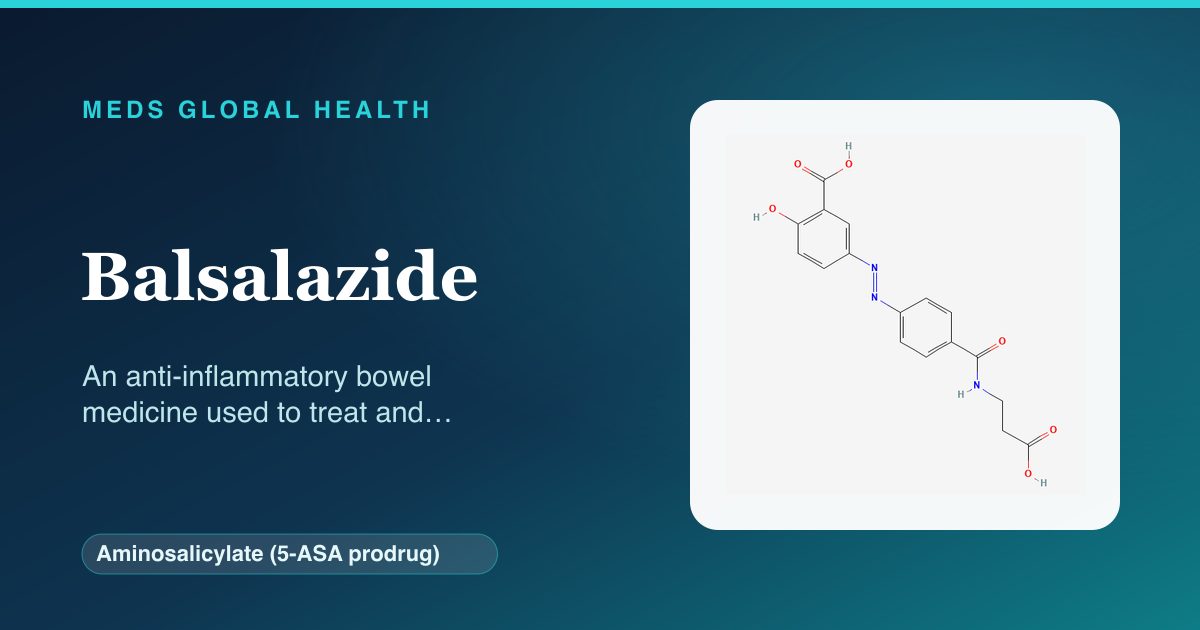
Balsalazide is one of the aminosalicylate medicines (often called 5-ASAs) used in ulcerative colitis, an inflammatory bowel disease that causes inflammation and ulcers in the large bowel. It is a prodrug carrier form: it passes through the upper gut largely unchanged and is split by bacteria in the colon to release mesalazine (5-ASA), the part that calms inflammation, directly at the site of disease. It is taken by mouth as capsules and is used both to bring a flare-up under control and, at a lower ongoing amount, to help keep the condition in remission. It is generally a well-tolerated treatment.
How it works
The active part of balsalazide, 5-ASA, acts directly on the inflamed lining of the bowel to reduce inflammation, which helps settle the symptoms of ulcerative colitis such as diarrhoea, urgency and blood in the stool. Because balsalazide is a prodrug that only releases the active medicine once gut bacteria break it down in the colon, much of the effect is delivered to the lower bowel where the disease usually is. Taking it regularly, even when well, is important because continuing it helps keep inflammation down and reduces the chance of a flare-up returning.
Company & origin
A medicine used in the UK to treat and help prevent flare-ups of ulcerative colitis, a form of inflammatory bowel disease.
Practical use
How to take Balsalazide
General, dose-free guidance — always follow your prescriber's and the leaflet's specific instructions.
- Take the capsules by mouth as prescribed, swallowing them with water.
- Keep taking it regularly even when you feel well, as this helps keep ulcerative colitis settled.
- Drink enough fluids while taking it, which is sensible for your kidneys.
- Report any unexplained bruising, bleeding, sore throat or fever, as these can rarely signal a blood problem.
- Tell your team if your bowel symptoms get worse rather than better, and mention any kidney problems before starting.
Weighing it up
Advantages & disadvantages of Balsalazide
Advantages
- An effective, generally well-tolerated treatment for ulcerative colitis flare-ups and for keeping the condition settled.
- Designed to release its active anti-inflammatory part in the lower bowel, where the disease usually is.
- Taken by mouth as capsules.
Disadvantages
- Can cause stomach upset such as tummy pain, nausea or diarrhoea.
- Rarely affects the kidneys, so occasional blood tests are needed.
- Very rarely affects blood counts, which need to be reported and checked.
Practical use
Good to know
Balsalazide is generally well tolerated, and the most common bother is mild stomach upset such as tummy pain, nausea or diarrhoea, which often settles. The most useful thing to know is that it is worth continuing even when you feel well, because keeping it going helps maintain remission and lowers the risk of a flare-up. A few uncommon but important points: it can rarely affect the kidneys, so occasional kidney blood tests are usually arranged, and very rarely it can affect blood counts, so report unexplained bruising, bleeding, sore throat or fever. Rarely, aminosalicylates can cause a worsening of bowel symptoms that mimics a flare; if symptoms get worse rather than better, tell your team. Keeping well hydrated is sensible. Let your prescriber know about kidney problems before starting.
Who should not take it / use with caution
- People who have had a serious allergic reaction to balsalazide or other aminosalicylates (such as mesalazine) should not take it.
- It is used with caution in people with kidney problems, with monitoring.
- It is used with care in people with a history of blood disorders, and any salicylate sensitivity should be discussed.
Monitoring
- Kidney blood tests, usually before starting and from time to time during treatment.
- Blood counts if there are signs of a problem, such as unexplained bruising or infection.
- Reviewing how well bowel symptoms are controlled over time.
Side effects
- Tummy pain, nausea, diarrhoea or wind, which often settle.
- Headache in some people.
- Rarely, kidney effects, which is why occasional blood tests are done.
- Very rarely, a drop in blood cells, signalled by unexplained bruising, bleeding, sore throat or fever, needing urgent attention.
Key interactions
- It is generally used with care alongside other medicines that can affect the kidneys, such as some anti-inflammatory painkillers.
- It may interact with azathioprine or mercaptopurine, increasing the risk of low blood counts, so monitoring is used.
- Tell your prescriber about all your medicines, including over-the-counter ones, before starting.
Available as: Capsules taken by mouth.
Answers
Balsalazide: frequently asked questions
What is balsalazide used for?
It is used to treat flare-ups of ulcerative colitis and to help keep the condition settled, by delivering an anti-inflammatory medicine to the lower bowel.
How does it know where to work?
It is a prodrug that passes through the upper gut and is broken down by bacteria in the colon, releasing the active anti-inflammatory part where the disease usually is.
Should I keep taking it when I feel well?
Yes. Continuing it even when you feel well helps keep ulcerative colitis settled and lowers the chance of a flare-up returning.
Does it affect the kidneys?
It can rarely affect the kidneys, so occasional kidney blood tests are usually arranged while you take it.
What should I report straight away?
Tell your team about unexplained bruising, bleeding, sore throat or fever, and if your bowel symptoms get worse rather than better.
The wider class
About Aminosalicylate (5-ASA prodrug)
Balsalazide belongs to the aminosalicylate (5-asa prodrug) class. For how the class as a whole works, its shared safety principles and monitoring, see the full guide.
Browse by body system
Authoritative sources
- BNF
- NICE CKS
Building a medicines information resource?
We create evidence-led, dose-free drug and formulary references for teams.