A skin lotion used for scabies
Benzyl benzoate
A skin lotion applied to the body to treat scabies, the itchy rash caused by tiny mites burrowing into the skin.
What is Benzyl benzoate?
Benzyl benzoate is a skin lotion used to treat scabies, an itchy rash caused by tiny mites that burrow into the skin. It is applied to the whole body and left on for a set time before washing off, killing the mites. It is an older treatment, sometimes used when creams such as permethrin are not suitable. It commonly causes a stinging or burning feeling and skin irritation, so it is not used on broken skin and must be kept away from the eyes and mouth. Close contacts are usually treated at the same time, and itching can continue for a while after the mites are gone.
Education and reference only. This is a plain-language guide to Benzyl benzoate — it deliberately contains no doses. Doses depend on the person, the brand and the reason for treatment, and belong with your prescriber. Always check the BNF, the product labelling (SmPC) and follow medical advice.
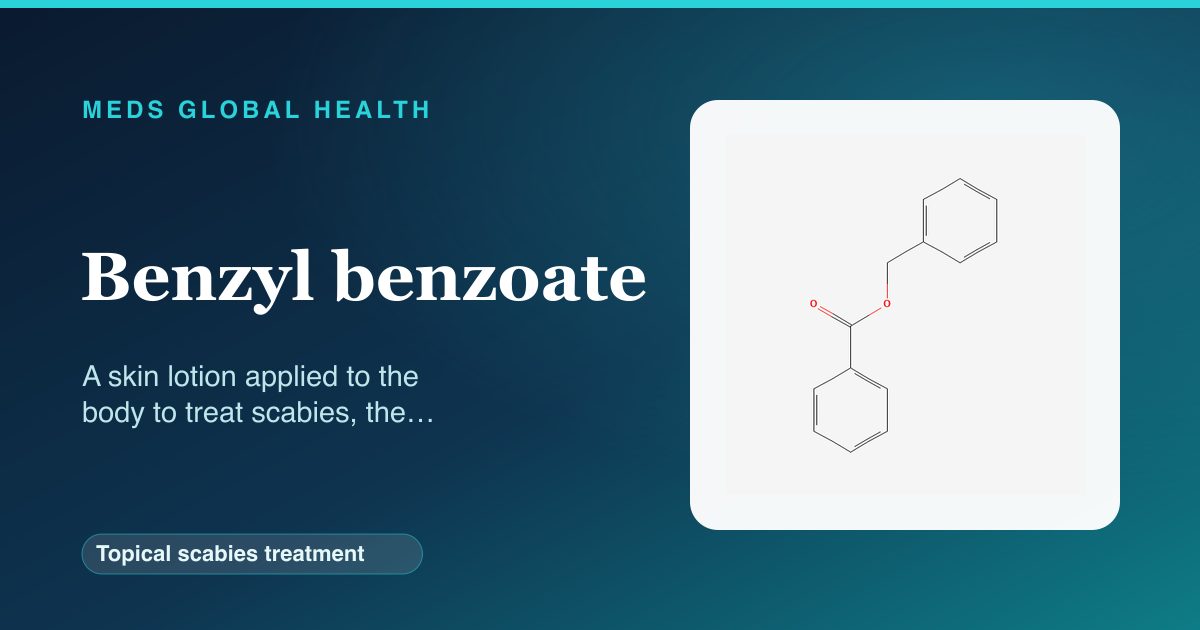
What it is
Benzyl benzoate is a long-established lotion applied to the skin to treat scabies, an infestation in which tiny mites burrow into the skin and cause an intensely itchy rash. It is painted or rubbed over the body and left on before being washed off. It is an older treatment that is sometimes used when other scabies treatments, such as permethrin cream, are not suitable. Because it can irritate the skin, it tends to be used with care and is not the first choice for everyone.
How it works
Scabies is caused by mites that live and lay eggs in tunnels they burrow into the top layer of the skin, and the itch comes from the body's reaction to them. Benzyl benzoate is applied over the skin and is toxic to these mites, killing them where they live in the skin's surface. Because the treatment needs to reach all the burrows, it is applied to the whole body rather than just the visible rash. The itch often continues for some time after the mites are killed, as the skin settles, which does not mean the treatment has failed.
Company & origin
An older skin lotion used in the UK to treat scabies, applied to the body, sometimes when other treatments are not suitable.
Practical use
How to take Benzyl benzoate
General, dose-free guidance — always follow your prescriber's and the leaflet's specific instructions.
- Apply it to the whole body as directed, usually from the neck down, covering all the skin rather than just the rash.
- Let it dry, then wash it off after the time your prescriber or pharmacist tells you.
- Keep it away from the eyes, mouth, lips and other delicate areas, and do not use it on broken or raw skin.
- Treat close contacts and household members at the same time, even if they have no symptoms, and wash bedding and clothing as advised.
- Repeat the treatment if you are told to, and remember that itching can continue for a while after the mites are gone.
Weighing it up
Advantages & disadvantages of Benzyl benzoate
Advantages
- An effective treatment that kills scabies mites when applied properly to the whole body.
- A useful option when other treatments, such as permethrin cream, are not suitable.
- A long-established treatment with decades of experience behind its use.
Disadvantages
- Commonly causes stinging, burning and skin irritation, especially on broken skin.
- Must be applied to the whole body and kept away from the eyes and mouth, which takes care.
- Not the first choice for everyone and may need repeating.
Practical use
Good to know
The most important practical point with benzyl benzoate is that it must be applied to the whole body, not just where the rash shows, because the mites can be present in skin that looks normal; the usual advice is to cover the body from the neck down (and to include the scalp, face and ears in young children and older people as directed), let it dry, and wash it off after the time you are told. It commonly causes stinging, burning and skin irritation, especially on raw or broken skin, so it should not be used on broken skin and must be kept out of the eyes, mouth and other delicate areas. Close contacts and household members are usually treated at the same time, even if they have no symptoms, to stop the infestation passing back and forth. The itch can last for a couple of weeks after successful treatment as the skin recovers, which is normal.
Who should not take it / use with caution
- People who have had a serious allergic reaction to benzyl benzoate should not use it.
- It should not be applied to broken, raw or badly inflamed skin.
- It is used with caution, or avoided, in young children unless specifically advised, as it can be more irritating.
- It is used with care in pregnancy and breastfeeding; seek advice on whether it is suitable.
Monitoring
- Checking that the treatment has worked and whether it needs repeating.
- Watching for skin irritation, particularly on sensitive or broken skin.
- Making sure close contacts have been treated to prevent reinfestation.
Side effects
- Stinging or burning where it is applied, especially soon after use.
- Redness, irritation or dryness of the skin.
- Worsening of itch in some people before it settles.
- Rarely, a more troublesome skin reaction, which should be checked.
Key interactions
- There are few well-known medicine interactions, but avoid using other irritating skin products on the same areas at the same time.
- Tell your prescriber or pharmacist about other creams or treatments you are using on your skin.
- Keep it away from the eyes and mouth and off broken skin to reduce irritation.
Available as: A lotion applied to the skin.
Answers
Benzyl benzoate: frequently asked questions
What is benzyl benzoate used for?
It is a skin lotion used to treat scabies, the itchy rash caused by tiny mites that burrow into the skin.
How do I apply it?
It is applied to the whole body as directed, usually from the neck down, left to dry, and washed off after the time you are told, because the mites can be in skin that looks normal.
Why does it sting?
Stinging or burning and skin irritation are common, especially on broken or sensitive skin, which is why it should not be used on raw skin and kept away from the eyes and mouth.
Do other people need treating too?
Yes. Close contacts and household members are usually treated at the same time, even without symptoms, to stop the scabies passing back and forth.
Why am I still itchy after treatment?
Itching can continue for a couple of weeks after the mites are killed as the skin settles; this is normal and does not mean the treatment has failed.
The wider class
About Topical scabies treatment
Benzyl benzoate belongs to the topical scabies treatment class. For how the class as a whole works, its shared safety principles and monitoring, see the full guide.
Browse by body system
Authoritative sources
- BNF
- NICE CKS
Building a medicines information resource?
We create evidence-led, dose-free drug and formulary references for teams.