A scabies and lice treatment cream
Permethrin
A cream used as the main treatment for scabies, and in some lice products.
What is Permethrin?
Permethrin is a skin cream used as the first-choice treatment for scabies, a very itchy rash caused by tiny mites that burrow into the skin. It is applied to the whole body, left on for the recommended time and then washed off, usually with a repeat application about a week later. Close contacts are treated at the same time, and the itch can carry on for some weeks even after the mites are gone.
Education and reference only. This is a plain-language guide to Permethrin — it deliberately contains no doses. Doses depend on the person, the brand and the reason for treatment, and belong with your prescriber. Always check the BNF, the product labelling (SmPC) and follow medical advice.
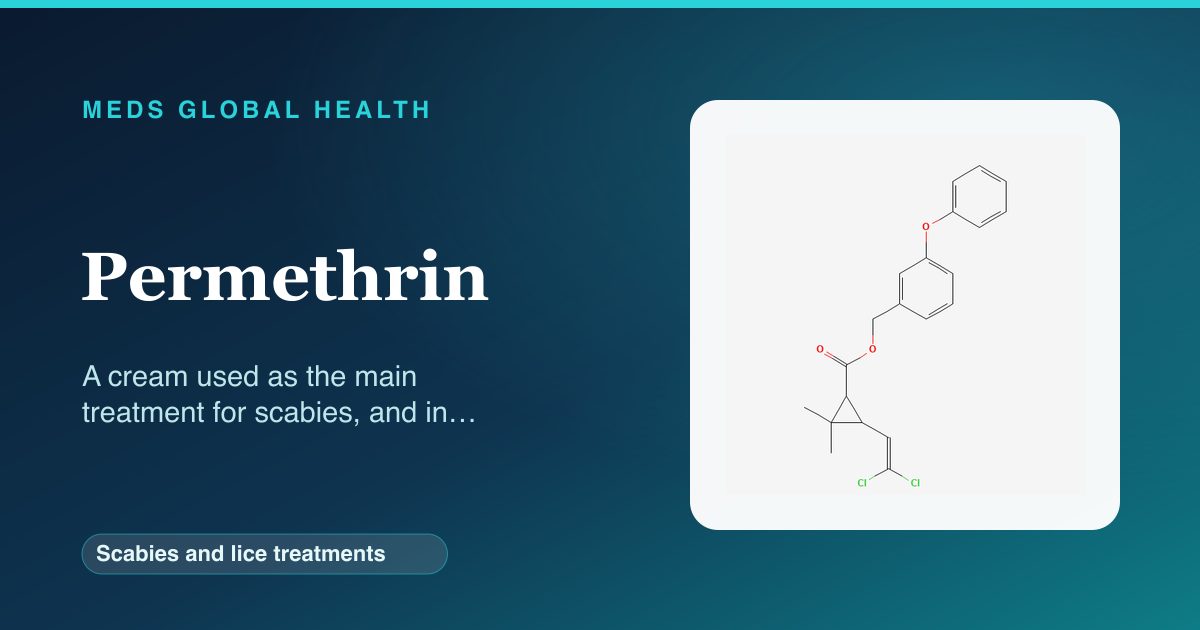
What it is
Permethrin is a treatment applied to the skin to kill scabies mites, and it is also found in some head-lice products. For scabies it is the usual first-choice treatment in the UK. Scabies is caused by tiny mites that burrow into the skin and cause intense itching, often worse at night. The cream is spread over the whole body, left on and then washed off, with a second application usually a week later.
How it works
Permethrin damages the nervous system of the scabies mites and lice, paralysing and killing them. Applied across the skin, it reaches the mites burrowing in the surface layers. Because eggs may survive a single treatment, a repeat application after about a week helps catch mites that hatch later.
Company & origin
Originated / developed by: Sumitomo (originator chemistry).
A topical insecticide used in the UK as first-line treatment for scabies.
Practical use
How to take Permethrin
General, dose-free guidance — always follow your prescriber's and the leaflet's specific instructions.
- Apply the cream to clean, cool, dry skin over the whole body, paying attention to between fingers and toes, under nails and the genital area.
- Leave it on for the recommended time, often overnight, before washing it all off.
- If you wash your hands or any area during the treatment time, reapply the cream to that area.
- Repeat the application about a week later to catch newly hatched mites, and treat close contacts at the same time.
- There is no missed-dose timing as such; if you wash it off too soon, reapply and leave it on for the full recommended time.
Weighing it up
Advantages & disadvantages of Permethrin
Advantages
- First-choice, effective treatment for scabies in the UK.
- Applied to the skin rather than taken by mouth, so it acts where the mites are.
- Suitable for many people, including with care in pregnancy and young children under advice.
Disadvantages
- Must be applied to the whole body and repeated, which can feel fiddly.
- Itching can persist for weeks afterwards, which is easily mistaken for failure.
- All close contacts need treating at once or the infestation can return.
Practical use
Good to know
For scabies the cream is applied to the whole body from the neck down (and including the scalp, face and ears in young children, older people and anyone with widespread infection), not just the itchy areas. It is left on for the recommended time, often overnight, then washed off, and the treatment is repeated about a week later. Everyone in close contact, including household members and sexual partners, should be treated at the same time even if they have no symptoms. Importantly, the itch can continue for a few weeks after successful treatment as the skin settles — this does not mean the treatment has failed.
Who should not take it / use with caution
- Anyone who has had an allergic reaction to permethrin or similar insecticides should avoid it.
- Use on very young infants, and in pregnancy or breastfeeding, should be guided by a pharmacist or GP.
- Broken or badly inflamed skin may need medical advice before applying it.
Monitoring
- No blood tests are needed; treatment is judged by whether the rash and itch settle.
- Expect itch to ease over a few weeks; persistent or spreading symptoms should be reviewed.
- Return to a pharmacist or GP if new burrows appear or itching does not improve.
Side effects
- Mild stinging, burning or itching of the skin where applied is common and usually short-lived.
- Temporary redness or a feeling of tightness in the skin.
- Rarely, a more troublesome rash or allergic reaction — seek advice if the skin becomes very inflamed.
Key interactions
- Few important interactions because little is absorbed through intact skin.
- Tell a pharmacist about other skin treatments you are using on the same areas.
- Avoid applying other creams at the same time unless advised, so the treatment is not diluted.
Available as: A cream applied to the skin.
Answers
Permethrin: frequently asked questions
Why am I still itchy after treatment?
Itching can continue for a few weeks even after the mites are dead, as the skin reacts and settles; this usually does not mean the treatment has failed.
Do I really need to treat my whole body?
Yes. Mites can be anywhere, so the cream is applied over the whole body, not just the itchy spots, to clear the infestation.
Should my family be treated too?
Yes, close contacts such as household members and partners should be treated at the same time, even without symptoms, to prevent reinfection.
How soon do I repeat the treatment?
A second application is usually done about a week later to kill any mites that have newly hatched from eggs.
What if I wash my hands during treatment?
Reapply the cream to any area you wash, so the whole skin stays covered for the full recommended time.
The wider class
About Scabies and lice treatments
Permethrin belongs to the scabies and lice treatments class. For how the class as a whole works, its shared safety principles and monitoring, see the full guide.
Browse by body system
Authoritative sources
- BNF
- NICE CKS
Building a medicines information resource?
We create evidence-led, dose-free drug and formulary references for teams.