A head-lice and scabies treatment lotion
Malathion
A lotion used to treat head lice, and as an alternative treatment for scabies.
What is Malathion?
Malathion is a treatment applied to the skin or scalp to kill head lice, and it is also used as an alternative treatment for scabies. It is rubbed in, left on for the recommended time and then washed out, usually with a repeat application about a week later. Some preparations are flammable while wet, so the hair and skin must be kept well away from flames, cigarettes and hairdryers until dry.
Education and reference only. This is a plain-language guide to Malathion — it deliberately contains no doses. Doses depend on the person, the brand and the reason for treatment, and belong with your prescriber. Always check the BNF, the product labelling (SmPC) and follow medical advice.
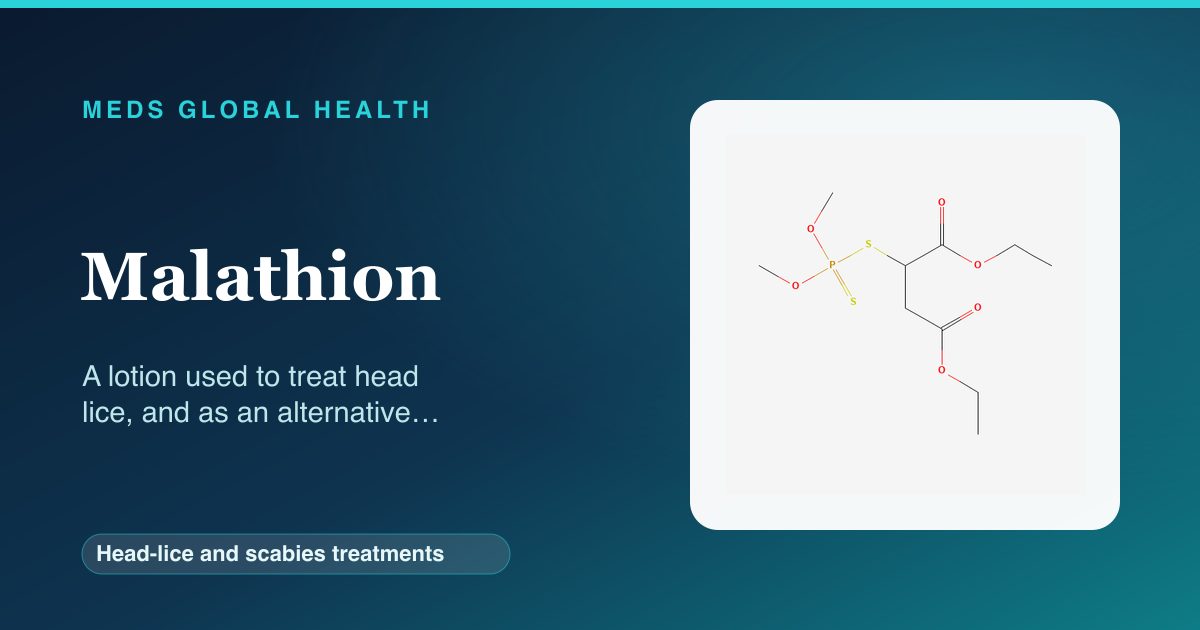
What it is
Malathion is an insecticide applied to the skin or scalp to kill head lice and their eggs, and it is also used as an alternative to permethrin for scabies. It is one of the longer-established head-lice treatments, used when a chemical option is preferred. Some products are alcohol-based liquids, which are effective but flammable while still wet.
How it works
Malathion poisons the nervous system of lice and mites, paralysing and killing them. When left on the hair or skin for long enough it can kill both the insects and, for many products, their eggs. A repeat application after about a week helps catch any lice or mites that hatch after the first treatment.
Company & origin
A topical insecticide used in the UK for head lice and as an alternative for scabies.
Practical use
How to take Malathion
General, dose-free guidance — always follow your prescriber's and the leaflet's specific instructions.
- Apply to dry hair and scalp (or to the body as directed for scabies), making sure it is spread evenly and reaches the roots.
- Keep away from naked flames, cigarettes and hairdryers while the hair or skin is still wet, as some products are flammable.
- Leave it on for the full recommended time before washing it out, and avoid getting it in the eyes.
- Repeat the application about a week later to catch newly hatched lice or mites, and treat affected household members.
- There is no daily missed-dose schedule; if it is washed off too soon, reapply and leave on for the full recommended time.
Weighing it up
Advantages & disadvantages of Malathion
Advantages
- An effective, long-established option for head lice and an alternative for scabies.
- Applied to the skin or scalp, acting directly where the insects live.
- Useful when an insecticide treatment is preferred or other products have not worked.
Disadvantages
- Some preparations are flammable while wet and need careful handling.
- Must be left on for the recommended time and usually repeated after a week.
- Can irritate the skin or scalp, and is unpleasant to get in the eyes.
Practical use
Good to know
Some malathion preparations are flammable while wet, so during and just after applying keep away from naked flames, lit cigarettes and other sources of ignition, and do not use a hairdryer to speed drying — let the hair dry naturally. The lotion is worked into the hair and scalp (or, for scabies, over the body as directed), left on for the recommended time, then washed out, with a repeat about a week later. Avoid getting it in the eyes. For head lice, check other household members and treat anyone affected, and use a fine-tooth comb to help remove lice and eggs.
Who should not take it / use with caution
- Anyone who has had an allergic reaction to malathion should avoid it.
- Use in young infants, pregnancy or breastfeeding should be guided by a pharmacist or GP.
- Broken, badly inflamed or weeping skin may need advice before treatment.
Monitoring
- No blood tests are needed; success is judged by whether lice or mites are cleared.
- Recheck the hair or skin after treatment and again after the repeat application.
- Return to a pharmacist if live lice are still seen after correct treatment.
Side effects
- Stinging, irritation or redness of the skin or scalp where applied.
- An unpleasant smell and, occasionally, temporary effects on hair.
- Rarely, a more troublesome skin reaction — seek advice if the skin becomes very inflamed.
Key interactions
- Few important interactions because little is absorbed through intact skin.
- Tell a pharmacist about other scalp or skin products you are using.
- Avoid using other lotions on the same area at the same time unless advised.
Available as: A lotion or liquid applied to the scalp or skin.
Answers
Malathion: frequently asked questions
Is malathion flammable?
Some alcohol-based preparations are flammable while wet, so keep away from flames, cigarettes and hairdryers and let the hair dry naturally.
How long do I leave it on?
Leave it on for the full recommended time stated on the product before washing it out; washing off too soon reduces how well it works.
Do I need to repeat the treatment?
Yes, a repeat application about a week later is usually advised to kill lice or mites that hatch after the first treatment.
Can I use it for scabies?
It can be used as an alternative scabies treatment when permethrin is unsuitable; follow the instructions for whole-body application.
Can a hairdryer speed up drying?
No. Because some products are flammable while wet, do not use a hairdryer; allow the hair to dry naturally instead.
The wider class
About Head-lice and scabies treatments
Malathion belongs to the head-lice and scabies treatments class. For how the class as a whole works, its shared safety principles and monitoring, see the full guide.
Browse by body system
Authoritative sources
- BNF
- NICE CKS
Building a medicines information resource?
We create evidence-led, dose-free drug and formulary references for teams.