The pink stomach remedy in Pepto-Bismol
Bismuth subsalicylate
An over-the-counter pink remedy used to settle indigestion, nausea and mild diarrhoea, including travellers' diarrhoea.
What is Bismuth subsalicylate?
Bismuth subsalicylate is the pink medicine found in Pepto-Bismol, used over the counter to settle indigestion, an upset stomach, nausea and mild diarrhoea, and to help with travellers' diarrhoea. A well-known and completely harmless effect is that it can darken the tongue and turn the stools black, which fades after stopping. Because it contains a salicylate (related to aspirin), it should not be given to children or teenagers who have a viral illness, because of the risk of a rare but serious condition called Reye's syndrome, and it should be avoided by anyone allergic to aspirin.
Education and reference only. This is a plain-language guide to Bismuth subsalicylate — it deliberately contains no doses. Doses depend on the person, the brand and the reason for treatment, and belong with your prescriber. Always check the BNF, the product labelling (SmPC) and follow medical advice.
What it is
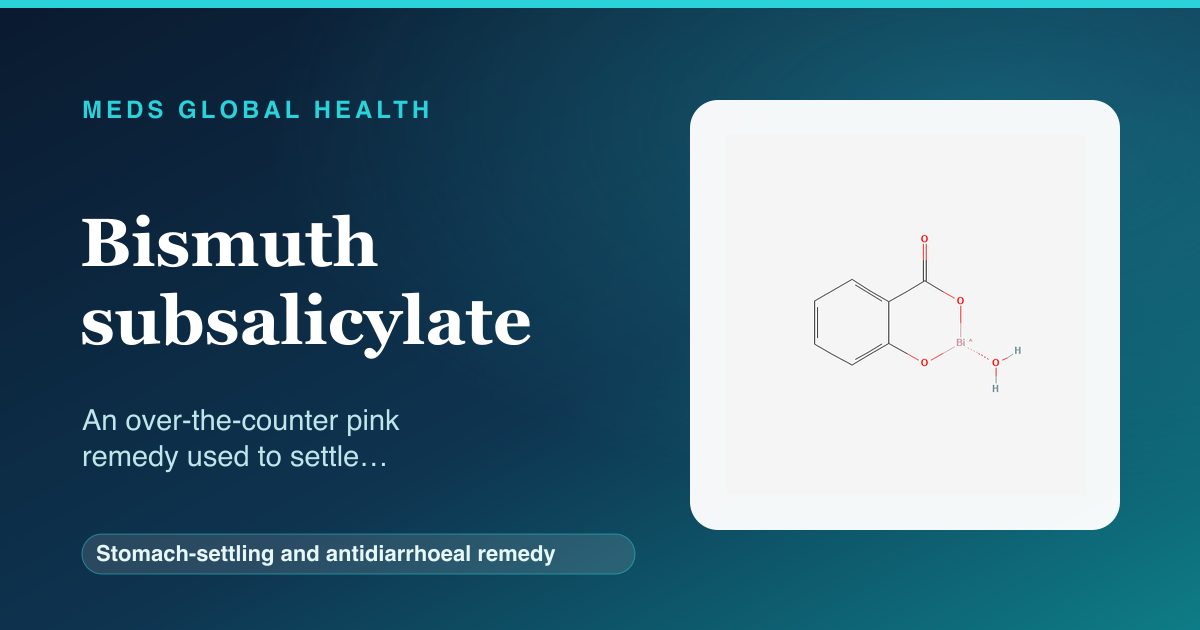
Bismuth subsalicylate is the active ingredient in the familiar pink stomach remedy sold as Pepto-Bismol. It is bought over the counter to ease the symptoms of an upset stomach, such as indigestion, heartburn, feeling sick and mild diarrhoea, and it is often used to prevent or treat travellers' diarrhoea. It comes as a pink liquid or as chewable tablets. It contains a salicylate, the same family as aspirin, which is why some important safety rules apply to who can take it.
How it works
Bismuth subsalicylate works in several gentle ways in the stomach and gut. It forms a soothing coating that protects the stomach lining, helps to calm inflammation and reduces the amount of fluid lost in diarrhoea, which firms up the stools. It also has a mild action against some of the bugs that cause travellers' diarrhoea. Because it works on the surface of the gut and is largely not absorbed, its effects are mostly local, settling the symptoms of an upset stomach while the underlying cause clears.
Company & origin
A long-established over-the-counter remedy used in the UK and widely abroad for indigestion, nausea and travellers' diarrhoea.
Practical use
How to take Bismuth subsalicylate
General, dose-free guidance — always follow your prescriber's and the leaflet's specific instructions.
- Shake the liquid well or chew the tablets, and take it as directed on the pack, spacing doses across the day if symptoms continue.
- Do not be alarmed if your stools turn black or your tongue darkens; this is harmless and fades after you stop.
- Use it for short-term relief only, and see a pharmacist or doctor if symptoms do not settle within a couple of days.
- Do not give it to children or teenagers with a viral illness such as flu or chickenpox, because of the risk of Reye's syndrome.
- Drink plenty of fluids if you have diarrhoea, and consider rehydration sachets to replace lost salts and water.
Weighing it up
Advantages & disadvantages of Bismuth subsalicylate
Advantages
- A handy over-the-counter remedy that eases several upset-stomach symptoms, including indigestion, nausea and mild diarrhoea.
- Useful for preventing and treating travellers' diarrhoea.
- Mostly stays in the gut, so its effects are largely local and it is well tolerated for short-term use.
Disadvantages
- Harmlessly turns the stools black and can darken the tongue, which can be alarming if unexpected.
- Contains a salicylate, so it is unsuitable for children and teenagers with viral illness and for people allergic to aspirin.
- Only suitable for short-term relief, not for severe, bloody or long-lasting diarrhoea.
Practical use
Good to know
The most striking thing to expect is that bismuth subsalicylate often turns the stools black and can darken the tongue; this is harmless and fades within a few days of stopping, but it is worth knowing so it is not mistaken for something serious. The key safety point is that it contains a salicylate, related to aspirin, so it must not be given to children or teenagers who have a viral illness such as flu or chickenpox, because of the rare but serious risk of Reye's syndrome, and it should be avoided by anyone who is allergic to aspirin. Because it is a salicylate, it should also be used with care alongside other aspirin-like medicines or blood thinners. It is meant for short-term relief; if diarrhoea is severe, contains blood, or lasts more than a couple of days, or if there are signs of dehydration, medical advice should be sought rather than continuing the remedy.
Who should not take it / use with caution
- Children and teenagers with a viral illness such as flu or chickenpox should not take it, because of the risk of Reye's syndrome.
- People who are allergic to aspirin or other salicylates should not take it.
- It is used with caution alongside aspirin-like medicines or blood thinners, and people with kidney problems or stomach ulcers should seek advice first.
Monitoring
- No routine monitoring is needed for short-term over-the-counter use.
- Watching that diarrhoea or stomach symptoms settle, and seeking advice if they are severe, bloody or last more than a couple of days.
- Being alert to ringing in the ears, which can signal too much salicylate.
Side effects
- Harmless darkening of the tongue and black stools, which fade after stopping.
- Occasional constipation or a feeling of fullness.
- Rarely, ringing in the ears, which can be a sign of taking too much of the salicylate and should prompt stopping and seeking advice.
Key interactions
- It can add to the effect of aspirin and other salicylates, so combined use should be checked with a pharmacist.
- It may interact with blood thinners such as warfarin, so seek advice before using the two together.
- It can reduce the absorption of some other medicines, including certain antibiotics, so separate the timing.
Available as: A pink liquid and chewable tablets taken by mouth.
Answers
Bismuth subsalicylate: frequently asked questions
What is bismuth subsalicylate used for?
It is the pink remedy in Pepto-Bismol, used over the counter to ease indigestion, nausea, an upset stomach and mild diarrhoea, and to help with travellers' diarrhoea.
Why has it turned my stools black?
Bismuth subsalicylate commonly turns the stools black and can darken the tongue; this is completely harmless and fades within a few days of stopping.
Can children take it?
It should not be given to children or teenagers who have a viral illness such as flu or chickenpox, because the salicylate it contains carries a rare risk of Reye's syndrome.
Can I take it if I'm allergic to aspirin?
No. It contains a salicylate from the same family as aspirin, so it should be avoided by anyone who is allergic to aspirin or other salicylates.
How long can I take it for?
It is meant for short-term relief; if diarrhoea is severe, bloody or lasts more than a couple of days, or you feel dehydrated, see a pharmacist or doctor rather than continuing.
The wider class
About Stomach-settling and antidiarrhoeal remedy
Bismuth subsalicylate belongs to the stomach-settling and antidiarrhoeal remedy class. For how the class as a whole works, its shared safety principles and monitoring, see the full guide.
Browse by body system
Authoritative sources
- BNF
- NICE CKS
Building a medicines information resource?
We create evidence-led, dose-free drug and formulary references for teams.