A clay-based adsorbent that coats the gut for diarrhoea
Diosmectite
A clay-based adsorbent medicine used to help relieve diarrhoea by coating the gut lining.
What is Diosmectite?
Diosmectite is a clay-based medicine used to help relieve diarrhoea. It is an adsorbent, which means it works in the gut by binding to substances and helping to coat and protect the lining of the bowel rather than being absorbed into the body. It is generally well tolerated, though it can sometimes cause constipation. An important practical point is that, because it can bind to things in the gut, it may reduce the absorption of other medicines, so it should be taken separately from them, usually with a gap of a couple of hours.
Education and reference only. This is a plain-language guide to Diosmectite — it deliberately contains no doses. Doses depend on the person, the brand and the reason for treatment, and belong with your prescriber. Always check the BNF, the product labelling (SmPC) and follow medical advice.
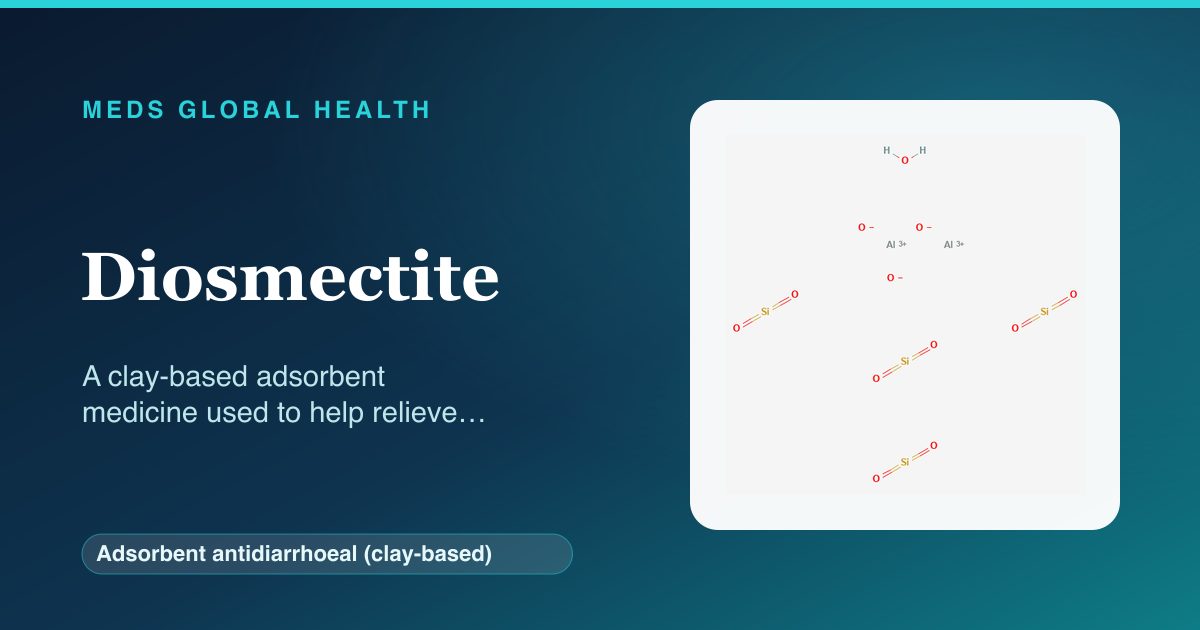
What it is
Diosmectite is a medicine made from a natural clay-like material, used to help relieve diarrhoea. It belongs to a group of medicines called adsorbents, which work inside the gut rather than being taken up into the body. It is usually mixed into water and drunk. It can be used in both adults and children for diarrhoea, working by coating and protecting the bowel lining and binding to substances in the gut. It is generally a gentle, well-tolerated medicine, and its main practical consideration is keeping it apart from other medicines.
How it works
Diosmectite works by spreading a protective layer over the lining of the gut and by binding (adsorbing) to substances within the bowel, such as toxins and excess fluid-related materials, helping to firm up the stool and protect the inflamed lining. Because it stays in the gut and is not absorbed into the bloodstream, its effects are local. This same binding property is why it can reduce the absorption of other medicines taken at the same time, so they need to be spaced apart. Its gentle, local action is also why it is generally well tolerated.
Company & origin
A clay-based adsorbent medicine used in the UK and elsewhere to help relieve diarrhoea by coating the lining of the gut.
Practical use
How to take Diosmectite
General, dose-free guidance — always follow your prescriber's and the leaflet's specific instructions.
- Mix it into water and drink it as directed for diarrhoea.
- Take it separately from your other medicines, leaving a gap of a couple of hours, as it can reduce their absorption.
- Keep drinking plenty of fluids, as it does not replace the fluids and salts lost with diarrhoea.
- Stop using it and seek advice if it causes troublesome constipation.
- Seek medical advice if diarrhoea is severe, bloody, lasts more than a few days or comes with a high fever.
Weighing it up
Advantages & disadvantages of Diosmectite
Advantages
- Helps relieve diarrhoea by coating and protecting the gut lining.
- Generally well tolerated, as it works locally and is not absorbed into the body.
- Can be used in adults and children, mixed into water to drink.
Disadvantages
- Can cause constipation, especially if used more than needed.
- May reduce the absorption of other medicines, so timing them apart is needed.
- Does not replace the fluids and salts lost with diarrhoea.
Practical use
Good to know
Two practical points are worth knowing about diosmectite. First, it is generally well tolerated, but because it coats and firms up the stool it can sometimes cause constipation, especially if used more than needed. Second, and importantly, it can bind to other medicines in the gut and reduce how well they are absorbed, so you should take it separately from your other medicines, usually leaving a gap of a couple of hours before or after. It is usually mixed into water before drinking, and it is important to keep up good fluid intake when you have diarrhoea, as the medicine itself does not replace lost fluids and salts. As with any diarrhoea, seek medical advice if it is severe, bloody, lasts more than a few days or comes with a high fever.
Who should not take it / use with caution
- People who have had a serious allergic reaction to it should not use it.
- It should not be relied on alone in severe, bloody or prolonged diarrhoea, where medical advice is needed.
- It is used with care in anyone prone to constipation or with a bowel blockage.
- Other medicines should be kept separate from it because of reduced absorption.
Monitoring
- Checking that diarrhoea is settling and that good fluid intake is kept up.
- Watching for constipation, especially with heavier or longer use.
- Reviewing the timing of other medicines to avoid reduced absorption.
Side effects
- Constipation, especially with heavier or prolonged use.
- Bloating or wind in some people.
- It is otherwise generally well tolerated, as it is not absorbed into the body.
Key interactions
- It can bind to other medicines in the gut and reduce their absorption, so they should be taken a couple of hours apart.
- This applies to a wide range of medicines, so check timing with your pharmacist.
- It does not replace rehydration treatment, which may be needed alongside it.
Available as: A powder mixed into water to drink (oral suspension).
Answers
Diosmectite: frequently asked questions
What is diosmectite used for?
It is a clay-based adsorbent medicine used to help relieve diarrhoea by coating and protecting the lining of the gut.
How does it work?
It works locally in the gut, spreading a protective layer over the bowel lining and binding to substances inside it, and is not absorbed into the body.
Can it affect my other medicines?
Yes, it can bind to other medicines in the gut and reduce their absorption, so take it separately, usually a couple of hours apart.
Is it well tolerated?
Generally yes, as it works locally and is not absorbed, though it can sometimes cause constipation, especially if used more than needed.
Does it replace fluids lost with diarrhoea?
No. It does not replace lost fluids and salts, so it is important to keep drinking plenty of fluids when you have diarrhoea.
The wider class
About Adsorbent antidiarrhoeal (clay-based)
Diosmectite belongs to the adsorbent antidiarrhoeal (clay-based) class. For how the class as a whole works, its shared safety principles and monitoring, see the full guide.
Browse by body system
Authoritative sources
- BNF
- NICE CKS
Building a medicines information resource?
We create evidence-led, dose-free drug and formulary references for teams.