An antiseptic
Chlorhexidine
A widely used antiseptic for cleaning skin and as a mouthwash, killing a broad range of germs to help prevent and control infection.
What is Chlorhexidine?
Chlorhexidine is an antiseptic used to clean skin before procedures and as a mouthwash for gum problems and mouth ulcers. It kills a broad range of germs. Used as a mouthwash over time it can stain teeth and alter taste, so it is kept separate from toothpaste and used short-term.
Education and reference only. This is a plain-language guide to Chlorhexidine — it deliberately contains no doses. Doses depend on the person, the brand and the reason for treatment, and belong with your prescriber. Always check the BNF, the product labelling (SmPC) and follow medical advice.
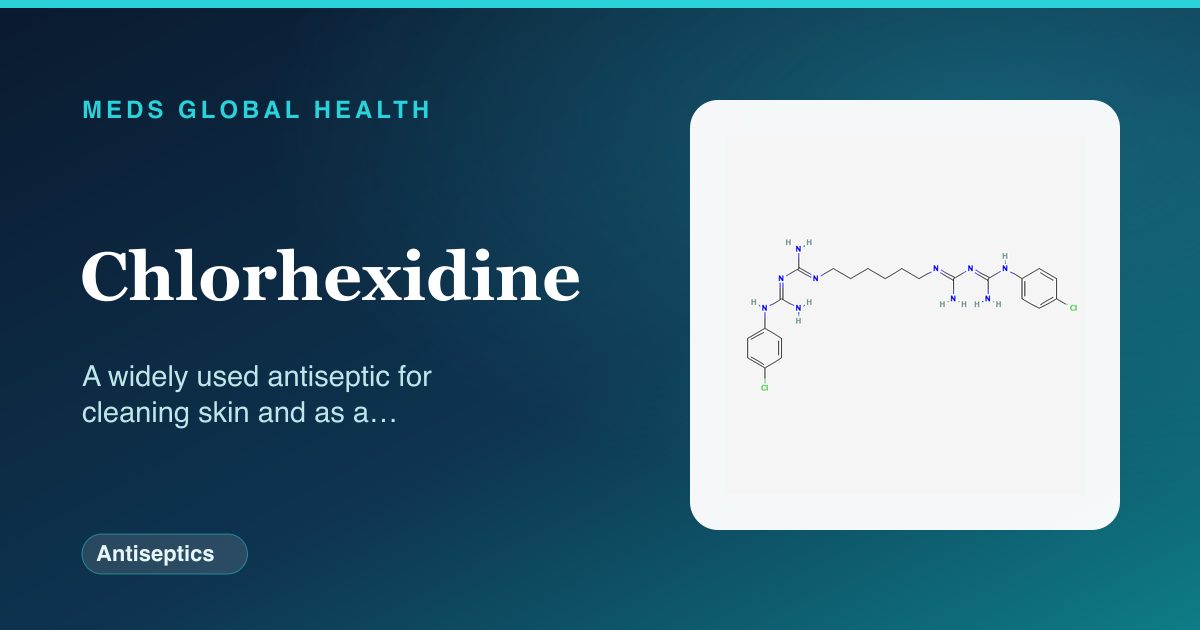
What it is
Chlorhexidine is a broad-spectrum antiseptic used in many settings. As a skin preparation it cleans the skin before injections, surgery or inserting a line. As a mouthwash or dental gel it helps with gum inflammation, mouth ulcers and oral hygiene when normal brushing is difficult. It is an antiseptic that acts on contact rather than a medicine taken into the body.
How it works
Chlorhexidine carries a positive electrical charge that attaches to the negatively charged outer surface of bacteria and many other germs. At lower strengths it disturbs the germ's outer membrane so it cannot function; at higher strengths it makes the contents clump and the germ dies. It also sticks to surfaces such as skin and teeth and keeps working for a while afterwards, giving lasting antiseptic action.
Company & origin
Originated / developed by: Imperial Chemical Industries.
Chlorhexidine was discovered in the United Kingdom in the 1950s and has become one of the most widely used antiseptics in healthcare and dental care.
Practical use
How to take Chlorhexidine
General, dose-free guidance — always follow your prescriber's and the leaflet's specific instructions.
- Use it on the skin or in the mouth as directed; it is for surface use, not to be swallowed.
- As a mouthwash, separate it from brushing by about half an hour and rinse the mouth in between, as toothpaste reduces its effect.
- Use the mouthwash short-term as advised, since prolonged use can stain teeth and alter taste.
- On the skin, keep it away from the eyes and inner ears.
- Stop and seek advice if you develop a rash, swelling or breathing problems, which may signal an allergy.
Weighing it up
Advantages & disadvantages of Chlorhexidine
Advantages
- Kills a broad range of germs and keeps working on skin and teeth for a while after use.
- Versatile — used both as a skin antiseptic and as a mouthwash or dental gel.
- Widely available and effective for cleaning skin before procedures.
Disadvantages
- Prolonged mouthwash use can stain teeth and the tongue and alter the sense of taste.
- Less effective if used straight after toothpaste, so timing matters.
- A small number of people can have an allergic reaction, occasionally a serious one.
Practical use
Good to know
As a mouthwash, chlorhexidine can stain the teeth and tongue brown and alter the sense of taste if used for more than a short period, though this usually fades after stopping. It works less well if used right after toothpaste, so it is best separated from brushing by a while, and the mouth rinsed in between. It is for surface use only and should not be swallowed. On the skin it should be kept away from the eyes and inner ears, and a small number of people can have an allergic reaction to it, which can occasionally be serious.
Who should not take it / use with caution
- People who have had an allergic reaction to chlorhexidine — a reason to avoid all chlorhexidine products.
- It should be kept away from the eyes, inner ears and brain or spinal tissues.
- Use with caution on broken or very delicate skin, and in newborns, as directed.
Monitoring
- No routine monitoring; it is used on the surface only.
- Watch for staining or taste change with prolonged mouthwash use, prompting a review.
- Stop and seek help at any sign of an allergic reaction.
Side effects
- As a mouthwash, brown staining of teeth and tongue and an altered sense of taste with prolonged use, usually reversible.
- Local irritation, dryness or a stinging feeling on skin or in the mouth.
- Rarely, an allergic reaction with rash, swelling or breathing problems, which can occasionally be serious — seek urgent help.
Key interactions
- Toothpaste and some mouth products reduce its effect, so the mouthwash is best used separately from brushing.
- It can be inactivated by ordinary soaps and some other antiseptics, so they are not mixed.
- It is for surface use and barely absorbed, so interactions with tablets taken by mouth are not expected.
Available as: Skin cleansing solutions and wipes, mouthwash, and dental gel.
Answers
Chlorhexidine: frequently asked questions
Does chlorhexidine mouthwash stain teeth?
Yes, with prolonged use it can stain the teeth and tongue brown and alter the sense of taste. This usually fades after you stop using it and any staining can be removed by a dental hygienist, which is why it is generally used short-term.
Can I use chlorhexidine mouthwash right after brushing?
It is best not to. Toothpaste reduces the effect of chlorhexidine, so leave about half an hour between brushing and using the mouthwash, and rinse your mouth with water in between.
What is chlorhexidine used for?
It is a broad-spectrum antiseptic used to clean skin before injections, surgery or inserting a line, and as a mouthwash or dental gel for gum inflammation, mouth ulcers and oral hygiene. It kills a wide range of germs on contact.
Can I swallow chlorhexidine mouthwash?
No. Chlorhexidine is for surface use only and should be spat out, not swallowed. If a child swallows a significant amount, seek advice. Keep it away from the eyes and inner ears.
Can chlorhexidine cause an allergic reaction?
Yes, though it is uncommon. A small number of people are allergic to chlorhexidine, and reactions can occasionally be serious. Stop using it and seek urgent help if you develop a rash, swelling of the face or throat, or breathing difficulty.
The wider class
About Antiseptics
Chlorhexidine belongs to the antiseptics class. For how the class as a whole works, its shared safety principles and monitoring, see the full guide.
Browse by body system
Authoritative sources
- BNF: Chlorhexidine.
- NICE CKS: Antiseptics.
Building a medicines information resource?
We create evidence-led, dose-free drug and formulary references for teams.