An antibacterial burn cream
Silver sulfadiazine
An antibacterial cream applied to burns and certain wounds to help prevent and treat infection.
What is Silver sulfadiazine?
Silver sulfadiazine is an antibacterial cream applied to clean burns and certain wounds to help prevent and treat infection. The silver and the sulfonamide together act against a wide range of bacteria on the skin surface. It should be avoided in people allergic to sulfonamides and is not used in late pregnancy, newborn babies or people with G6PD deficiency.
Education and reference only. This is a plain-language guide to Silver sulfadiazine — it deliberately contains no doses. Doses depend on the person, the brand and the reason for treatment, and belong with your prescriber. Always check the BNF, the product labelling (SmPC) and follow medical advice.
What it is
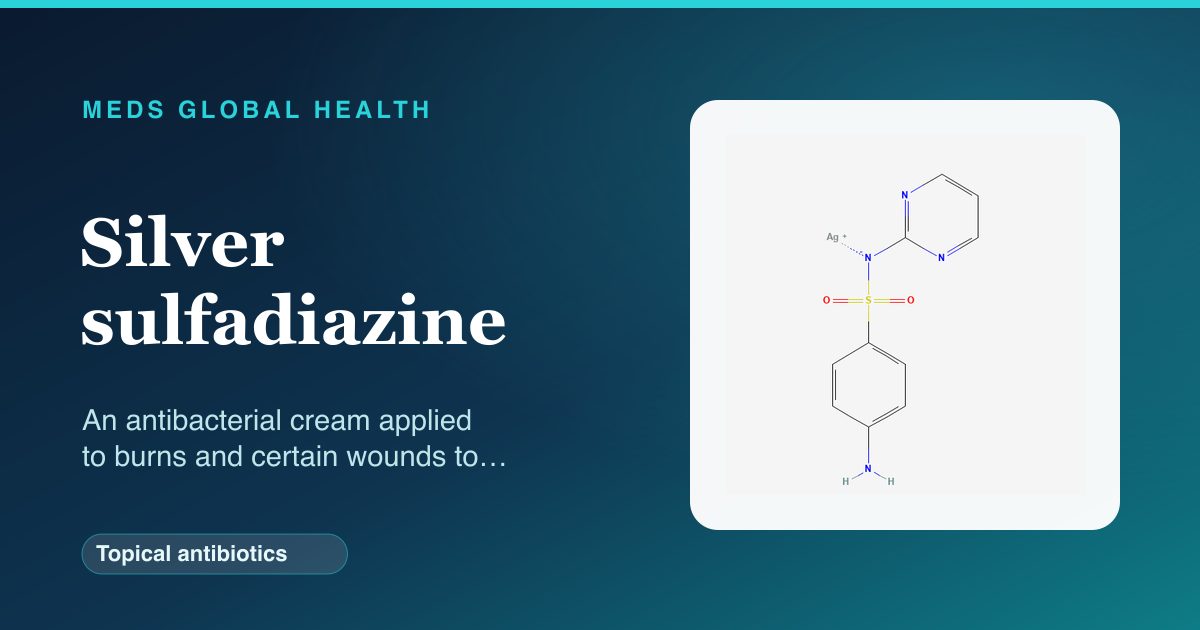
Silver sulfadiazine is an antibacterial cream used on burns and some other wounds, such as leg ulcers and pressure sores, to help prevent and control infection while the skin heals. It combines silver with a sulfonamide antibacterial, and is applied to the surface of the wound rather than taken into the body. It is widely used in burns care.
How it works
Silver sulfadiazine releases silver and a sulfonamide at the wound surface, both of which act against bacteria. The silver damages bacterial cell membranes and key processes, while the sulfonamide blocks a step bacteria need to grow. Together they reduce the number of bacteria on the wound, helping to prevent infection while the skin repairs.
Company & origin
Originated / developed by: Available from several manufacturers; Flamazine is a long-established UK brand..
Introduced in the late 1960s and widely adopted in burns care to help prevent wound infection.
Practical use
How to take Silver sulfadiazine
General, dose-free guidance — always follow your prescriber's and the leaflet's specific instructions.
- Clean the burn or wound gently as advised before applying a fresh layer of cream.
- Apply an even layer to the wound surface, usually covering it with a dressing afterwards.
- Reapply at each dressing change, following the schedule your team gives you.
- Wash your hands before and after, and avoid getting it in the eyes.
- Be aware it can stain skin, clothing and bedding, so protect surfaces where you can.
- Tell your team if the wound looks more inflamed, smells offensive or is not healing.
Weighing it up
Advantages & disadvantages of Silver sulfadiazine
Advantages
- Acts against a broad range of bacteria that can infect burns and wounds.
- Applied directly to the skin, so it works where it is needed with little absorbed into the body.
- Long-established and familiar in burns and wound care.
Disadvantages
- Not suitable for people allergic to sulfonamide medicines.
- Can stain the skin and dressings and may sometimes delay how clearly the wound can be assessed.
- Avoided in late pregnancy, newborn babies and people with G6PD deficiency.
Practical use
Good to know
The cream is applied to a clean burn or wound, usually under a dressing, and the wound is cleaned and re-covered at each change. Tell your healthcare team if you have ever reacted to a sulfonamide medicine, as this cream should usually be avoided. It can stain skin, clothing and dressings, and is not recommended in late pregnancy, in newborn babies, or in people with the inherited condition G6PD deficiency.
Who should not take it / use with caution
- People who have had an allergic reaction to a sulfonamide medicine.
- Newborns and infants under 2 months old (risk of kernicterus — a serious type of jaundice).
- Newborn babies and women in late pregnancy, because of a risk to the baby.
- People with G6PD deficiency, in whom sulfonamides can trigger breakdown of red blood cells.
- Used with care on large burns or wounds in people with kidney or liver problems, because the sulfonamide can build up in the body.
Monitoring
- Regular review of how the wound is healing and whether infection is controlled.
- Watch for signs of an allergic reaction or skin irritation.
- Blood counts may be checked with large areas or prolonged use.
Side effects
- Stinging, burning or irritation where it is applied.
- Rash or allergic skin reaction.
- Staining of the skin or treated area.
- Rarely, effects on blood counts with large areas or prolonged use.
- Rarely, absorption causing wider sulfonamide side effects when used on large wounds.
Key interactions
- Some wound-cleaning enzymes can be inactivated by the silver, reducing their effect.
- Other sulfonamide medicines may add to the risk of a sulfonamide reaction.
- Effects are mainly local, but absorption is more likely with large or long-treated wounds.
Available as: Cream.
Answers
Silver sulfadiazine: frequently asked questions
How do I apply silver sulfadiazine cream?
Clean the wound as advised, apply an even layer of cream to the surface, and usually cover it with a dressing. It is reapplied at each dressing change following your team's instructions.
Can I use it if I am allergic to sulfa medicines?
No. Silver sulfadiazine contains a sulfonamide, so it should be avoided if you have reacted to a sulfonamide medicine. Tell your healthcare team about any such allergy.
Why does it stain my skin and dressings?
The silver in the cream can cause staining of the skin, dressings and clothing. This is expected and not usually harmful, but protect bedding and clothes where you can.
Is it safe in pregnancy?
It is not recommended in late pregnancy or in newborn babies because of a possible risk to the baby. Tell your team if you are or might be pregnant before using it.
What is silver sulfadiazine used for?
It is used on burns and some other wounds, such as leg ulcers and pressure sores, to help prevent and treat infection while the skin heals.
The wider class
About Topical antibiotics
Silver sulfadiazine belongs to the topical antibiotics class. For how the class as a whole works, its shared safety principles and monitoring, see the full guide.
Browse by body system
Authoritative sources
- BNF
- NICE CKS
Building a medicines information resource?
We create evidence-led, dose-free drug and formulary references for teams.