A progestogen-only ('mini') pill
Desogestrel
A progestogen-only ('mini') pill that prevents pregnancy and has a more forgiving missed-pill window than older progestogen-only pills.
What is Desogestrel?
Desogestrel is a progestogen-only contraceptive pill, sometimes called the 'mini pill'. It contains only a progestogen and no oestrogen, which makes it suitable for many people who cannot take the combined pill. It tends to have a more forgiving missed-pill window than older progestogen-only pills, and irregular bleeding is a common side effect.
Education and reference only. This is a plain-language guide to Desogestrel — it deliberately contains no doses. Doses depend on the person, the brand and the reason for treatment, and belong with your prescriber. Always check the BNF, the product labelling (SmPC) and follow medical advice.
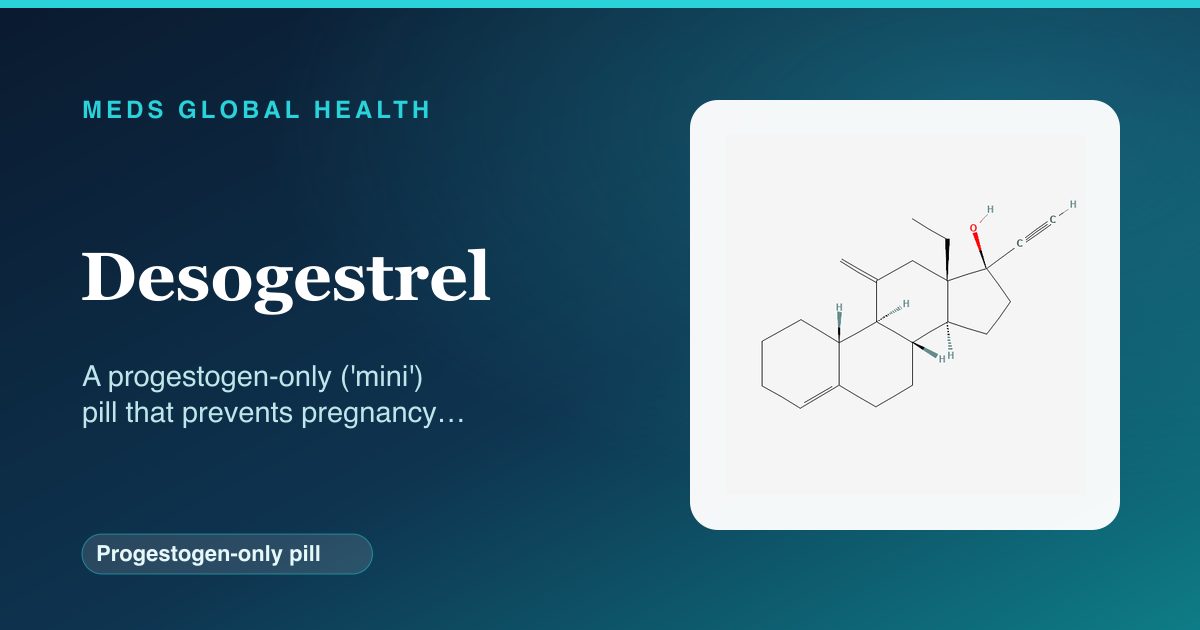
What it is
Desogestrel is a progestogen-only contraceptive pill, often called the 'mini pill'. It contains a progestogen only, with no oestrogen, which makes it an option for many people who cannot or prefer not to take the combined pill — for example while breastfeeding or when oestrogen is best avoided. It is taken every day without a break.
How it works
Desogestrel works mainly by stopping the release of an egg each month (preventing ovulation), and it also thickens the mucus at the neck of the womb so sperm find it harder to get through. Because it is good at suppressing ovulation, it has a more forgiving window for a missed pill than some older progestogen-only pills, although it still needs to be taken regularly to work well.
Company & origin
Originated / developed by: A widely used progestogen.
A progestogen used in the UK as a progestogen-only ('mini') pill, with a more forgiving missed-pill window than some older versions.
Practical use
How to take Desogestrel
General, dose-free guidance — always follow your prescriber's and the leaflet's specific instructions.
- Take one pill every day at around the same time, with no break between packs.
- If you are late or miss a pill, follow the missed-pill advice in the leaflet and use extra precautions if needed.
- If you are sick or have severe diarrhoea, the pill may not be absorbed, so check the leaflet advice.
- Start it as advised by your prescriber, and use additional contraception at first if told to.
- Keep a spare pack so you do not run out and have to stop.
Weighing it up
Advantages & disadvantages of Desogestrel
Advantages
- Contains no oestrogen, so it suits many people who cannot take the combined pill.
- Has a more forgiving missed-pill window than older progestogen-only pills.
- Can be used while breastfeeding and by many people with migraine or raised clot risk.
Disadvantages
- Irregular or unpredictable bleeding is common and can be a nuisance.
- Must be taken every day, with no pill-free week.
- Does not protect against sexually transmitted infections.
Practical use
Good to know
Desogestrel is taken every day at around the same time, without the week's break that the combined pill has. Compared with older progestogen-only pills, it gives a somewhat longer window if you are late taking a pill, but you should still aim to take it on time and follow the missed-pill advice on the leaflet. Irregular bleeding — from no periods at all to frequent spotting — is the most common reason people find it unsettling, though it is not harmful. Because it contains no oestrogen, it can suit people who cannot take the combined pill.
Who should not take it / use with caution
- Women who are pregnant or who think they could be pregnant.
- People with certain current cancers, serious liver disease, or unexplained vaginal bleeding before it has been checked.
- Used with caution alongside certain medicines that can reduce its effectiveness — discuss your medicines first.
Monitoring
- Your bleeding pattern, especially in the first few months.
- Blood pressure and a general review at routine contraception checks.
- Any new or persistent symptoms that might need a change of method.
Side effects
- Irregular bleeding, ranging from no periods to frequent spotting, is the most common effect.
- Headaches, breast tenderness, mood changes, acne or changes in sex drive.
- Less commonly, ovarian cysts or other effects — discuss anything troubling with your prescriber.
Key interactions
- Some medicines for epilepsy, certain antibiotics for TB, and St John's wort can reduce how well it works.
- Tell your prescriber about all medicines and herbal products before starting it.
- If you take an enzyme-inducing medicine, a different method may be recommended.
Available as: Tablets.
Answers
Desogestrel: frequently asked questions
What is the 'mini pill'?
It is a progestogen-only pill, containing a progestogen and no oestrogen. Desogestrel is one type, taken every day without a break.
How is it different from older progestogen-only pills?
Desogestrel mainly works by stopping ovulation and tends to give a more forgiving window if you are late taking a pill, though you should still aim to take it on time.
Why am I bleeding irregularly?
Irregular bleeding, from no periods to frequent spotting, is the most common effect and is not harmful. If it is heavy or troubling, speak to your GP or pharmacist.
Can I take it while breastfeeding?
Yes, progestogen-only pills like desogestrel are generally suitable while breastfeeding, as they contain no oestrogen. Your prescriber can confirm it is right for you.
What should I do if I miss a pill?
Follow the missed-pill advice in the leaflet, which may include using extra precautions for a short time. If you are unsure, ask a pharmacist.
The wider class
About Progestogen-only pill
Desogestrel belongs to the progestogen-only pill class. For how the class as a whole works, its shared safety principles and monitoring, see the full guide.
Browse by body system
Authoritative sources
- BNF
- NICE CKS
Building a medicines information resource?
We create evidence-led, dose-free drug and formulary references for teams.