The contraceptive implant
Etonogestrel
The progestogen hormone in the contraceptive implant, a small rod under the upper arm that prevents pregnancy.
What is Etonogestrel?
Etonogestrel is the hormone in the contraceptive implant (Nexplanon), a small flexible rod placed just under the skin of the upper arm. It is one of the most reliable forms of contraception and works for up to three years before it needs replacing. It steadily releases a progestogen hormone that mainly stops the ovaries releasing an egg. The most common effect is a change in bleeding pattern — periods can become irregular, lighter, stop, or sometimes be more frequent.
Education and reference only. This is a plain-language guide to Etonogestrel — it deliberately contains no doses. Doses depend on the person, the brand and the reason for treatment, and belong with your prescriber. Always check the BNF, the product labelling (SmPC) and follow medical advice.
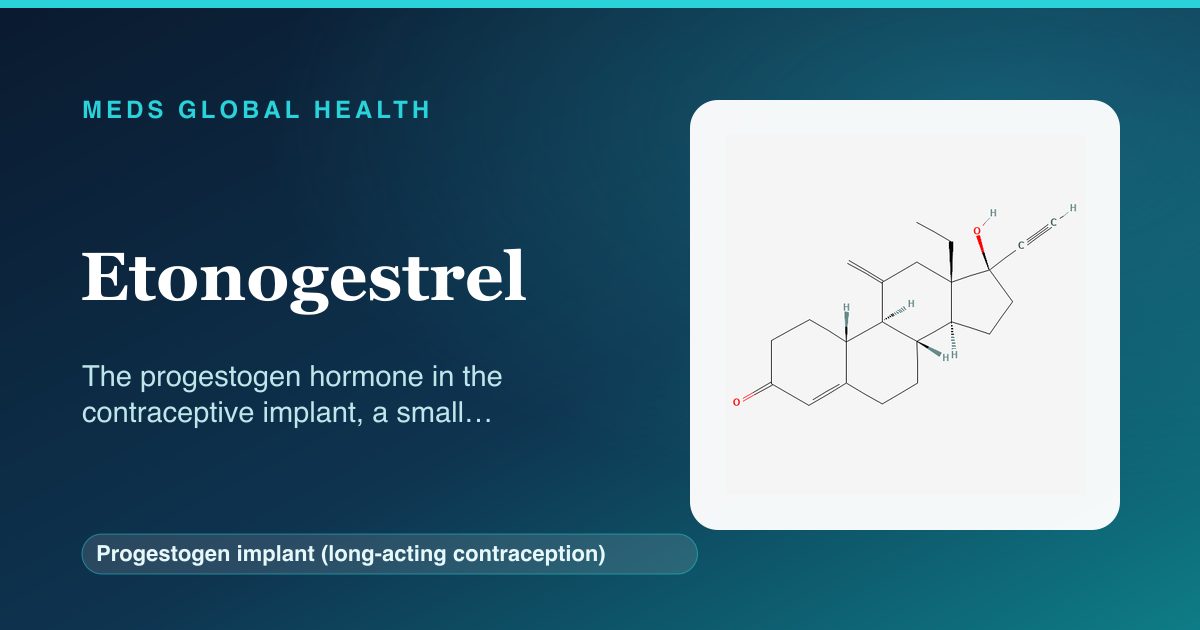
What it is
Etonogestrel is a progestogen hormone used in the contraceptive implant, a small, flexible rod about the size of a matchstick that is inserted just under the skin of the upper arm. It provides long-acting, very reliable contraception without needing to remember a daily pill. Once fitted, it works for up to three years and can be removed at any time if a woman wants to stop or become pregnant. It is fitted and removed by a trained healthcare professional.
How it works
The implant slowly releases etonogestrel into the bloodstream, where it mainly works by stopping the ovaries from releasing an egg each month. It also thickens the mucus at the neck of the womb, making it harder for sperm to get through, and thins the womb lining. Because the hormone is released steadily and does not rely on remembering a daily dose, it is one of the most effective methods of contraception. Its effect ends soon after the implant is removed.
Company & origin
Originated / developed by: Organon.
The hormone in the UK contraceptive implant, a small rod placed under the skin of the upper arm for long-acting contraception.
Practical use
How to take Etonogestrel
General, dose-free guidance — always follow your prescriber's and the leaflet's specific instructions.
- The implant is fitted under the skin of the inner upper arm by a trained professional, using local anaesthetic.
- You can usually feel the implant under the skin but should not be able to see it.
- It works for up to three years, after which it needs to be replaced if you want to continue.
- It can be removed at any time, and fertility usually returns quickly afterwards.
- Use condoms as well if you need protection against sexually transmitted infections.
- Tell your prescriber about all your medicines, as some (such as certain epilepsy medicines) can reduce its effect.
Weighing it up
Advantages & disadvantages of Etonogestrel
Advantages
- One of the most reliable forms of contraception, working for up to three years.
- No need to remember a daily pill, and it can be removed at any time with a quick return of fertility.
- Suitable for many women who cannot use oestrogen-containing methods.
Disadvantages
- Irregular or unpredictable bleeding is common, especially in the first months.
- It needs a small procedure to fit and to remove it.
- It does not protect against sexually transmitted infections.
Practical use
Good to know
The biggest thing to expect is a change in your bleeding pattern: periods may become irregular, lighter or stop altogether, while some women have more frequent or prolonged bleeding, particularly in the first months. This is not harmful but is the most common reason women choose to have it removed. Fitting and removal are quick procedures done under local anaesthetic, and fertility returns soon after removal. It does not protect against sexually transmitted infections, so condoms are still needed for that. Certain medicines, such as some used for epilepsy, can make it less effective, so it is worth mentioning all your medicines.
Who should not take it / use with caution
- Women with current breast cancer should not use it.
- It is avoided in those with certain liver conditions or unexplained vaginal bleeding until investigated.
- It may be unsuitable for women taking medicines that significantly reduce its effectiveness.
Monitoring
- A check that the implant is correctly placed and can be felt after fitting.
- Reviewing any troublesome bleeding pattern and discussing options.
- A reminder of when the implant is due to be replaced or removed.
Side effects
- Changes in bleeding pattern — irregular, lighter, absent or more frequent periods — are the most common.
- Headaches, acne, breast tenderness or mood changes in some women.
- Bruising, soreness or, rarely, problems at the insertion site.
Key interactions
- Some epilepsy medicines and other enzyme-inducing drugs can reduce how well it works.
- The herbal remedy St John's wort can also lower its effectiveness.
- Certain medicines for HIV or tuberculosis may interact, so tell your prescriber what you take.
Available as: A small flexible rod (implant) placed under the skin of the upper arm.
Answers
Etonogestrel: frequently asked questions
How long does the implant last?
It works for up to three years before it needs replacing, though it can be removed earlier at any time if you want to stop or try for a baby.
Will it change my periods?
Often yes. Bleeding can become irregular, lighter or stop, and some women have more frequent bleeding, especially in the first few months. This is common and not harmful.
Where is it placed?
It is a small rod fitted just under the skin of the inner upper arm by a trained professional, using local anaesthetic. You can usually feel it but not see it.
Does it protect against STIs?
No. The implant prevents pregnancy but not sexually transmitted infections, so use condoms as well if you need that protection.
How quickly does fertility return after removal?
Fertility usually returns soon after the implant is removed, as its hormone effect wears off quickly.
The wider class
About Progestogen implant (long-acting contraception)
Etonogestrel belongs to the progestogen implant (long-acting contraception) class. For how the class as a whole works, its shared safety principles and monitoring, see the full guide.
Browse by body system
Authoritative sources
- BNF
- NICE CKS
Building a medicines information resource?
We create evidence-led, dose-free drug and formulary references for teams.