A bladder antispasmodic
Flavoxate
A bladder antispasmodic used to ease urgency, frequency and bladder discomfort in an overactive bladder.
What is Flavoxate?
Flavoxate is a bladder antispasmodic used to relieve the urgency, frequency and discomfort of an overactive bladder. It relaxes the bladder muscle and has anticholinergic effects, so it can cause a dry mouth and blurred vision. It is used with caution in people with glaucoma, difficulty passing urine or a bowel blockage.
Education and reference only. This is a plain-language guide to Flavoxate — it deliberately contains no doses. Doses depend on the person, the brand and the reason for treatment, and belong with your prescriber. Always check the BNF, the product labelling (SmPC) and follow medical advice.
What it is
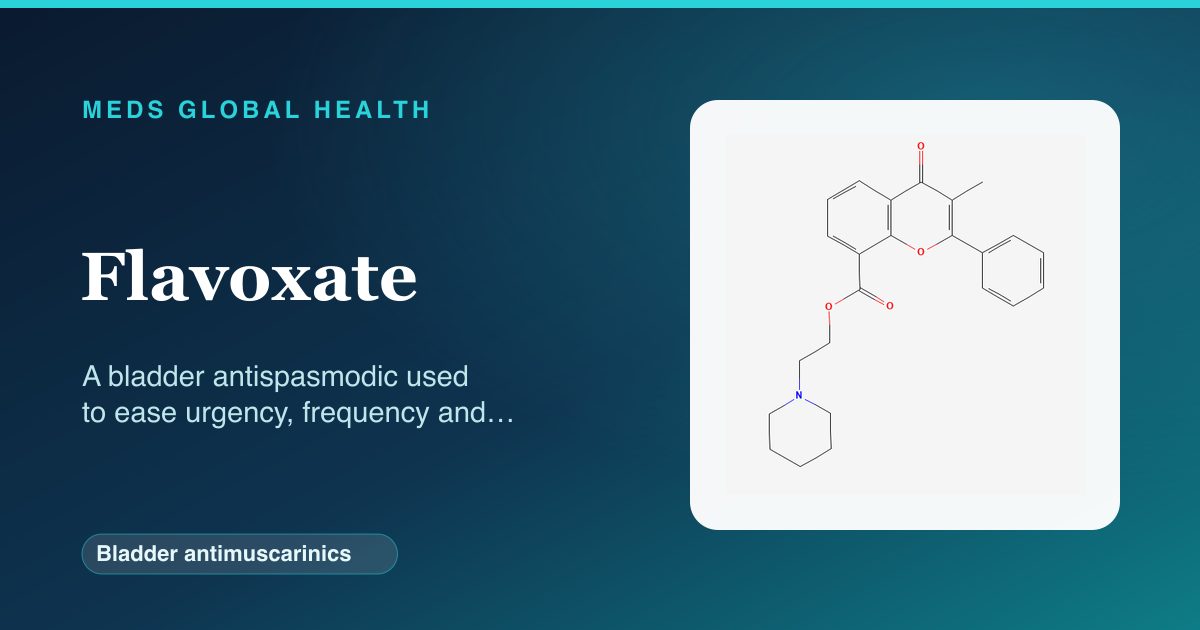
Flavoxate is a bladder antispasmodic that relaxes the smooth muscle of the bladder. It is used to ease the urgency, frequent need to pass urine, getting up at night and bladder discomfort that can come with an overactive bladder and some urinary conditions. It has anticholinergic (antimuscarinic) effects, which is why it can cause a dry mouth and blurred vision. It is taken regularly as tablets.
How it works
Flavoxate relaxes the muscle in the wall of the bladder, reducing the unwanted contractions that cause urgency and frequency. It does this partly through a direct relaxing (antispasmodic) effect and partly by blocking acetylcholine, the chemical messenger that triggers bladder muscle contractions. Because acetylcholine is used elsewhere in the body, blocking it also causes effects such as dry mouth, blurred vision and constipation.
What it treats
Conditions Flavoxate is used for
Practical use
How to take Flavoxate
General, dose-free guidance — always follow your prescriber's and the leaflet's specific instructions.
- Take it regularly as prescribed, usually spread across the day.
- It can be taken with or without food; with food may ease any stomach upset.
- Give it time — bladder symptoms may take a little while to settle.
- Drink enough fluid, but try to limit drinks late in the evening if getting up at night is a problem.
- Sucking sugar-free sweets or sipping water can help with a dry mouth.
- If you miss a dose, take it when you remember unless it is nearly time for the next one — do not double up.
Weighing it up
Advantages & disadvantages of Flavoxate
Advantages
- Eases the urgency, frequency and discomfort of an overactive bladder.
- Calms bladder spasms, which can also help getting up at night.
- A straightforward tablet treatment.
- Can be used when bladder discomfort is a particular problem.
Disadvantages
- Causes anticholinergic effects such as dry mouth and blurred vision.
- Can worsen glaucoma, difficulty passing urine and bowel blockage, so is not for everyone.
- May cause drowsiness or confusion, particularly in older people.
- Bladder symptoms may take some time to improve.
Practical use
Good to know
It works by calming the bladder muscle, so it can ease the constant urge to go and the need to get up at night. Like other anticholinergic medicines, it commonly causes a dry mouth and can blur vision, so take care when driving until you know how it affects you. It is used cautiously in people with glaucoma, those who struggle to pass urine and those with a bowel blockage, because it can make these worse.
Who should not take it / use with caution
- People with a blockage of the bowel or stomach outlet, or reduced bowel movement.
- People who cannot fully empty the bladder (urinary retention).
- People with closed-angle glaucoma or raised eye pressure that is not controlled.
- Caution in older people, in heart disease and in pregnancy or breastfeeding — discussed with the prescriber.
Monitoring
- Review of bladder symptoms and how well they are controlled.
- A check for side effects such as dry mouth, constipation or difficulty passing urine.
- Particular care and review in older people because of confusion and falls risk.
Side effects
- Dry mouth and blurred vision.
- Constipation and difficulty passing urine.
- Drowsiness, dizziness or, occasionally, confusion.
- A faster heartbeat.
- Nausea or stomach upset.
Key interactions
- Other medicines with anticholinergic effects add to dry mouth, constipation and blurred vision.
- Sedating medicines and alcohol can add to drowsiness.
- Medicines that speed up the heart may have an added effect.
- Tell your pharmacist about all your medicines, as anticholinergic effects build up when several are combined.
Available as: Tablets.
Answers
Flavoxate: frequently asked questions
What does flavoxate do?
It relaxes the bladder muscle to ease the urgency, frequent need to pass urine and discomfort that can come with an overactive bladder.
Why does it cause a dry mouth?
Flavoxate has anticholinergic effects, which reduce saliva and can also blur vision and cause constipation. These effects are common with this type of medicine.
Who should be careful with flavoxate?
It is used with caution in people with glaucoma, those who struggle to pass urine and those with a bowel blockage, because it can make these worse.
Can I drive while taking it?
It can blur your vision and cause drowsiness, so take care and avoid driving until you know how it affects you.
How quickly will it work?
Bladder symptoms may take a little while to settle. If you notice no improvement after a reasonable trial, tell your prescriber.
The wider class
About Bladder antimuscarinics
Flavoxate belongs to the bladder antimuscarinics class. For how the class as a whole works, its shared safety principles and monitoring, see the full guide.
Browse by body system
Authoritative sources
- BNF
- NICE CKS
Building a medicines information resource?
We create evidence-led, dose-free drug and formulary references for teams.