An older bladder antimuscarinic medicine
Oxybutynin
An older antimuscarinic for an overactive bladder; effective but more prone to dry mouth and confusion, so it is used cautiously in frail older people.
What is Oxybutynin?
Oxybutynin is one of the older antimuscarinic medicines for an overactive bladder. It relaxes the bladder muscle to reduce the sudden urge to pass urine, frequency and urge-related leaks.
Education and reference only. This is a plain-language guide to Oxybutynin — it deliberately contains no doses. Doses depend on the person, the brand and the reason for treatment, and belong with your prescriber. Always check the BNF, the product labelling (SmPC) and follow medical advice.
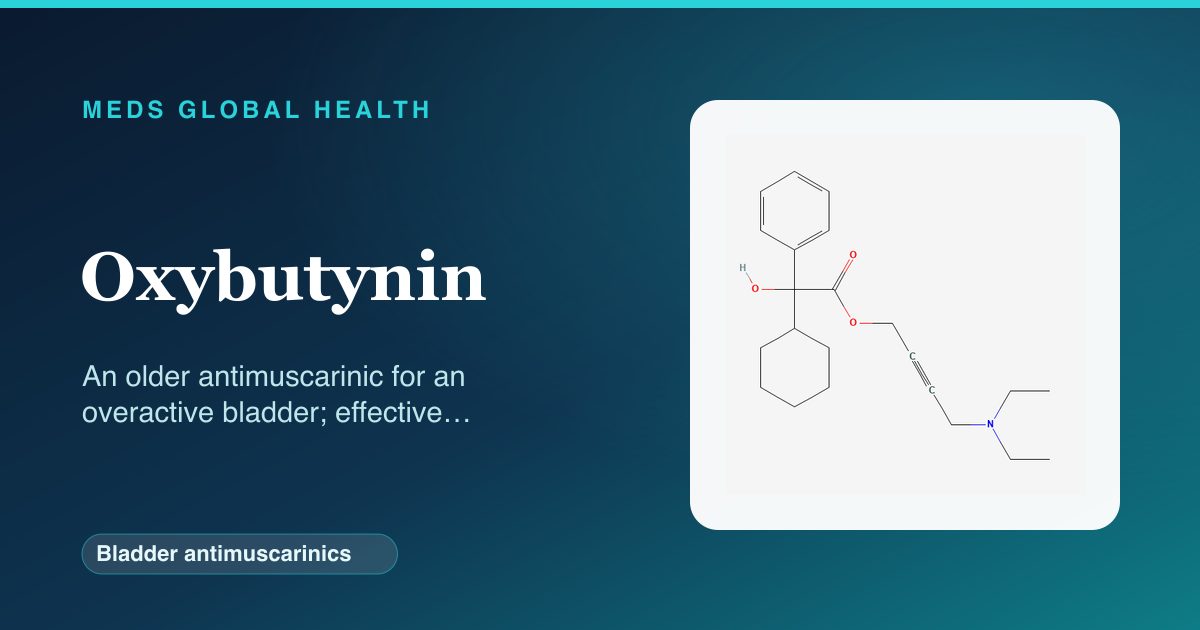
What it is
Oxybutynin is one of the older antimuscarinic medicines for an overactive bladder — the combination of a sudden urge to pass urine, going very often, and sometimes leaking before reaching the toilet. It is also used in some children for bladder problems under specialist guidance. It comes as standard tablets, a once-daily slow-release tablet and a skin patch. Because it is an older medicine, it tends to cause more drying and brain side effects than newer alternatives. In the UK and US the active ingredient is the same; familiar brands include Ditropan and the slow-release Lyrinel XL.
How it works
In an overactive bladder, the bladder-wall muscle contracts too readily, creating a sudden urge even when the bladder is not full. Oxybutynin blocks the muscarinic receptors that this muscle uses to receive its "squeeze" signal, so the bladder relaxes, holds more comfortably and contracts less suddenly — easing urgency, frequency and urge leakage. The same receptors sit in the salivary glands, the gut, the eye and the brain, so blocking them also causes dry mouth, constipation, blurred vision and, more than with newer medicines, effects on memory and alertness. The skin patch can cause fewer of these effects because it bypasses the gut and the first pass through the liver.
Company & origin
Originated / developed by: Mead Johnson.
Oxybutynin was developed by Mead Johnson, which held patents on the compound in the early 1960s; it was subsequently brought to market in the US as Ditropan by Marion Laboratories.
What it treats
Conditions Oxybutynin is used for
Practical use
How to take Oxybutynin
General, dose-free guidance — always follow your prescriber's and the leaflet's specific instructions.
- Take oxybutynin as prescribed; a skin-patch form is also available for some people.
- Expect a dry mouth and constipation, which are common with this medicine.
- Avoid driving if you have blurred vision or drowsiness, and report difficulty passing urine.
- Be especially cautious in older adults, as oxybutynin can cause confusion and is linked to a higher anticholinergic burden.
- Tell your prescriber about your other medicines, since many can add to its drying effects.
Weighing it up
Advantages & disadvantages of Oxybutynin
Advantages
- Effective and long-established treatment for an overactive bladder.
- Available in tablet and skin-patch forms, giving some flexibility.
- Inexpensive and widely available.
- Can substantially reduce urgency and leaks for many people.
Disadvantages
- Frequently causes a dry mouth, constipation and blurred vision.
- Has a high anticholinergic burden and can cause confusion, so it is often avoided in frail older adults.
- Side effects mean some people cannot tolerate it.
- Not suitable for people with certain eye, bowel or bladder-emptying problems.
Practical use
Good to know
It is effective, but among bladder antimuscarinics it is one of the more likely to cause a dry mouth and to affect the brain — so it is generally avoided in frail, older people, in whom it can worsen confusion and increase falls. The slow-release tablet and the skin patch tend to cause fewer drying side effects than the standard tablet, and the patch is an option for people who get a troublesome dry mouth. The benefit builds over a few weeks. As with other antimuscarinics, it adds to the overall "anticholinergic burden" from other medicines, which is worth reviewing.
Who should not take it / use with caution
- People with certain types of uncontrolled glaucoma, urinary retention (difficulty emptying the bladder) or significant bowel blockage problems should not take it.
- It is generally avoided in frail, older people because it can worsen confusion and increase the risk of falls more than newer bladder medicines.
- Care in significant kidney or liver impairment, in people with reduced gut movement, and in pregnancy or breastfeeding.
Monitoring
- Improvement in urgency, frequency and leakage
- Tolerability — dry mouth, constipation, vision and (in older people) confusion or falls
- For the patch, the application-site skin
Side effects
- A dry mouth is very common; constipation, blurred vision and a dry eye are also frequent.
- Difficulty fully emptying the bladder, indigestion, flushing and reduced sweating (with a risk of overheating in hot weather).
- Drowsiness, dizziness and — particularly in older people — confusion or memory problems; the patch can cause skin redness or itching where it is applied.
Key interactions
- Its drying effects add strongly to those of other "anticholinergic" medicines (some bladder, bowel, allergy, Parkinson's and mental-health medicines).
- Adds to drowsiness with alcohol and other sedating medicines.
- Certain antifungal and some other medicines can raise its levels; care alongside medicines that slow the gut.
Available as: Standard tablets, a once-daily slow-release tablet, an oral liquid, and a skin patch.
Answers
Oxybutynin: frequently asked questions
Why is oxybutynin not recommended for elderly people?
Oxybutynin is one of the older bladder medicines and is more likely than newer ones to pass into the brain, where it can cause confusion and memory problems and add to the risk of falls. In frail, older people a newer antimuscarinic or a medicine that works in a different way is usually preferred.
Will the patch cause fewer side effects than tablets?
Often yes. The skin patch and the slow-release tablet tend to cause less dry mouth than the standard tablet, because they release the medicine steadily and the patch bypasses the gut and liver. The patch can, though, cause redness or itching where it is stuck on.
Why do I feel hot and sweat less on it?
Oxybutynin reduces sweating as part of its drying (anticholinergic) effect, which can make it harder to cool down and risks overheating in hot weather or heavy exercise. Take care in the heat, keep cool and hydrated, and seek advice if you feel unwell.
How long before it helps my bladder?
The full benefit usually builds over a few weeks, so it is worth giving it a fair trial. Bladder-training and reducing caffeine and fizzy drinks work alongside it. If dry mouth or other effects are troublesome, the patch or a newer medicine may suit you better.
What is the difference between oxybutynin, Ditropan and Lyrinel XL?
They all contain the same active ingredient, oxybutynin. Ditropan is a brand of the standard form and Lyrinel XL is a once-daily slow-release brand; generic oxybutynin contains the identical active ingredient. Your prescriber chooses the form to balance convenience against side effects.
The wider class
About Bladder antimuscarinics
Oxybutynin belongs to the bladder antimuscarinics class. For how the class as a whole works, its shared safety principles and monitoring, see the full guide.
Browse by body system
Authoritative sources
- BNF: Oxybutynin hydrochloride.
- electronic Medicines Compendium (SmPC): Oxybutynin (Ditropan).
- NICE CKS: Oxybutynin.
Building a medicines information resource?
We create evidence-led, dose-free drug and formulary references for teams.