A bladder antimuscarinic medicine
Solifenacin
A once-daily antimuscarinic for an overactive bladder, calming the urge to pass urine; dry mouth and constipation are common.
What is Solifenacin?
Solifenacin is an antimuscarinic medicine used to treat an overactive bladder. It eases the sudden, strong urge to pass urine, frequent trips to the toilet and any associated leaks by relaxing the bladder muscle.
Education and reference only. This is a plain-language guide to Solifenacin — it deliberately contains no doses. Doses depend on the person, the brand and the reason for treatment, and belong with your prescriber. Always check the BNF, the product labelling (SmPC) and follow medical advice.
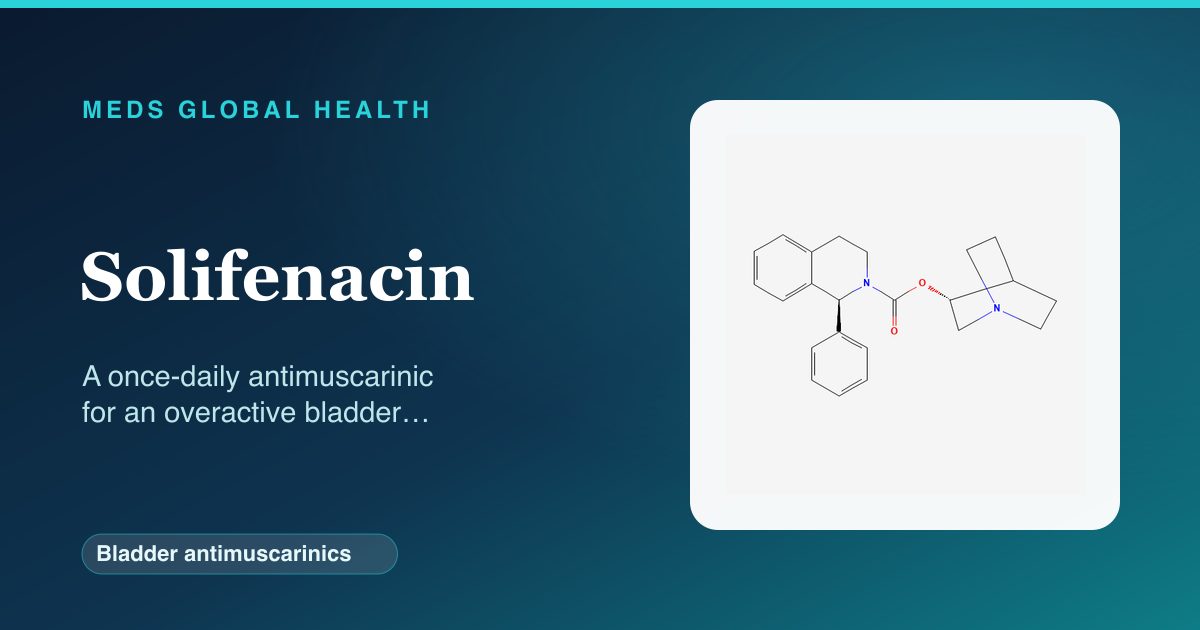
What it is
Solifenacin is an antimuscarinic medicine used to treat an overactive bladder — the troublesome combination of a sudden, strong urge to pass urine, going very often, and sometimes leaking before reaching the toilet. It is usually tried after bladder-training and lifestyle measures, and is taken as a once-daily tablet. In the UK and US the active ingredient and the original brand (Vesicare) are the same; generic solifenacin is identical.
How it works
In an overactive bladder, the muscle in the bladder wall contracts too readily, creating a sudden urge to urinate even when the bladder is not full. Solifenacin blocks muscarinic receptors that this muscle uses to receive its "squeeze" signal, so the bladder muscle relaxes, holds more comfortably and contracts less suddenly. This reduces urgency, frequency and urge leakage. The same receptors are present in other parts of the body — including the salivary glands, the gut and the eye — which is why blocking them can also cause a dry mouth, constipation and blurred vision.
Company & origin
Originated / developed by: Yamanouchi Pharmaceutical (now Astellas).
Solifenacin was discovered by Japan's Yamanouchi Pharmaceutical (which merged with Fujisawa to form Astellas in 2005) and was approved in Europe and the US in 2004, marketed as Vesicare.
What it treats
Conditions Solifenacin is used for
Practical use
How to take Solifenacin
General, dose-free guidance — always follow your prescriber's and the leaflet's specific instructions.
- Take solifenacin regularly as prescribed; it may take a few weeks to feel the full benefit.
- Expect a dry mouth and constipation, which are common; sipping water and eating enough fibre can help.
- Watch for blurred vision or difficulty passing urine, and report these to your prescriber.
- In older people, be alert to confusion or drowsiness, as the brain can be sensitive to this type of medicine.
- Tell your prescriber about all your other medicines, as several can add to the drying, anticholinergic effects.
Weighing it up
Advantages & disadvantages of Solifenacin
Advantages
- Effective at reducing urgency, frequency and urge-related leaks.
- Usually taken once daily, which is convenient.
- Can meaningfully improve quality of life for people with an overactive bladder.
- Often somewhat better tolerated for dry mouth than the oldest medicines in its class.
Disadvantages
- Commonly causes a dry mouth, constipation and blurred vision.
- Adds to the overall anticholinergic burden, which is a particular concern in older adults and can affect memory.
- Can cause confusion or drowsiness, especially in frail elderly people.
- Not suitable for some people, including those with certain bladder, bowel or eye conditions.
Practical use
Good to know
It is taken once a day and is usually swallowed whole with water; the benefit builds over a few weeks, so it is worth persevering before judging whether it helps. A dry mouth and constipation are the most common nuisances — sips of water, sugar-free sweets and keeping well hydrated and active can help. Because antimuscarinics add to the overall "anticholinergic burden" — the combined drying and brain effects of several such medicines — they are used more cautiously in older people, in whom they can contribute to confusion, falls and constipation. If it is not helping, it can be reviewed; alternatives include a different bladder medicine that works in another way.
Who should not take it / use with caution
- People with certain types of glaucoma (raised eye pressure that is not controlled), urinary retention (difficulty emptying the bladder) or significant bowel blockage problems should not take it.
- Used with caution in older or frail people, where it adds to "anticholinergic burden" and can worsen confusion, falls and constipation.
- Care in significant kidney or liver impairment, in people with reduced gut movement, and in pregnancy or breastfeeding.
Monitoring
- Improvement in urgency, frequency and leakage
- Tolerability — dry mouth, constipation, vision
- In older people, any confusion or falls and the total anticholinergic burden
Side effects
- A dry mouth is the most common effect; constipation and blurred vision are also frequent.
- Indigestion, a dry or itchy eye, and difficulty fully emptying the bladder can occur.
- In some people, especially older ones, drowsiness or confusion; rarely, a serious eye reaction (sudden eye pain and visual loss) needing urgent care.
Key interactions
- Its drying effects add to those of other "anticholinergic" medicines (some bladder, bowel, allergy, Parkinson's and mental-health medicines), increasing dry mouth, constipation and confusion.
- Certain antifungal and some other medicines can raise its levels, so the usable amount may be limited when they are combined.
- Care alongside medicines that slow the gut or affect the heart's rhythm.
Available as: Tablets (swallowed whole) and, in some cases, an oral suspension for people who cannot swallow tablets.
Answers
Solifenacin: frequently asked questions
How long before solifenacin works?
It often takes a few weeks for the full benefit to build up, so it is worth giving it a fair trial before deciding whether it helps. Bladder-training and cutting back on caffeine and fizzy drinks work alongside it to improve symptoms.
Why does it give me a dry mouth?
Solifenacin relaxes the bladder by blocking muscarinic receptors, but the same receptors sit in the salivary glands and gut. Blocking them there reduces saliva and slows the bowel, which is why dry mouth and constipation are common. Sips of water, sugar-free sweets and staying active and hydrated can help.
What is "anticholinergic burden" and why does it matter?
Many medicines — for the bladder, bowel, allergies, sleep and mood — have drying, "anticholinergic" effects. Taken together they add up to a "burden" that can cause dry mouth, constipation, blurred vision and, especially in older people, confusion and falls. Your pharmacist can review all your medicines to keep this in check.
Is it safe for my elderly parent?
It can be used in older people but more cautiously, because antimuscarinics can add to confusion, constipation and the risk of falls. Sometimes a bladder medicine that works in a different way is preferred. A medicines review weighs the benefit against these risks.
What is the difference between solifenacin and Vesicare?
They are the same medicine — solifenacin is the generic (active-ingredient) name and Vesicare is the original brand name, used in both the UK and US. Generic solifenacin contains the identical active ingredient.
The wider class
About Bladder antimuscarinics
Solifenacin belongs to the bladder antimuscarinics class. For how the class as a whole works, its shared safety principles and monitoring, see the full guide.
Browse by body system
Authoritative sources
- BNF: Solifenacin succinate.
- electronic Medicines Compendium (SmPC): Solifenacin (Vesicare).
- NICE CKS: Solifenacin.
Building a medicines information resource?
We create evidence-led, dose-free drug and formulary references for teams.