An oral antifungal for skin/hair/nails
Griseofulvin
An older oral antifungal taken in long courses for stubborn fungal infections of the skin, hair (scalp) and nails.
What is Griseofulvin?
Griseofulvin is an oral antifungal medicine used for fungal infections of the skin, hair and nails that have not cleared with creams. It works slowly, so courses are long — often weeks to months — and it is taken with fatty food to help absorption. It must be avoided in pregnancy and is no longer first choice for many infections, but it remains useful for scalp ringworm.
Education and reference only. This is a plain-language guide to Griseofulvin — it deliberately contains no doses. Doses depend on the person, the brand and the reason for treatment, and belong with your prescriber. Always check the BNF, the product labelling (SmPC) and follow medical advice.
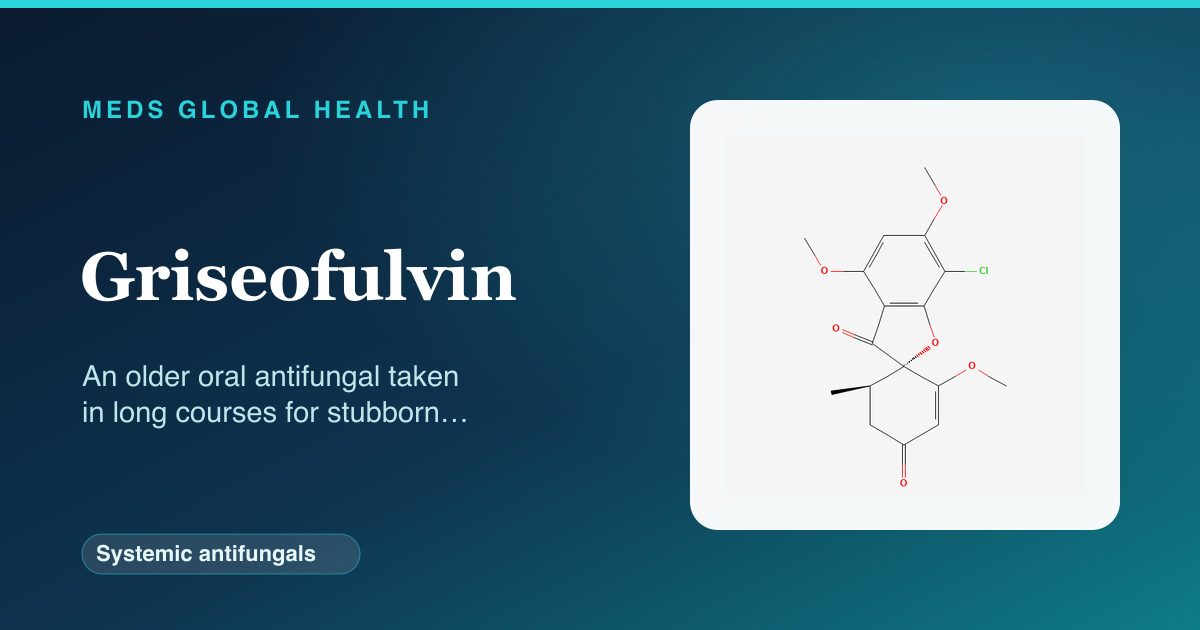
What it is
Griseofulvin is an older antifungal taken by mouth. It is used for fungal infections that creams cannot reach well — particularly scalp ringworm (tinea capitis), and sometimes stubborn skin or nail infections. It works gradually by becoming part of new, healthy skin, hair and nail as they grow, so treatment continues until the infected tissue has been completely replaced, which means long courses.
How it works
Griseofulvin is taken up into newly forming skin, hair and nail cells, where it stops the fungus from growing into the healthy tissue. As infected skin, hair or nail grows out and is replaced by uninfected tissue, the infection clears. Because this depends on natural growth, treatment must continue for weeks or months until the affected area has fully grown out.
Practical use
How to take Griseofulvin
General, dose-free guidance — always follow your prescriber's and the leaflet's specific instructions.
- Take it with or just after a meal containing some fat, which helps your body absorb it.
- Complete the full course even once the infection looks better, or it may come back.
- Avoid alcohol, which can cause flushing, a fast heartbeat and feeling unwell.
- Protect your skin from strong sunlight and use sun protection, as it can increase sun sensitivity.
- Use reliable non-hormonal contraception, because it can make the combined contraceptive pill less effective.
- If you miss a dose, take it when you remember unless it is nearly time for the next — do not double up.
Weighing it up
Advantages & disadvantages of Griseofulvin
Advantages
- Effective for scalp ringworm, where oral treatment is needed because creams cannot reach the hair root.
- Long experience of use, including in children for scalp infections.
- Reaches fungal infections in skin, hair and nail that topical treatments cannot clear.
Disadvantages
- Long courses, often weeks to months, requiring good adherence and patience.
- Must be avoided in pregnancy, needs contraception precautions, and reduces the effectiveness of the combined pill.
- Causes sun sensitivity and a flushing reaction with alcohol, and newer antifungals are now preferred for many infections.
Practical use
Good to know
Take it with a fatty meal, which greatly improves how well it is absorbed. Courses are long and it is important to finish them, even after the skin or nail looks better, or the infection can return. It must not be taken in pregnancy and pregnancy should be avoided for a while after stopping; men are also advised to avoid fathering a child for a period after a course. Alcohol can cause flushing and a faster heartbeat, so it is best avoided, and the medicine can make skin more sensitive to sunlight.
Who should not take it / use with caution
- Must not be used in pregnancy; pregnancy should be avoided during and for a period after treatment, and men are advised not to father a child for a time after a course.
- Avoided in severe liver disease and in porphyria, and in people allergic to it.
- Used with caution in those who must drive or operate machinery, as it can cause dizziness or drowsiness.
Monitoring
- Whether the skin, hair or nail infection is clearing, with long enough treatment.
- Liver function and blood counts may be checked during prolonged courses.
- Anticoagulation (INR) if you also take warfarin.
Side effects
- Headache, which is common, especially at the start of treatment.
- Nausea, stomach upset, diarrhoea or altered taste.
- Skin rashes, increased sensitivity to sunlight, and sometimes dizziness or tiredness.
Key interactions
- Reduces the effectiveness of the combined contraceptive pill — additional or alternative contraception is needed.
- Can reduce the effect of warfarin, so anticoagulation may need monitoring; it also interacts with ciclosporin.
- Alcohol can cause flushing and a fast heartbeat; barbiturates can reduce griseofulvin's absorption.
- It speeds up how the body clears some other medicines (an enzyme-inducing effect) — including the combined contraceptive pill and warfarin — so tell your prescriber about everything you take.
Available as: Tablets, and an oral suspension.
Answers
Griseofulvin: frequently asked questions
Why do I take griseofulvin with fatty food?
Fat in a meal greatly improves how much of the medicine your body absorbs, so taking it with or just after a meal containing some fat helps it work properly.
Can I take it in pregnancy?
No — griseofulvin must be avoided in pregnancy. You should also avoid becoming pregnant for a while after stopping, and men are advised not to father a child for a period after a course.
Why does the course last so long?
The medicine works as new, healthy skin, hair and nail grow in to replace the infected tissue. Because this relies on natural growth, treatment must continue for weeks or months until the area has fully grown out.
Does it affect the contraceptive pill?
Yes — it can make the combined contraceptive pill less effective, so you should use additional or alternative contraception. Discuss the best option with your prescriber.
Can I drink alcohol while taking it?
It is best to avoid alcohol, because the combination can cause flushing, a fast heartbeat and a generally unwell feeling.
The wider class
About Systemic antifungals
Griseofulvin belongs to the systemic antifungals class. For how the class as a whole works, its shared safety principles and monitoring, see the full guide.
Browse by body system
Authoritative sources
- BNF
- NICE CKS
Building a medicines information resource?
We create evidence-led, dose-free drug and formulary references for teams.