An antifungal drip (echinocandin)
Micafungin
A hospital antifungal drip (echinocandin) used for serious invasive candida infections.
What is Micafungin?
Micafungin is an antifungal given by a drip into a vein in hospital to treat serious invasive candida infections, and sometimes to prevent fungal infection in people having stem-cell transplants. It is an echinocandin, a group that works by damaging the wall around fungal cells, and it is usually well tolerated. The main thing the team keeps an eye on is the liver, with blood tests during treatment, along with any reactions while the drip is running. It is always given and monitored by specialists.
Education and reference only. This is a plain-language guide to Micafungin — it deliberately contains no doses. Doses depend on the person, the brand and the reason for treatment, and belong with your prescriber. Always check the BNF, the product labelling (SmPC) and follow medical advice.
What it is
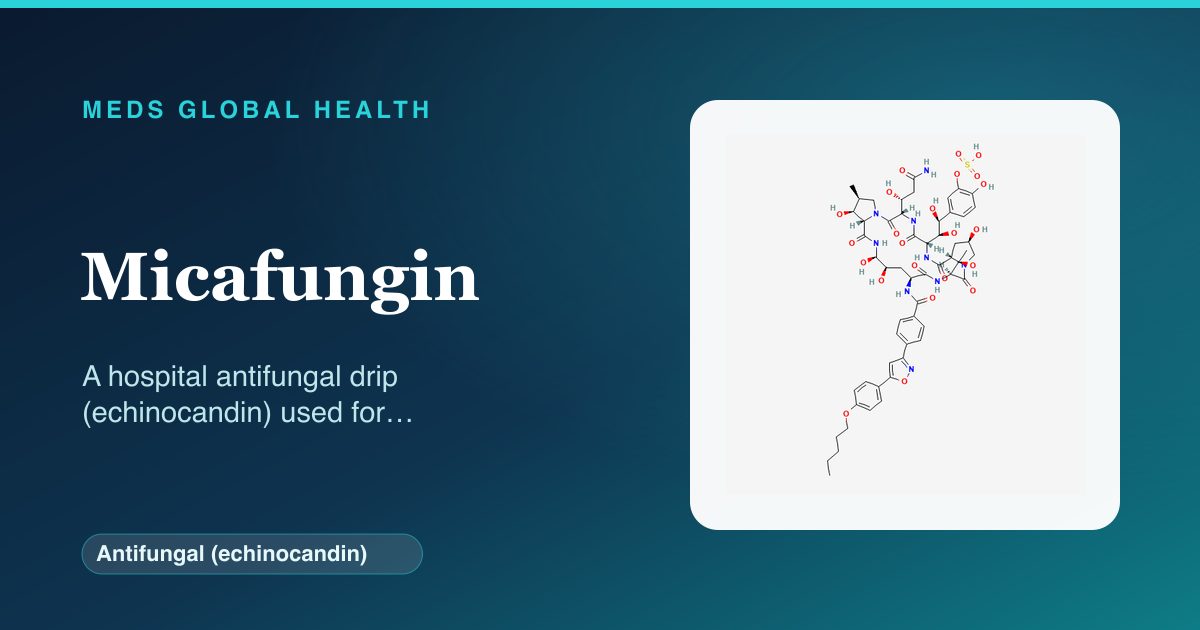
Micafungin is an echinocandin antifungal used in hospital to treat serious candida infections, including those in the bloodstream and internal organs, and to help prevent fungal infections in some people having a stem-cell transplant. Like other echinocandins, it is given only as a drip into a vein because it is not absorbed by mouth. It is reserved for deep, invasive infections rather than minor thrush or skin fungal problems, and it is given under specialist care.
How it works
Micafungin stops an enzyme the fungus uses to build its cell wall, the protective outer layer of each fungal cell. With the wall weakened, the fungal cells break down and the infection is controlled. Human cells do not have this type of cell wall, so the medicine acts mainly on the fungus rather than the body's own cells, which is why echinocandins are generally well tolerated.
Company & origin
Originated / developed by: Astellas.
An echinocandin antifungal given as a drip in hospital for serious invasive candida infections.
Practical use
How to take Micafungin
General, dose-free guidance — always follow your prescriber's and the leaflet's specific instructions.
- It is given only as a slow drip into a vein in hospital by trained staff; it is not available as a tablet.
- The dose and length of treatment are set and adjusted by the specialist team looking after you.
- Tell the staff if you notice a rash, flushing, itching or feel feverish while the drip is running.
- Blood tests, including liver tests, are done during treatment so the team can monitor how you are responding.
- Keep taking your other prescribed medicines as advised, as micafungin is used alongside treatment of your main illness.
Weighing it up
Advantages & disadvantages of Micafungin
Advantages
- An effective treatment for serious invasive candida infections.
- Generally well tolerated, with fewer kidney effects than some older antifungals.
- Useful both to treat candida and to help prevent fungal infection in some transplant patients.
Disadvantages
- Can only be given as a drip in hospital.
- Can affect the liver, so blood tests are needed during treatment.
- May cause infusion-related reactions such as rash, flushing or fever.
Practical use
Good to know
Micafungin is a specialist hospital medicine, so dosing and timing are managed by the care team. It is usually well tolerated, but the liver is the main thing watched, with blood tests during treatment, as liver effects can occur. Some people get reactions during the infusion, such as rash, flushing or fever, which can often be eased by slowing the drip. The team weighs up its use carefully in people with existing liver problems and reviews your other medicines. It is given alongside treatment of the underlying illness, and how long it is needed depends on how the infection responds.
Who should not take it / use with caution
- People who have had an allergic reaction to micafungin or other echinocandins should not be given it.
- It is used with caution in people with existing liver problems, who are monitored more closely.
- In pregnancy and breastfeeding it is used only if the specialist decides the benefit outweighs the risk.
Monitoring
- Liver blood tests during treatment.
- Watching for infusion reactions while the drip is running.
- Checking minerals such as potassium and magnesium, and reviewing how the infection responds.
Side effects
- Nausea, vomiting, diarrhoea or headache.
- Changes in liver blood tests, low potassium or magnesium, and rash or fever.
- Rarely, more serious allergic or liver reactions, which the team watches for.
Key interactions
- It has relatively few drug interactions, but the team still reviews all your medicines.
- It may slightly raise levels of some medicines such as sirolimus or nifedipine, which can be monitored.
- Other antifungals and certain other medicines are taken into account by the specialist team.
Available as: A drip (infusion) into a vein, given in hospital.
Answers
Micafungin: frequently asked questions
What is micafungin used for?
It treats serious invasive candida infections and can help prevent fungal infections in some people having a stem-cell transplant; it is not used for minor thrush.
Is it the same as caspofungin?
Both are echinocandin antifungals that work in a similar way; the team chooses between them based on the infection, your other medicines and your liver and kidneys.
Why are my liver tests checked while I have it?
Micafungin can affect the liver, so blood tests are taken during treatment so any change can be noticed and managed early.
Why can't I take it as a tablet?
It is not absorbed properly from the gut, so it has to be given as a drip into a vein to work, which is why it is a hospital medicine.
Will it harm my kidneys?
Echinocandins such as micafungin are usually gentler on the kidneys than older antifungals, though the team still monitors you carefully.
The wider class
About Antifungal (echinocandin)
Micafungin belongs to the antifungal (echinocandin) class. For how the class as a whole works, its shared safety principles and monitoring, see the full guide.
Browse by body system
Authoritative sources
- BNF
- NICE CKS
Building a medicines information resource?
We create evidence-led, dose-free drug and formulary references for teams.