An antifungal (azole)
Isavuconazole
An azole antifungal for serious invasive aspergillosis and mucormycosis, with many drug interactions.
What is Isavuconazole?
Isavuconazole is an azole antifungal used to treat serious invasive fungal infections, particularly invasive aspergillosis and mucormycosis (a rare but dangerous mould infection). It can be given as a drip or by mouth under specialist care. Unusually for an azole, it slightly shortens the QT interval of the heart rather than lengthening it, but it still has many drug interactions, so all your medicines need reviewing. The team monitors the liver and checks for interactions throughout treatment.
Education and reference only. This is a plain-language guide to Isavuconazole — it deliberately contains no doses. Doses depend on the person, the brand and the reason for treatment, and belong with your prescriber. Always check the BNF, the product labelling (SmPC) and follow medical advice.
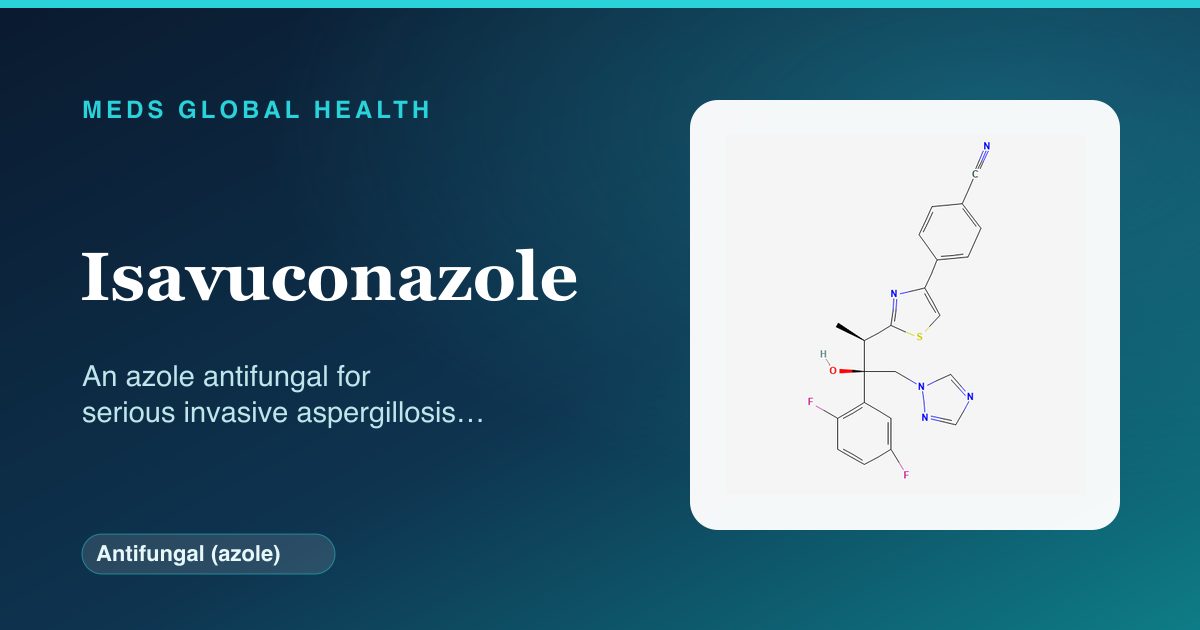
What it is
Isavuconazole is an azole antifungal used in hospital for serious, invasive fungal infections, mainly invasive aspergillosis and mucormycosis, which are dangerous mould infections that usually affect people who are very unwell or have a weakened immune system. It can be given as a drip into a vein or as capsules by mouth, which makes it convenient for switching from hospital to continued treatment. It is used under specialist supervision for these serious infections rather than minor fungal problems.
How it works
Isavuconazole, like other azole antifungals, blocks an enzyme the fungus needs to make a key building block of its cell membrane. Without it, the membrane becomes faulty and the fungus cannot grow properly, so the infection is controlled. The same family of enzymes is used in the human liver to handle many medicines, which is why isavuconazole has a number of drug interactions, and why all your other medicines need to be reviewed.
Company & origin
Originated / developed by: Basilea / Pfizer.
An azole antifungal used in hospital for invasive aspergillosis and mucormycosis.
Practical use
How to take Isavuconazole
General, dose-free guidance — always follow your prescriber's and the leaflet's specific instructions.
- It can be given as a drip into a vein in hospital or as capsules by mouth, as decided by the specialist team.
- Take capsules exactly as directed and swallow them whole; do not chew or open them.
- Make sure the team knows every medicine, supplement and herbal product you take, as there are many interactions.
- Blood tests, including liver tests, are taken during treatment, so attend these as arranged.
- Keep taking your other prescribed medicines as advised, as it is used alongside treatment of your main illness.
Weighing it up
Advantages & disadvantages of Isavuconazole
Advantages
- Effective for serious invasive aspergillosis and the rare but dangerous mucormycosis.
- Available as both a drip and capsules, making it easy to switch and continue treatment.
- Slightly shortens the QT heart interval, unlike many azoles, which may suit some patients.
Disadvantages
- Has many drug interactions, so all your medicines need careful review.
- Can affect the liver, so blood tests are needed during treatment.
- Reserved for serious infections and used only under specialist care.
Practical use
Good to know
Isavuconazole is a specialist medicine for serious mould infections, so the team manages it closely. A notable and unusual feature is that, unlike many azoles which lengthen the QT heart interval, isavuconazole slightly shortens it, so it may be chosen for some people in whom a lengthened QT is a concern. Even so, it has many drug interactions, so every medicine you take is reviewed, and the team watches the liver with blood tests. It can be switched between the drip and capsules, which helps treatment continue smoothly. It is given alongside treatment of the underlying illness, often for a long course.
Who should not take it / use with caution
- People who have had an allergic reaction to isavuconazole or other azole antifungals should not be given it.
- It should not be used with certain medicines that strongly affect its levels, which the team will check.
- It is avoided in a rare inherited heart condition that causes a short QT interval, and used cautiously in liver problems.
Monitoring
- Liver blood tests during treatment.
- Reviewing all your medicines for interactions before and during treatment.
- Checking minerals such as potassium and reviewing how the infection responds.
Side effects
- Nausea, vomiting, diarrhoea or headache.
- Changes in liver blood tests, low potassium, and tiredness.
- Rarely, more serious liver effects or allergic reactions, which the team watches for.
Key interactions
- It has many interactions because it is handled by the same liver enzymes as many other medicines.
- Strong enzyme-affecting medicines, such as rifampicin and some anti-epileptics, can change its levels and may be avoided.
- It can raise levels of some medicines, so the team reviews and may adjust all your treatments.
Available as: A drip (infusion) into a vein, and capsules by mouth, given under specialist care.
Answers
Isavuconazole: frequently asked questions
What is isavuconazole used for?
It treats serious invasive fungal infections, particularly invasive aspergillosis and mucormycosis, which are dangerous mould infections, usually in people who are very unwell.
Is it true it shortens the QT interval?
Yes. Unlike many azole antifungals that lengthen the QT heart interval, isavuconazole slightly shortens it, which is unusual and may suit some patients.
Why does the team need a full list of my medicines?
Isavuconazole has many drug interactions because it is processed by the same liver enzymes as many other medicines, so all your treatments need reviewing.
Can I take it at home as capsules?
Yes, it comes as capsules as well as a drip, so treatment can often continue by mouth after hospital, under specialist guidance.
Why are my liver tests being checked?
It can affect the liver, so blood tests are taken during treatment so any change can be picked up and managed early.
The wider class
About Antifungal (azole)
Isavuconazole belongs to the antifungal (azole) class. For how the class as a whole works, its shared safety principles and monitoring, see the full guide.
Browse by body system
Authoritative sources
- BNF
- NICE CKS
Building a medicines information resource?
We create evidence-led, dose-free drug and formulary references for teams.