A single-infusion antibiotic for skin infections
Oritavancin
A long-acting antibiotic given as a single drip to treat skin infections, including some caused by resistant bacteria.
What is Oritavancin?
Oritavancin is a long-acting antibiotic used to treat skin and soft-tissue infections, including some caused by resistant bacteria such as MRSA. Its main advantage is that it is so long-acting that a single drip into a vein can treat the whole infection, avoiding a course of repeated doses. The most common issues are reactions during the infusion, which can sometimes be eased by slowing it down, and allergic reactions. An important practical point is that for a few days afterwards it can falsely affect certain blood clotting tests, so labs need to know it has been given. It is a specialist antibiotic given under hospital supervision.
Education and reference only. This is a plain-language guide to Oritavancin — it deliberately contains no doses. Doses depend on the person, the brand and the reason for treatment, and belong with your prescriber. Always check the BNF, the product labelling (SmPC) and follow medical advice.
What it is
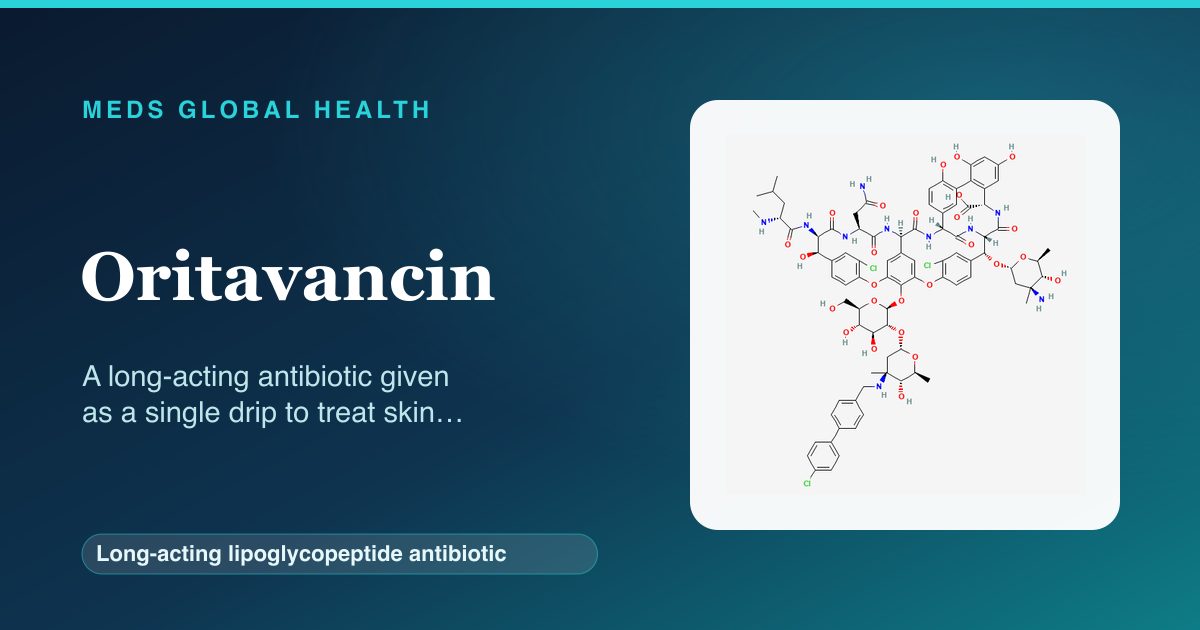
Oritavancin is a long-acting antibiotic in the lipoglycopeptide group, related to the glycopeptide antibiotics. It is used to treat acute bacterial skin and soft-tissue infections, including those caused by resistant bacteria such as MRSA. Its standout feature is that it stays in the body and keeps working for a long time, so a single drip into a vein can be enough to treat the infection, rather than needing a course of repeated doses. It is given as an infusion under hospital or specialist supervision, often as a way to treat a serious skin infection without a prolonged stay or repeated treatments.
How it works
Oritavancin kills bacteria by interfering with the building of their cell walls, so the bacteria cannot hold their shape and break apart. It is particularly active against the kinds of bacteria that cause skin infections, including some resistant ones. Because the medicine is long-acting and stays at effective levels in the body for a long time after a single dose, one infusion can cover the whole course of treatment. This is convenient, but it also means that once it has been given it cannot simply be stopped, so the team checks suitability carefully before the infusion.
Company & origin
A specialist antibiotic used in the UK to treat skin infections, given as a single drip into a vein because it is long-acting.
Practical use
How to take Oritavancin
General, dose-free guidance — always follow your prescriber's and the leaflet's specific instructions.
- It is given by trained staff as a single drip into a vein in hospital or a specialist setting.
- Tell the team about any allergy to antibiotics, especially glycopeptides, before it is given.
- If you have a flushing reaction during the infusion, the team may slow it down to ease this.
- Remind any healthcare professional that you have had it for a few days afterwards, as it can affect some clotting blood tests.
- Report any rash, swelling or breathing difficulty during or after the infusion straight away.
Weighing it up
Advantages & disadvantages of Oritavancin
Advantages
- A single infusion can treat the whole skin infection, avoiding a course of repeated doses.
- Works against difficult skin infections, including some caused by resistant bacteria such as MRSA.
- Can allow serious skin infections to be treated without a prolonged hospital stay.
Disadvantages
- Can cause reactions during the infusion, such as flushing, itching or a rash.
- Falsely affects some blood clotting tests for a few days afterwards.
- Being long-acting, it cannot be removed once given, so suitability must be checked first.
Practical use
Good to know
A key practical point is that, because oritavancin is long-acting, a single infusion can treat the infection, but it also means it stays in the body for some time and cannot be removed once given. Reactions during the infusion, such as flushing, itching or a rash, can occur and are sometimes eased by giving it more slowly. A particularly important point is that for a few days after the infusion it can interfere with some blood clotting tests, making them read falsely, so any laboratory doing such tests needs to know it has been given to avoid confusion or wrong decisions. As with other antibiotics, allergic reactions can occur, and any history of allergy to glycopeptide antibiotics should be mentioned. It is given under hospital supervision so that reactions can be managed.
Who should not take it / use with caution
- People who have had a serious allergic reaction to oritavancin or other glycopeptide antibiotics should not have it.
- It is used with care in people who need certain blood clotting tests, which it can affect for a few days.
- It is used with care, or avoided, where a treatment that can be stopped quickly would be safer, under specialist judgement.
Monitoring
- Watching for infusion reactions and allergic reactions during and after the drip.
- Reviewing how well the skin infection responds.
- Being aware that some clotting tests may read falsely for a few days afterwards.
Side effects
- Reactions during the infusion, such as flushing, itching or a rash.
- Nausea, headache or reactions where the drip goes in.
- Less commonly, allergic reactions, and rarely C. difficile diarrhoea, which need attention.
Key interactions
- For a few days it can falsely affect some blood clotting tests, so labs must know it has been given.
- It can interact with warfarin, which may raise warfarin levels, and it also affects clotting tests (such as INR) for a short time, so anticoagulation needs careful review.
- Tell the team about all your medicines so interactions can be checked.
Available as: A powder made up into a solution for a single drip into a vein.
Answers
Oritavancin: frequently asked questions
What is oritavancin used for?
It is a long-acting antibiotic used to treat skin and soft-tissue infections, including some caused by resistant bacteria such as MRSA.
Is it really just one dose?
Yes, its main advantage is that it is so long-acting that a single drip into a vein can treat the whole infection, avoiding a course of repeated doses.
Why does it affect my blood tests?
For a few days after the infusion it can falsely affect some blood clotting tests, so any lab doing these tests needs to know you have had it to avoid wrong results.
What happens during the infusion?
Some people get flushing, itching or a rash during the drip; the team may slow the infusion down to ease this and will watch for any allergic reaction.
Can it be stopped if there is a problem?
Because it is long-acting it stays in the body and cannot simply be removed once given, so the team checks carefully that it is suitable before the infusion.
The wider class
About Long-acting lipoglycopeptide antibiotic
Oritavancin belongs to the long-acting lipoglycopeptide antibiotic class. For how the class as a whole works, its shared safety principles and monitoring, see the full guide.
Browse by body system
Authoritative sources
- BNF
- NICE CKS
Building a medicines information resource?
We create evidence-led, dose-free drug and formulary references for teams.