A lipoglycopeptide antibiotic given into a vein
Telavancin
A specialist hospital antibiotic given into a vein for some serious skin infections and types of pneumonia.
What is Telavancin?
Telavancin is a specialist antibiotic given into a vein in hospital to treat certain serious skin infections and some types of pneumonia, often when other antibiotics cannot be used. It works against difficult Gram-positive bacteria, including some that resist other medicines. Its most important safety issues are that it can harm the kidneys, so kidney function is checked closely, and that it can cause harm in pregnancy, so pregnancy must be ruled out first and reliable contraception used. It can also alter the taste of food and interfere with some blood-clotting tests, so labs are told you are taking it.
Education and reference only. This is a plain-language guide to Telavancin — it deliberately contains no doses. Doses depend on the person, the brand and the reason for treatment, and belong with your prescriber. Always check the BNF, the product labelling (SmPC) and follow medical advice.
What it is
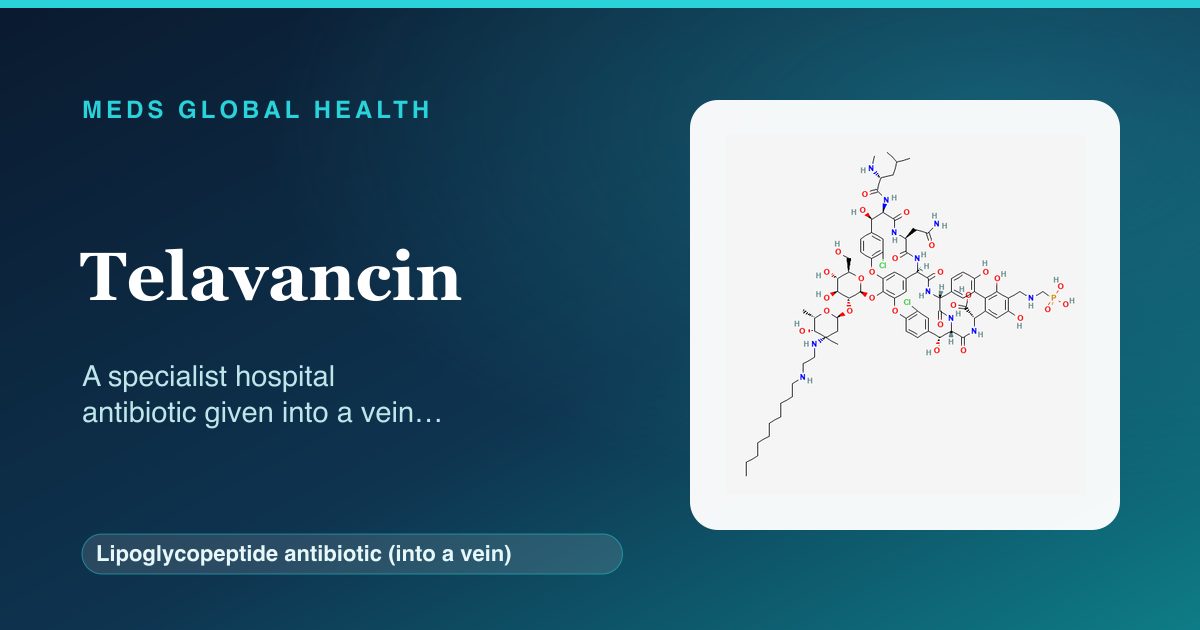
Telavancin is a lipoglycopeptide antibiotic, a relative of the older glycopeptide antibiotics, used to treat serious infections caused by certain Gram-positive bacteria. It is given as an infusion into a vein in hospital, usually for complicated skin and soft-tissue infections, and for some hospital-acquired or ventilator-associated pneumonia, when other antibiotics are unsuitable. It is a reserved, specialist medicine because of its side effects and is used under close supervision, often guided by microbiology advice.
How it works
Telavancin kills bacteria in two ways: it stops them building their cell walls properly and it disrupts the bacterial cell membrane. Because it attacks the bacteria from two angles, it can be effective against some Gram-positive organisms, including certain resistant ones, that are hard to treat with other antibiotics. It is given into a vein so that enough of the medicine reaches the infection. As an antibiotic, it works only against bacteria, not viruses, and it is reserved for situations where its benefits outweigh its risks.
Company & origin
A specialist antibiotic used in hospital in the UK for certain serious skin infections and some types of pneumonia, usually when other treatments are not suitable.
Practical use
How to take Telavancin
General, dose-free guidance — always follow your prescriber's and the leaflet's specific instructions.
- It is given as a slow infusion into a vein by hospital staff; you do not take it yourself.
- Have the kidney blood tests arranged around your treatment, as the team checks kidney function closely.
- Tell the team straight away if you could be pregnant; a pregnancy test is done first and reliable contraception is needed during treatment.
- Expect a possible strange or metallic taste and foamy urine, which usually settle after treatment ends.
- Make sure any clotting blood tests are taken just before a dose, and that the lab knows you are on telavancin.
Weighing it up
Advantages & disadvantages of Telavancin
Advantages
- Works against difficult Gram-positive bacteria, including some resistant ones, when other antibiotics cannot be used.
- Has two ways of attacking bacteria, which can help in hard-to-treat infections.
- Provides a hospital option for certain serious skin infections and types of pneumonia.
Disadvantages
- Can harm the kidneys, so it carries a strong warning and needs close monitoring.
- Can harm an unborn baby, so pregnancy must be ruled out and reliable contraception used.
- Can cause taste disturbance and interfere with some blood-clotting tests.
Practical use
Good to know
The most important things to understand about telavancin relate to its safety. It carries a strong warning that it can harm the kidneys, so kidney function is checked before and during treatment and the medicine may be avoided or used with extra care if the kidneys are not working well. It also carries a strong warning about harm to an unborn baby, so pregnancy must be excluded with a test before treatment and reliable contraception used during it; it is not used in pregnancy unless there is no alternative. A common, harmless effect is a strange or metallic taste, and people may notice their urine becomes foamy. Importantly, telavancin can interfere with certain blood-clotting tests, giving falsely abnormal results, so blood for these tests should be taken just before a dose and the lab told you are on it. Treatment is given and monitored entirely under hospital specialist care.
Who should not take it / use with caution
- People who have had a serious allergic reaction to telavancin should not be given it.
- It is not used in pregnancy unless there is no suitable alternative, because of the risk of harm to the baby.
- It is used with great caution, or avoided, in people whose kidneys are not working well.
- It is a reserved medicine, used only under hospital specialist supervision with close monitoring.
Monitoring
- Checking kidney function before and during treatment.
- Excluding pregnancy before treatment and ensuring reliable contraception during it.
- Watching for allergic or infusion-related reactions and reviewing how the infection responds.
Side effects
- A strange or metallic taste and foamy urine, which usually settle after treatment.
- Nausea, vomiting or stomach upset in some people.
- Worsening kidney function, which is why kidney blood tests are checked closely.
- Rarely, serious allergic or infusion-related reactions, which need urgent medical attention.
Key interactions
- It can interfere with certain blood-clotting tests, so the lab must know you are taking it.
- Using it with other medicines that can affect the kidneys may add to the risk, so the team reviews your medicines.
- Tell the team about all your medicines, as some may affect the heart's rhythm alongside telavancin.
Available as: A powder made up into a solution for infusion into a vein, given in hospital.
Answers
Telavancin: frequently asked questions
What is telavancin used for?
It is a hospital antibiotic given into a vein for certain serious skin infections and some types of pneumonia, usually when other antibiotics are not suitable.
Why are my kidneys checked so often?
Telavancin can harm the kidneys, so it carries a strong warning and your kidney function is checked closely before and during treatment.
Why do I need a pregnancy test before it?
It can harm an unborn baby, so pregnancy is ruled out with a test first and reliable contraception is used during treatment unless there is no alternative.
Why does my food taste strange?
A strange or metallic taste is a common, harmless effect of telavancin and usually settles after the course of treatment ends.
Why does the lab need to know I am taking it?
Telavancin can interfere with some blood-clotting tests and make the results look abnormal, so blood is taken just before a dose and the lab is told you are on it.
The wider class
About Lipoglycopeptide antibiotic (into a vein)
Telavancin belongs to the lipoglycopeptide antibiotic (into a vein) class. For how the class as a whole works, its shared safety principles and monitoring, see the full guide.
Browse by body system
Authoritative sources
- BNF
- NICE CKS
Building a medicines information resource?
We create evidence-led, dose-free drug and formulary references for teams.