An older hepatitis C protease inhibitor
Simeprevir
An older hepatitis C medicine used in combination, now largely replaced by newer, better-tolerated treatments.
What is Simeprevir?
Simeprevir is an older medicine for hepatitis C, a virus that infects the liver. It is a protease inhibitor (it blocks an enzyme the virus needs) and was used together with other medicines as a course of treatment. It is taken as a capsule by mouth. Its notable effects include increased sensitivity to sunlight (photosensitivity) and rashes, and it can raise a substance called bilirubin in the blood. Because it is related to sulfonamide medicines, a sulfa allergy is relevant. It has now been largely superseded by newer, simpler hepatitis C treatments.
Education and reference only. This is a plain-language guide to Simeprevir — it deliberately contains no doses. Doses depend on the person, the brand and the reason for treatment, and belong with your prescriber. Always check the BNF, the product labelling (SmPC) and follow medical advice.
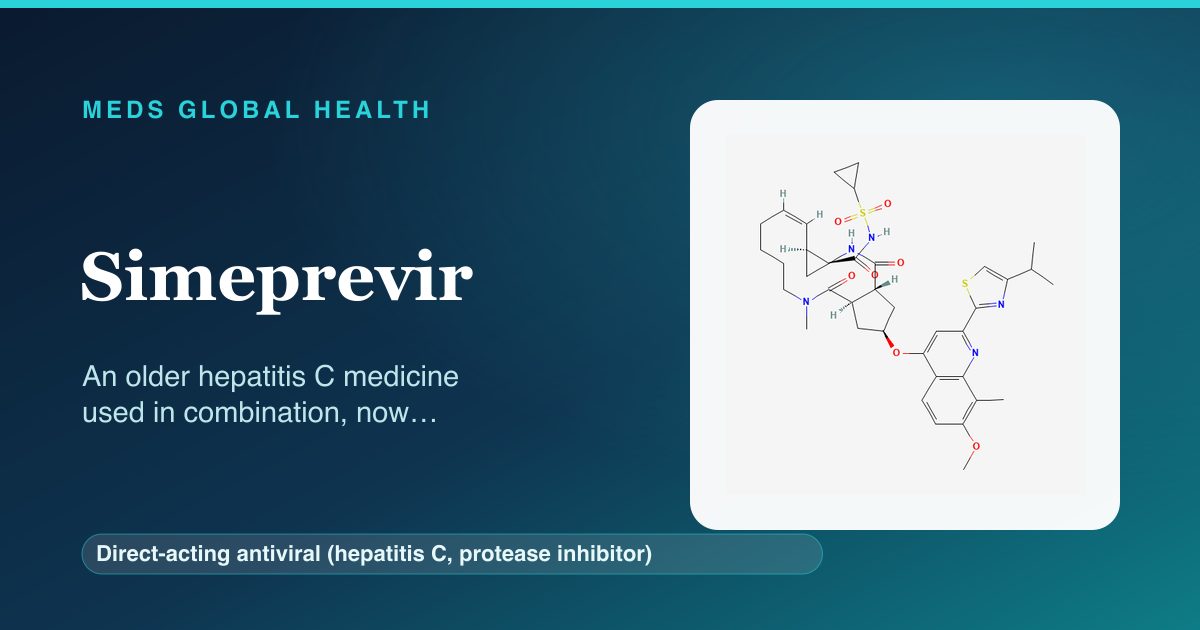
What it is
Simeprevir is a direct-acting antiviral for hepatitis C, working as a protease inhibitor that blocks an enzyme (NS3/4A) the virus needs to multiply. It was used as part of a combination, alongside other antivirals, as a course of treatment aimed at clearing the infection. It is taken by mouth as a capsule. It is an older medicine that has largely been replaced by newer combinations that are simpler, shorter and better tolerated, so it is now rarely used in the UK. It was prescribed and supervised by a specialist.
How it works
Hepatitis C uses an enzyme called a protease (NS3/4A) to cut up and prepare its own proteins so it can make copies of itself. Simeprevir blocks this enzyme, so the virus cannot process its proteins properly and cannot multiply. Because blocking a single step is not enough on its own, it was always used together with other medicines, so the combination attacked the virus from more than one direction and lowered the chance of resistance over the course of treatment.
Company & origin
An older medicine used for hepatitis C as part of a combination, now largely superseded by newer treatments in the UK.
Practical use
How to take Simeprevir
General, dose-free guidance — always follow your prescriber's and the leaflet's specific instructions.
- Take it by mouth as prescribed, with food, as part of the full combination course.
- Protect your skin from strong sunlight and avoid sunbeds during treatment, as it can make you burn more easily.
- Finish the whole course as directed, alongside the other medicines in the combination.
- Tell your team if you have ever had an allergy to sulfonamide ('sulfa') medicines, as simeprevir is related to them.
- Give your team a full list of your medicines, as simeprevir interacts with several of them.
Weighing it up
Advantages & disadvantages of Simeprevir
Advantages
- Could help clear hepatitis C when used as part of a combination course.
- Taken as a capsule by mouth, usually once a day.
- A once-daily option that was simpler than some of the treatments that came before it.
Disadvantages
- Can cause increased sensitivity to sunlight (photosensitivity) and rashes.
- Can raise bilirubin in the blood and is related to sulfonamide drugs, so a sulfa allergy matters.
- An older medicine that has been largely superseded by newer, better-tolerated treatments.
Practical use
Good to know
A few specific points stand out with simeprevir. It can make the skin much more sensitive to sunlight (photosensitivity), so sun protection and avoiding strong sun or sunbeds during treatment is important, and rashes can occur. It can also raise the level of bilirubin in the blood, which may cause a mild yellowing of the skin or eyes without necessarily meaning the liver is being harmed. Because the medicine is chemically related to sulfonamide ('sulfa') drugs, a history of sulfa allergy is worth telling the team about. It interacts with a number of other medicines. Overall it is an older treatment that has been superseded by newer hepatitis C medicines, so it is rarely chosen now.
Who should not take it / use with caution
- People who have had a serious allergic reaction to simeprevir should not take it.
- It is used with caution in people with a known sulfonamide ('sulfa') allergy, as it is chemically related.
- It should not be used with certain medicines that change its levels, and only under specialist care.
Monitoring
- Blood tests to check the hepatitis C response and liver function, including bilirubin.
- Checking the skin for rash and reactions to sunlight during treatment.
- Reviewing other medicines for interactions before and during the course.
Side effects
- Increased sensitivity to sunlight (photosensitivity), with a risk of burning more easily.
- Rash and itching.
- A rise in bilirubin, sometimes causing a mild yellowing of the skin or eyes.
- Nausea or tiredness in some people.
Key interactions
- Many medicines can raise or lower simeprevir levels, so a full medicines list is essential.
- It can affect the levels of some other medicines processed by the liver.
- Medicines that strongly speed up its breakdown, such as some epilepsy drugs and St John's wort, can stop it working.
Available as: Capsules taken by mouth.
Answers
Simeprevir: frequently asked questions
What is simeprevir used for?
It is an older hepatitis C medicine used as part of a combination course to help clear the infection, now largely replaced by newer treatments.
Why do I need to be careful in the sun?
Simeprevir can make your skin much more sensitive to sunlight, so you should protect your skin and avoid strong sun and sunbeds during treatment.
Why does it matter if I am allergic to sulfa medicines?
Simeprevir is chemically related to sulfonamide ('sulfa') medicines, so a history of sulfa allergy is important to tell your team about.
Why might my skin look slightly yellow?
It can raise a substance called bilirubin in the blood, which may cause a mild yellowing of the skin or eyes without necessarily meaning the liver is being harmed.
Is it still commonly used?
No. It has been largely superseded by newer hepatitis C medicines that are simpler, shorter and better tolerated, so it is rarely chosen now.
The wider class
About Direct-acting antiviral (hepatitis C, protease inhibitor)
Simeprevir belongs to the direct-acting antiviral (hepatitis c, protease inhibitor) class. For how the class as a whole works, its shared safety principles and monitoring, see the full guide.
Browse by body system
Authoritative sources
- BNF
- NICE CKS
Building a medicines information resource?
We create evidence-led, dose-free drug and formulary references for teams.