A statin (cholesterol-lowering medicine)
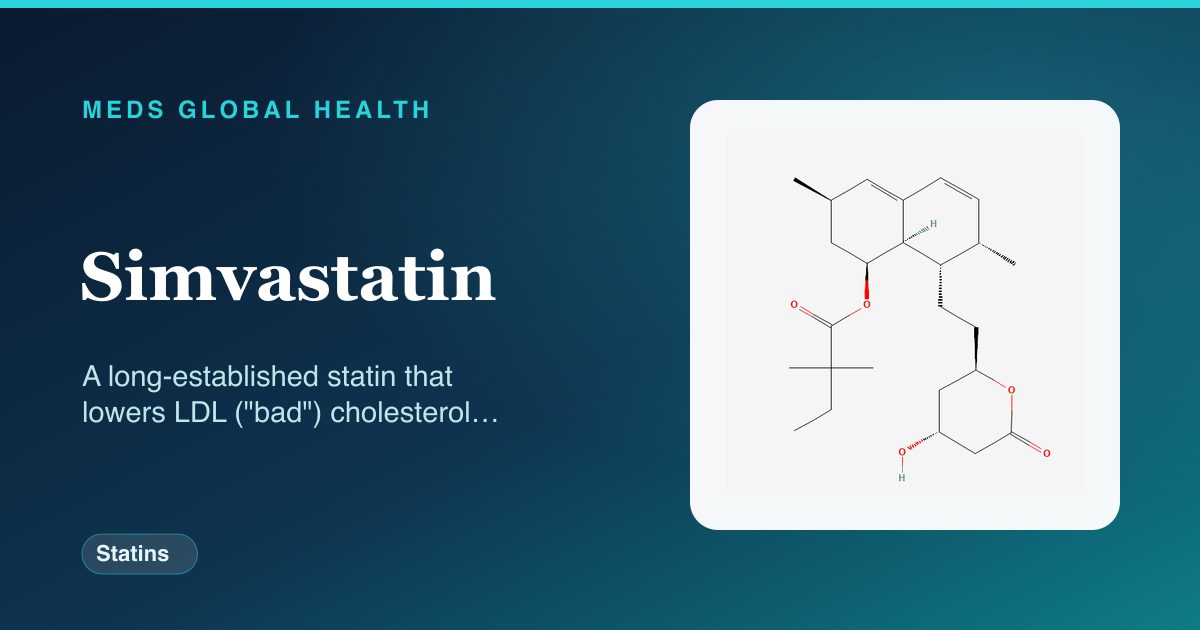
Simvastatin
A long-established statin that lowers LDL ("bad") cholesterol to reduce the risk of heart attack and stroke, usually taken at night.
What is Simvastatin?
Simvastatin is one of the longest-established statins in the UK and lowers LDL ('bad') cholesterol to reduce the risk of heart attack and stroke. It is taken as a long-term once-daily tablet for both prevention and protection in people with or at risk of cardiovascular disease.
Education and reference only. This is a plain-language guide to Simvastatin — it deliberately contains no doses. Doses depend on the person, the brand and the reason for treatment, and belong with your prescriber. Always check the BNF, the product labelling (SmPC) and follow medical advice.
What it is
Simvastatin is one of the oldest and most widely used statins in the UK. It lowers cholesterol — particularly LDL ("bad") cholesterol — and is used both to help prevent a first heart attack or stroke in people at raised cardiovascular risk (primary prevention) and to protect people who already have heart or vascular disease (secondary prevention). It is taken as a long-term tablet and works quietly in the background; the benefit is a reduction in cardiovascular risk measured over years, not something you feel day to day.
How it works
Simvastatin blocks an enzyme in the liver (HMG-CoA reductase) that the body uses to make cholesterol. With less cholesterol being produced, the liver pulls more LDL cholesterol out of the blood, so circulating levels fall. Lower LDL means less cholesterol is laid down in artery walls, which is how statins reduce the risk of heart attacks and strokes over time. Because the body makes most of its cholesterol overnight and simvastatin is shorter-acting than atorvastatin or rosuvastatin, it works best when taken in the evening.
Company & origin
Originated / developed by: Merck & Co. (MSD).
Simvastatin is a statin developed by Merck & Co. (known as MSD outside North America), derived from a fermentation product of Aspergillus terreus. It was first approved by the FDA in 1991 and marketed as Zocor, becoming a leading cholesterol-lowering drug in the 1990s.
What it treats
Conditions Simvastatin is used for
Practical use
How to take Simvastatin
General, dose-free guidance — always follow your prescriber's and the leaflet's specific instructions.
- Usually taken once a day in the evening, as it works best taken at night.
- Swallow the tablet whole with water, with or without food.
- If you miss a dose, skip it and take the next one as usual — do not double up.
- Avoid grapefruit juice, which can raise simvastatin levels and side-effect risk.
- Tell your doctor promptly if you get severe or widespread muscle pain or weakness, or dark-coloured urine.
- Always check with your pharmacist or GP before starting a new medicine, as some drugs (including certain antibiotics and heart medicines) can be unsafe to combine with simvastatin.
- Keep taking it long-term; the benefit is lost if you stop.
Weighing it up
Advantages & disadvantages of Simvastatin
Advantages
- Long track record and strong evidence for preventing cardiovascular events.
- Once daily and very inexpensive.
- Widely available and familiar to prescribers.
- Well tolerated by most people.
Disadvantages
- More prone to interactions than newer statins, so some medicines limit its use.
- Should be taken at night, which is less flexible than atorvastatin.
- Can cause muscle aches in some people.
- Grapefruit must be avoided, and occasional liver blood tests are needed.
Practical use
Good to know
Simvastatin is usually taken once a day in the evening, because it is shorter-acting than newer statins and so matches the body's overnight cholesterol production. It is taken long-term, and stopping it allows cholesterol — and risk — to drift back up. Large amounts of grapefruit juice are best avoided, as they can raise its levels and the risk of side effects. Muscle aches should be reported, though most people tolerate it well, and many reported "statin" symptoms turn out not to be caused by the statin when tested.
Who should not take it / use with caution
- People with active liver disease, or unexplained persistently raised liver blood tests.
- Women who are pregnant, planning pregnancy or breastfeeding — statins are stopped beforehand.
- People taking certain medicines that must not be combined with it (see interactions), and used with caution in significant kidney or muscle disease.
Monitoring
- Cholesterol (lipid) levels to confirm response
- Liver blood tests around starting and as advised
- Reported muscle symptoms
Side effects
- Often none. The most talked-about effect is muscle aches; genuine muscle injury is uncommon but should be reported.
- Occasional headache, digestive upset, or disturbed sleep.
- Rarely, a rise in liver enzymes (checked on blood tests) or, very rarely, serious muscle breakdown (rhabdomyolysis) — report severe, widespread or persistent muscle pain, especially with dark urine.
Key interactions
- Some calcium-channel blockers (amlodipine, diltiazem and verapamil) raise simvastatin levels, so the usable amount is limited when they are taken together.
- It must not be combined with certain antibiotics (such as clarithromycin and erythromycin) and antifungals (such as itraconazole and ketoconazole), which sharply raise levels and muscle-injury risk.
- Large amounts of grapefruit juice raise its levels — best avoided; care also alongside other cholesterol or fibrate medicines.
Available as: Tablets (several strengths). A liquid is sometimes available for people who cannot swallow tablets.
Answers
Simvastatin: frequently asked questions
Why should I take simvastatin at night?
Simvastatin is shorter-acting than newer statins, and the body makes most of its cholesterol overnight, so taking it in the evening lets it work when it is needed most. This differs from atorvastatin and rosuvastatin, which last long enough to be taken at any time of day.
Do I have to take it for life?
Usually it is long-term, because the cholesterol-lowering — and the reduction in heart-attack and stroke risk — only continues while you take it. Don't stop without discussing it; cholesterol and risk rise again if it is stopped.
It is giving me muscle aches — should I stop?
Tell your prescriber rather than just stopping. Muscle aches are common and often not actually caused by the statin; this can be tested by pausing and re-challenging or trying an alternative. Severe or widespread muscle pain, especially with dark urine, needs prompt review as it can signal rare but serious muscle breakdown.
Can I drink grapefruit juice with it?
Large amounts of grapefruit juice can raise simvastatin levels and the risk of muscle side effects, so it is best avoided or kept small. If you regularly drink grapefruit juice, mention it to your pharmacist, who can advise or suggest a different statin.
What is the difference between simvastatin and Zocor?
They are the same medicine — simvastatin is the generic (active-ingredient) name and Zocor is a brand name. Generic simvastatin contains the identical active ingredient.
The wider class
About Statins
Simvastatin belongs to the statins class. For how the class as a whole works, its shared safety principles and monitoring, see the full guide.
Browse by body system
Authoritative sources
- BNF: Simvastatin.
- electronic Medicines Compendium (SmPC): Simvastatin.
- NICE CKS: Simvastatin.
Keep reading
Related articles
Building a medicines information resource?
We create evidence-led, dose-free drug and formulary references for teams.