A low-intensity antiplatelet ("blood-thinning" use)
Aspirin
Used at low intensity as an antiplatelet — not as a painkiller — to help prevent clots after a stroke, TIA or heart problem.
What is Aspirin?
Low-dose aspirin used as an antiplatelet makes platelets less sticky so that blood is less likely to form a clot. It is taken regularly to help prevent heart attacks and strokes in people at high risk, which is a different use from the higher-intensity aspirin taken occasionally for pain.
Education and reference only. This is a plain-language guide to Aspirin — it deliberately contains no doses. Doses depend on the person, the brand and the reason for treatment, and belong with your prescriber. Always check the BNF, the product labelling (SmPC) and follow medical advice.
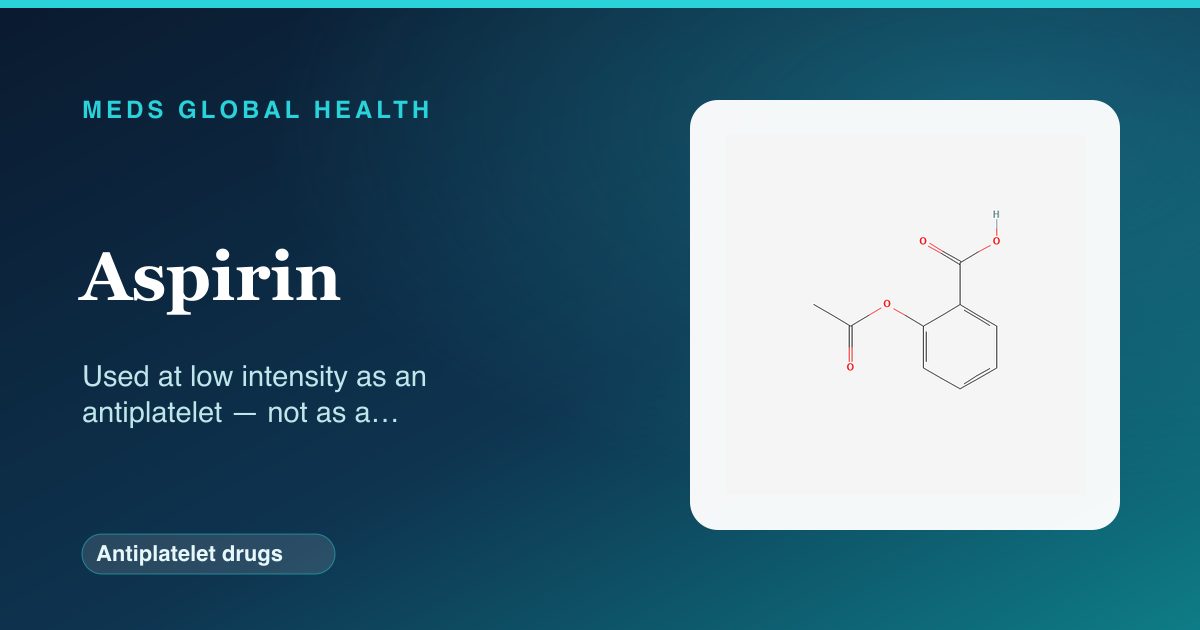
What it is
This page is about aspirin used at low intensity as an antiplatelet, to help prevent clots — not aspirin used at higher intensity as a painkiller for headaches or fever. At low intensity it is taken long-term to lower the risk of a clot in an artery, such as the clots that cause a stroke, a mini-stroke (TIA) or a heart attack. It is most often used in people who already have heart or vascular disease (secondary prevention), and sometimes with another antiplatelet for a period after a heart event or stent. It is a once-daily tablet that works in the background to reduce risk.
How it works
Platelets are tiny blood cells that clump together to form clots. Aspirin permanently switches off an enzyme (cyclo-oxygenase, COX-1) that platelets use to make thromboxane, a chemical signal that tells them to stick together. Because this effect is permanent for each platelet, even a low intensity keeps platelets less sticky for their whole lifespan, which is why a small daily amount is enough for clot prevention and why the effect lingers for several days after stopping.
Company & origin
Originated / developed by: Bayer.
Acetylsalicylic acid was synthesised in a stable, pure form by chemist Felix Hoffmann at Bayer in Germany in 1897, building on earlier work with salicylates. Bayer introduced it commercially under the trademark Aspirin in 1899.
What it treats
Conditions Aspirin is used for
Practical use
How to take Aspirin
General, dose-free guidance — always follow your prescriber's and the leaflet's specific instructions.
- Take it with or just after food to reduce the chance of stomach irritation.
- Take it at the same time each day so it becomes part of your routine.
- Do not stop taking it before surgery, dental work or other procedures without advice from your doctor.
- Watch for and report signs of bleeding, such as black stools, blood when you cough or vomit, or unusual bruising.
- Tell a pharmacist before buying other painkillers, as combining with ibuprofen-type medicines raises bleeding and stomach risks.
Weighing it up
Advantages & disadvantages of Aspirin
Advantages
- Long-established, low-cost protection against heart attack and stroke in high-risk people.
- Taken once a day and easy to combine with other heart medicines.
- Decades of evidence support its use after heart attacks and strokes.
- Widely available and familiar to clinicians.
Disadvantages
- Can irritate the stomach lining and cause indigestion, ulcers or bleeding.
- Increases the overall risk of bleeding, including in the gut and brain.
- Not suitable for everyone, including some people with asthma or a history of stomach ulcers.
- Routine use for prevention in healthy people is no longer recommended, as risks can outweigh benefits.
- Should not be given to children and young people because of a rare serious illness called Reye's syndrome.
Practical use
Good to know
For clot prevention it is taken once a day, long-term, usually with or after food to be gentler on the stomach; some brands are "enteric-coated" or dispersible to reduce stomach irritation. Because it makes platelets less sticky, it can cause stomach irritation, ulcers and bleeding, so any indigestion, black stools or blood in vomit should be reported. It is sometimes paired with a stomach-protection medicine in people at higher risk. It must not be given to children and teenagers (because of a rare but serious problem called Reye's syndrome) except on specialist advice, and it is used with caution in people with asthma. Only stop antiplatelet aspirin on medical advice.
Who should not take it / use with caution
- Children and teenagers under the age of about 16, because of the risk of Reye's syndrome (used only on specialist advice).
- People with active stomach ulcers or bleeding, a bleeding disorder, or a previous severe reaction to aspirin or other anti-inflammatory painkillers (NSAIDs).
- Used with caution in asthma (it can trigger wheeze in some people), in uncontrolled high blood pressure, and in significant kidney or liver problems.
Monitoring
- For indigestion or signs of stomach bleeding
- Blood pressure and, where relevant, kidney function
- Whether stomach protection is needed alongside it
Side effects
- Indigestion, heartburn or stomach irritation.
- Easier bruising and bleeding — bleeding gums, nosebleeds, or cuts that bleed longer.
- More seriously, a stomach ulcer or bleed (report indigestion that won't settle, black or tarry stools, or vomiting blood); in some people aspirin can trigger wheezing or an allergic reaction.
Key interactions
- Other "blood thinners" (anticoagulants such as warfarin or apixaban) and other antiplatelets increase the bleeding risk.
- Anti-inflammatory painkillers (NSAIDs such as ibuprofen) add to stomach and bleeding risks; ibuprofen can also blunt aspirin's antiplatelet effect if taken close together.
- Some antidepressants (SSRIs/SNRIs) and certain steroids further raise the chance of stomach bleeding.
Available as: Tablets, including enteric-coated ("gastro-resistant") and dispersible tablets designed to be gentler on the stomach.
Answers
Aspirin: frequently asked questions
Is low-intensity aspirin the same as aspirin for pain?
It is the same active ingredient, but used very differently. At the low intensity used here it works as an antiplatelet to prevent clots, and is not intended to relieve pain. Using it for clot prevention is a long-term, preventive role rather than an as-needed painkiller.
Should I take aspirin to prevent a heart attack if I am healthy?
Routine daily aspirin is no longer recommended for healthy people with no heart or vascular disease, because for most the bleeding risk outweighs the benefit. It is mainly used in people who already have, or are at high risk of, heart and circulation problems. Always take it only because a clinician has advised it.
Why can't children take aspirin?
Aspirin is avoided in children and teenagers (roughly under 16) because of Reye's syndrome, a rare but serious illness affecting the brain and liver that has been linked to aspirin use during viral infections. Children should use paracetamol or ibuprofen instead, unless a specialist advises otherwise.
I have asthma — can I take aspirin?
Some people with asthma get wheezing or breathing problems from aspirin and other anti-inflammatory painkillers. If you have asthma — especially with nasal polyps or known sensitivity — check with your doctor or pharmacist before taking it, and stop and seek help if it triggers your chest.
What is the difference between aspirin, Caprin and Nu-Seals?
They are the same medicine — aspirin is the generic (active-ingredient) name, and Caprin and Nu-Seals are brand names of enteric-coated aspirin. The branded versions contain the identical active ingredient, just with a coating designed to be gentler on the stomach.
The wider class
About Antiplatelet drugs
Aspirin belongs to the antiplatelet drugs class. For how the class as a whole works, its shared safety principles and monitoring, see the full guide.
Browse by body system
Authoritative sources
- BNF: Aspirin (antiplatelet).
- electronic Medicines Compendium (SmPC): Aspirin (Caprin, Nu-Seals).
- NICE CKS: Low-dose aspirin.
- NICE: Cardiovascular disease — antiplatelet treatment.
Building a medicines information resource?
We create evidence-led, dose-free drug and formulary references for teams.