A drip antiplatelet used during heart procedures
Eptifibatide
An antiplatelet given by drip in hospital to help prevent clots during heart procedures and acute coronary syndromes.
What is Eptifibatide?
Eptifibatide is a strong antiplatelet medicine, a glycoprotein IIb/IIIa inhibitor, given by drip into a vein in hospital. It is used during treatment for acute coronary syndromes, such as a heart attack or unstable angina, and around procedures to open blocked heart arteries, to help stop platelets clumping and forming clots. The dominant safety issue is bleeding and a fall in platelets, both of which are watched closely while it is running. It is a short-term hospital treatment used under close monitoring, not a medicine taken at home.
Education and reference only. This is a plain-language guide to Eptifibatide — it deliberately contains no doses. Doses depend on the person, the brand and the reason for treatment, and belong with your prescriber. Always check the BNF, the product labelling (SmPC) and follow medical advice.
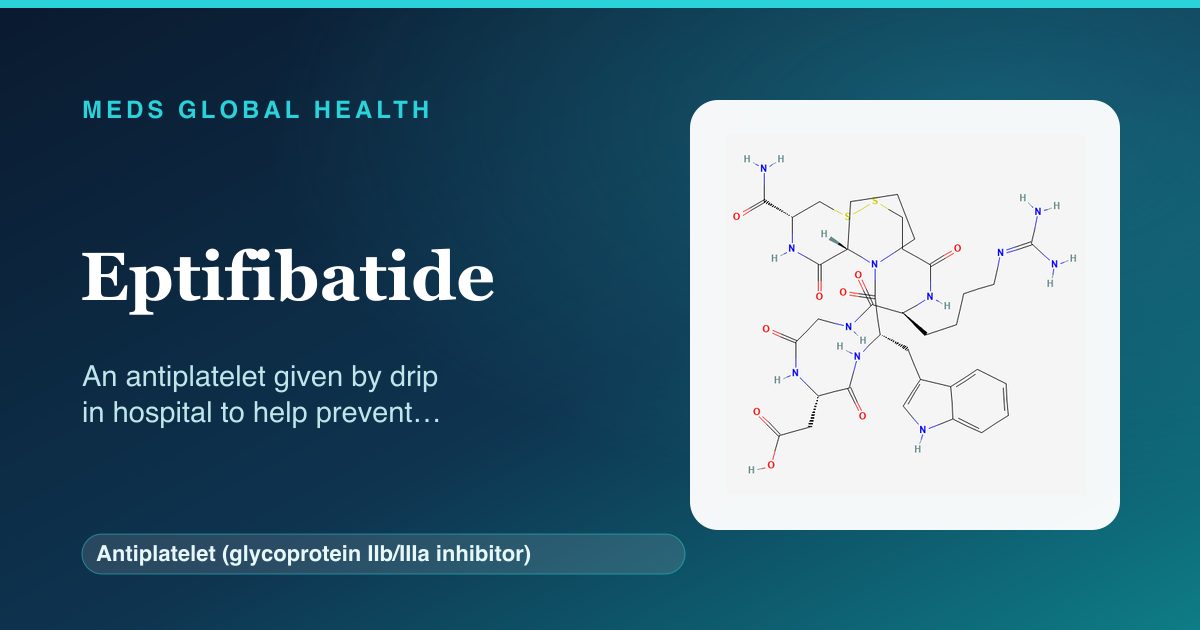
What it is
Eptifibatide is a powerful antiplatelet medicine used in hospital to reduce the risk of dangerous clots in the heart's arteries. It belongs to a group called glycoprotein IIb/IIIa inhibitors, the final common step that platelets use to stick together. It is given by drip into a vein during the treatment of acute coronary syndromes, such as a heart attack or unstable angina, and around procedures that open blocked arteries. Because it works quickly and strongly, and increases the risk of bleeding, it is a short-term treatment used only in hospital with close monitoring.
How it works
Platelets are tiny blood cells that clump together to form clots, which is helpful for stopping bleeding but harmful when a clot blocks a heart artery. Eptifibatide blocks the receptor that platelets need for the final step of clumping together, so they are much less able to form a clot. This helps keep the heart's arteries open during a heart attack, unstable angina or a procedure to widen a narrowed artery. Because the effect is strong and short-lived, it is given as a continuous drip in hospital and stopped when no longer needed, after which platelet function recovers.
Company & origin
A hospital medicine given by drip into a vein to help prevent clots during treatment for a heart attack or unstable angina.
Practical use
How to take Eptifibatide
General, dose-free guidance — always follow your prescriber's and the leaflet's specific instructions.
- It is given by drip into a vein by the hospital team; it is not a medicine you take yourself.
- Tell the team about any recent bleeding, surgery, ulcers or strokes, as these affect whether it can be used safely.
- Report any bleeding, unusual bruising, blood in the urine or stools, or a severe headache straight away while it is running.
- Allow the regular blood tests, including platelet counts, that are done while you are on it.
- Stay as still as advised around drip and puncture sites to reduce bleeding.
Weighing it up
Advantages & disadvantages of Eptifibatide
Advantages
- Strongly reduces the risk of dangerous clots in the heart's arteries during high-risk periods.
- Works quickly and can be stopped when no longer needed, after which platelet function recovers.
- Used as part of established hospital treatment for heart attacks, unstable angina and artery-opening procedures.
Disadvantages
- Increases the risk of bleeding, which is the main concern and needs close monitoring.
- Can cause a fall in the number of platelets, so blood tests are needed.
- Given only in hospital by drip under close supervision, not at home.
Practical use
Good to know
The dominant point with eptifibatide is bleeding. Because it strongly stops platelets working, bleeding, from puncture sites, the gut or elsewhere, is the main risk, and it can also cause a fall in the number of platelets. For this reason it is given only in hospital, often alongside other blood-thinning medicines, with close watching for bleeding and regular blood tests, including platelet counts. The medical team takes care around injections, drips and any procedures while it is running. It is a short-term treatment given for the high-risk period and then stopped. Any unusual bruising, bleeding that will not stop, blood in the urine or stools, or a severe headache should be reported to the team straight away.
Who should not take it / use with caution
- People with active bleeding, recent major bleeding, or a recent bleeding stroke should not be given it.
- It is avoided or used with great caution in people with very low platelets or severe uncontrolled high blood pressure.
- It is used with care in people with kidney problems, and only in hospital under specialist supervision.
Monitoring
- Close watching for any signs of bleeding while the drip is running.
- Regular blood tests, including platelet counts, to catch a fall in platelets early.
- Checking kidney function and blood pressure, as these affect how it is used.
Side effects
- Bleeding, from puncture sites, the gut or elsewhere, which is the most important risk.
- A fall in the number of platelets in the blood.
- Less commonly, low blood pressure or, rarely, a serious allergic reaction.
Key interactions
- Other blood-thinning and antiplatelet medicines add to the bleeding risk and are managed carefully by the team.
- It is often used deliberately alongside other clot-preventing medicines during heart treatment, under close monitoring.
- Tell the team about all medicines, including over-the-counter painkillers such as aspirin or ibuprofen, that affect bleeding.
Available as: A solution given by drip into a vein in hospital.
Answers
Eptifibatide: frequently asked questions
What is eptifibatide used for?
It is given by drip in hospital during a heart attack, unstable angina or a procedure to open blocked heart arteries, to help stop clots forming.
Why is it given only in hospital?
It strongly stops platelets working, so it raises the risk of bleeding and needs close monitoring with blood tests, which is only possible in hospital.
What is the main risk?
Bleeding is the main risk, and it can also lower the number of platelets, so the team watches closely and does regular blood tests.
Do I take it at home?
No. It is a short-term hospital treatment given by drip for the high-risk period and then stopped.
What should I report while on it?
Tell the team straight away about any bleeding, unusual bruising, blood in the urine or stools, or a severe headache.
The wider class
About Antiplatelet (glycoprotein IIb/IIIa inhibitor)
Eptifibatide belongs to the antiplatelet (glycoprotein iib/iiia inhibitor) class. For how the class as a whole works, its shared safety principles and monitoring, see the full guide.
Browse by body system
Authoritative sources
- BNF
- NICE CKS
Building a medicines information resource?
We create evidence-led, dose-free drug and formulary references for teams.