An antiplatelet medicine
Ticagrelor
An antiplatelet medicine used after a heart attack or stent to help stop dangerous blood clots forming in the arteries.
What is Ticagrelor?
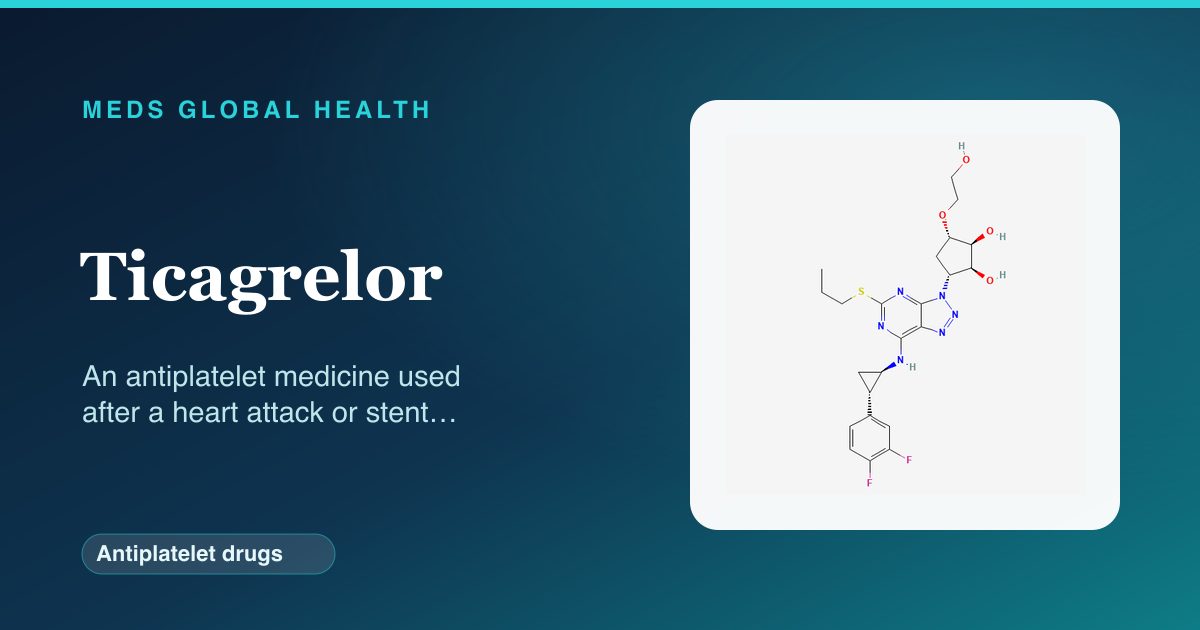
Ticagrelor is an antiplatelet medicine that makes blood platelets less sticky, so they are less likely to clump into a clot inside an artery. It is used mainly after a heart attack or a stent procedure, usually alongside aspirin, to help prevent further cardiovascular events.
Education and reference only. This is a plain-language guide to Ticagrelor — it deliberately contains no doses. Doses depend on the person, the brand and the reason for treatment, and belong with your prescriber. Always check the BNF, the product labelling (SmPC) and follow medical advice.
What it is
Ticagrelor is an antiplatelet medicine — it makes the blood platelets less "sticky" so they are less likely to clump into a clot inside an artery. It is used mainly after a heart attack or after stents are placed in the heart's arteries, usually together with low-dose aspirin, to protect against further clots. It can also be relevant in preventing further events in some people who have had a stroke or mini-stroke. It is taken regularly for a defined period decided by the specialist. It is sold as Brilique in the UK and Brilinta in the US.
How it works
When a blood vessel is injured — or when a stent or a fatty plaque triggers it — platelets gather and stick together to form a clot. Ticagrelor blocks a specific receptor (the P2Y12 receptor) on platelets that they use to clump together, so clots are much less likely to form in the arteries. Paired with aspirin, which blocks a different step, it gives stronger protection against the clots that cause heart attacks and strokes — at the cost of a higher bleeding risk.
Company & origin
Originated / developed by: AstraZeneca.
Ticagrelor, a P2Y12 antiplatelet, was developed by AstraZeneca (UK/Sweden). It received European approval in December 2010 (Brilique) and US FDA approval in July 2011 (Brilinta).
What it treats
Conditions Ticagrelor is used for
Practical use
How to take Ticagrelor
General, dose-free guidance — always follow your prescriber's and the leaflet's specific instructions.
- Usually taken twice a day; keeping to regular morning and evening times is important for steady protection.
- Can be taken with or without food; if you cannot swallow the tablet, ask your pharmacist about crushing it.
- Take it exactly as prescribed and do not stop without advice, as stopping early raises the risk of a clot.
- Some people notice breathlessness, especially early on; mention it to your doctor if it troubles you.
- Report any unusual bruising or bleeding that is heavy or does not stop.
- Tell any doctor or dentist you take an antiplatelet before surgery or dental work.
Weighing it up
Advantages & disadvantages of Ticagrelor
Advantages
- Strong evidence for reducing further heart attacks and strokes after a cardiac event.
- Works quickly and its effect wears off faster than some older antiplatelets once stopped.
- Used as part of a well-established treatment plan after heart attacks and stents.
Disadvantages
- Increases the risk of bleeding, particularly when combined with aspirin.
- Breathlessness is a recognised side effect that can be unsettling.
- Twice-daily dosing means good adherence is essential, and missed doses reduce protection.
- Interacts with some other medicines, so always check before starting anything new.
Practical use
Good to know
Bleeding is the main risk, so report unusual bruising or any heavy or prolonged bleeding. A well-known quirk of ticagrelor is that some people feel breathless on it; this is usually harmless and settles, but it should always be reported so it can be assessed rather than assumed. It is usually taken with low-dose aspirin, but high-dose aspirin should be avoided as it can reduce ticagrelor's benefit. Crucially, it should never be stopped early without specialist advice, as stopping too soon can put a recent stent at risk of clotting.
Who should not take it / use with caution
- People with active bleeding, or a history of bleeding in the brain.
- People with significant liver disease.
- Used with great care alongside other blood-thinning or antiplatelet medicines, and the dose of any accompanying aspirin is kept low.
Monitoring
- Signs of bleeding or anaemia
- Any breathlessness, so it can be assessed
- A planned review of how long the medicine should continue
Side effects
- Bleeding or bruising more easily — from minor (nosebleeds, gum bleeding) to, less often, more serious bleeding.
- Breathlessness, which is fairly common, usually mild and often settling, but should be reported.
- Rarely, serious bleeding, or pauses in the heartbeat — report sudden severe headache, fainting, black stools or coughing/vomiting blood urgently.
Key interactions
- Other medicines that affect clotting — anticoagulants, other antiplatelets and some NSAID painkillers — add to bleeding risk.
- High-dose aspirin should be avoided, as it can reduce ticagrelor's effectiveness; only low-dose aspirin is used alongside it.
- Some medicines and large amounts of grapefruit juice can raise or lower its levels — have combinations checked.
Available as: Tablets, including a form that can be dispersed for people who cannot swallow tablets.
Answers
Ticagrelor: frequently asked questions
Why do I feel breathless on ticagrelor?
A feeling of breathlessness is a recognised effect of ticagrelor and is usually harmless, often easing over time. However, it should always be reported rather than ignored, because breathlessness can have other causes too, and your prescriber will want to check it is the medicine and not something that needs attention.
Why must I keep taking aspirin alongside it — but only low-dose?
Ticagrelor and aspirin block clotting in two different ways, so together they give stronger protection after a heart attack or stent. But high-dose aspirin can actually reduce ticagrelor's benefit, so only low-dose aspirin is used with it. Take both exactly as prescribed and don't change the aspirin yourself.
Can I just stop ticagrelor if it bothers me?
No — stopping ticagrelor early can be dangerous, because a recent stent can clot off and cause a heart attack. If you have side effects or are due an operation, speak to your specialist or pharmacist first; never stop it on your own.
What should I do about bleeding or before dental work?
Minor bruising or the odd nosebleed is common; tell your team at your next review. Heavy or prolonged bleeding needs prompt advice. Before any surgery or dental procedure, always tell the team you take ticagrelor, so they can plan safely — but do not stop it yourself.
What is the difference between ticagrelor, Brilique and Brilinta?
They are the same medicine — ticagrelor is the generic (active-ingredient) name, Brilique is the UK brand name and Brilinta is the US brand name. The active ingredient is identical.
The wider class
About Antiplatelet drugs
Ticagrelor belongs to the antiplatelet drugs class. For how the class as a whole works, its shared safety principles and monitoring, see the full guide.
Browse by body system
Authoritative sources
- BNF: Ticagrelor.
- electronic Medicines Compendium (SmPC): Brilique.
- NICE CKS: Ticagrelor.
Building a medicines information resource?
We create evidence-led, dose-free drug and formulary references for teams.