An azole antifungal for vaginal thrush
Fenticonazole
An azole antifungal pessary and cream used to treat vaginal thrush by clearing the yeast that causes the symptoms.
What is Fenticonazole?
Fenticonazole is an antifungal treatment for vaginal thrush, used as a pessary placed inside the vagina, often with a cream for the outer area. It clears the candida yeast responsible for the itching, soreness and discharge. See a clinician if you are pregnant, get thrush often, or are not sure it is thrush.
Education and reference only. This is a plain-language guide to Fenticonazole — it deliberately contains no doses. Doses depend on the person, the brand and the reason for treatment, and belong with your prescriber. Always check the BNF, the product labelling (SmPC) and follow medical advice.
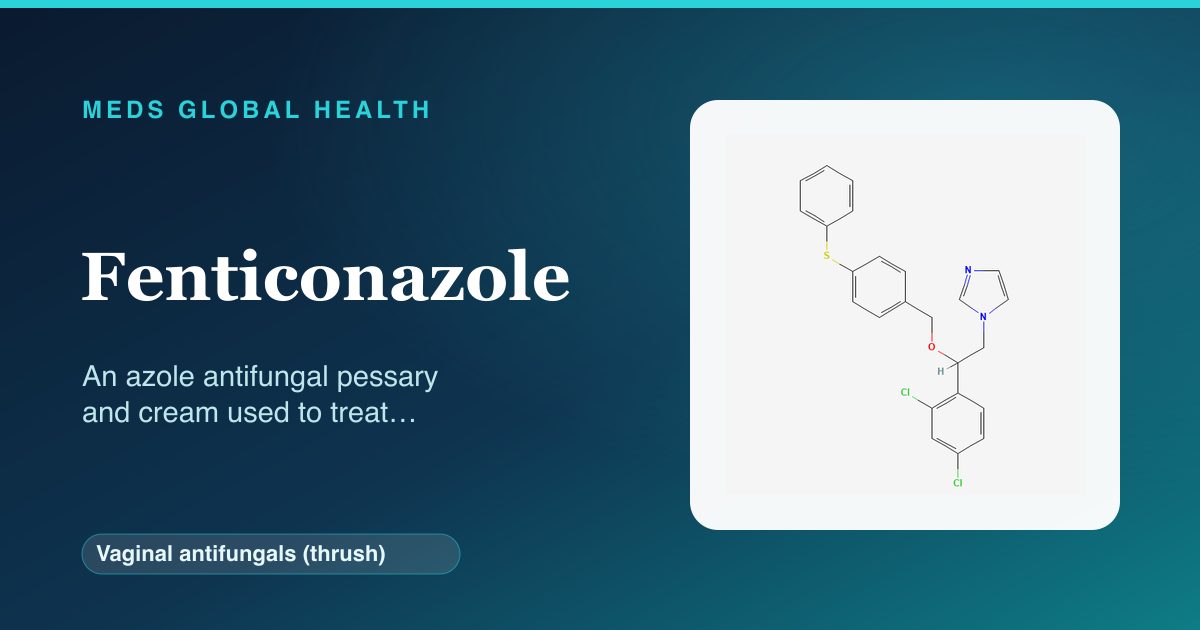
What it is
Fenticonazole is an azole antifungal used to treat vaginal thrush (a candida yeast infection). It comes as a pessary that is inserted into the vagina and sometimes with an external cream for the surrounding skin. It is a short course aimed at clearing the yeast that causes the typical itching, soreness, redness and thick white discharge of thrush.
How it works
Candida yeast needs a substance called ergosterol to build and maintain its cell wall. Fenticonazole, like other azole antifungals, blocks the enzyme the yeast uses to make ergosterol. Without a healthy cell wall the yeast cannot grow or survive, so the infection clears and the symptoms settle. It acts locally where it is applied rather than throughout the whole body.
Company & origin
Originated / developed by: Recordati.
Fenticonazole is an imidazole antifungal developed in Italy and used for vaginal thrush in the UK as a pessary and cream.
Practical use
How to take Fenticonazole
General, dose-free guidance — always follow your prescriber's and the leaflet's specific instructions.
- Insert the pessary high into the vagina, usually at bedtime so it stays in place overnight.
- If a cream is included, apply it to the itchy skin around the outside as directed.
- Avoid latex condoms and diaphragms around the time of treatment, as it can damage them.
- Finish the treatment even if symptoms ease quickly, and avoid using tampons during the course.
- See a clinician if symptoms do not improve within a few days, keep returning, or you are pregnant.
Weighing it up
Advantages & disadvantages of Fenticonazole
Advantages
- Acts locally in the vagina with very little absorbed into the rest of the body.
- A short, convenient course that treats most simple thrush.
- Often paired with an external cream to soothe vulval itching at the same time.
Disadvantages
- Can damage latex condoms and diaphragms, reducing their reliability.
- Treats thrush but not other causes of similar symptoms, so the wrong self-diagnosis can delay proper care.
- Recurrent or uncertain symptoms still need a clinical assessment.
Practical use
Good to know
Fenticonazole is used inside the vagina, so it works right where thrush is, with little absorbed into the rest of the body. The pessary and cream can damage latex condoms and diaphragms, making them less reliable, so an extra method of contraception is wise around the time of use. Thrush that keeps coming back, happens in pregnancy, or is not clearly thrush should be checked by a clinician rather than repeatedly self-treated, as similar symptoms can have other causes. An external cream is often used alongside the pessary to soothe itching around the vulva.
Who should not take it / use with caution
- People who have had an allergic reaction to fenticonazole or similar azole antifungals.
- Those who are pregnant or breastfeeding should get advice before use, as treatment may need to be supervised.
- People who are not sure their symptoms are thrush, or who get recurrent episodes, should be assessed rather than self-treat.
Monitoring
- No routine monitoring for a single, simple course.
- Review if symptoms do not settle within a few days or keep coming back.
- A clinical check is advised in pregnancy, recurrent thrush, or if the diagnosis is uncertain.
Side effects
- Often none; sometimes mild local irritation, burning or itching where it is used.
- Occasional redness or soreness of the surrounding skin.
- Rarely, an allergic reaction with marked swelling or rash — stop and seek advice if this happens.
Key interactions
- It can damage latex condoms and diaphragms, making them unreliable around the time of use.
- Other vaginal products used at the same time may interfere with it, so use them separately or as advised.
- Very little is absorbed, so interactions with tablets taken by mouth are unlikely, but mention all your medicines to the pharmacist.
Available as: Vaginal pessary (inserted into the vagina) and an external cream for the surrounding skin.
Answers
Fenticonazole: frequently asked questions
Can fenticonazole damage condoms?
Yes. Like other azole pessaries and creams, it can weaken latex condoms and diaphragms, making them less reliable. Use an extra method of contraception around the time of treatment, or avoid relying on latex barriers until a few days afterwards.
When should I see a doctor instead of treating thrush myself?
See a clinician if you are pregnant, get thrush often, are under 16 or over 60, have unusual discharge or bleeding, or are not sure it is thrush. Similar symptoms can have other causes that need different treatment.
Should I treat my partner too?
Routine treatment of a partner is not usually needed for a simple episode of thrush. If a male partner has symptoms such as itching or soreness of the penis, a pharmacist can suggest a suitable cream. Ask for advice if symptoms keep returning.
Can I use it during my period?
It is usually best to treat thrush when you are not bleeding, as a period can wash the pessary away and make it less effective, and tampons should be avoided during treatment. If your period starts mid-course, ask a pharmacist for advice.
How quickly does it work?
Many people notice symptoms easing within a few days, though the external soreness can take a little longer to settle. If there is no improvement after a few days, or symptoms keep coming back, see a clinician for assessment.
The wider class
About Vaginal antifungals (thrush)
Fenticonazole belongs to the vaginal antifungals (thrush) class. For how the class as a whole works, its shared safety principles and monitoring, see the full guide.
Browse by body system
Authoritative sources
- BNF: Fenticonazole.
- NICE CKS: Thrush in men and women.
Building a medicines information resource?
We create evidence-led, dose-free drug and formulary references for teams.