A triazole antifungal
Voriconazole
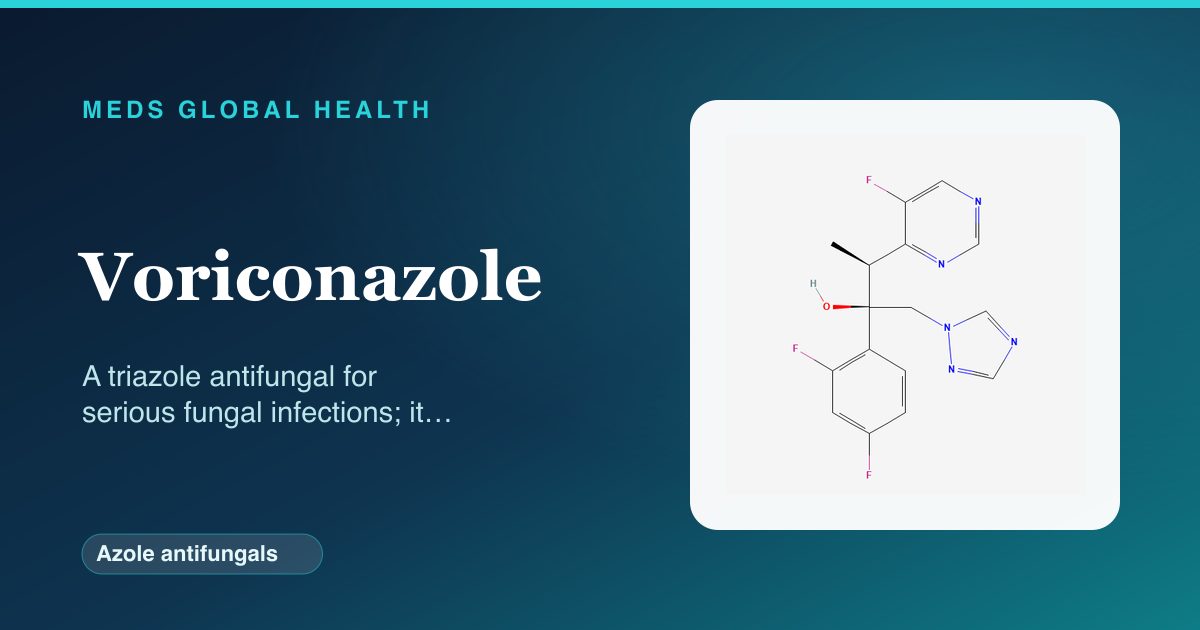
A triazole antifungal for serious fungal infections; it has many drug interactions and can cause temporary visual disturbances and sun-sensitive skin.
What is Voriconazole?
Voriconazole is a triazole antifungal medicine used to treat serious fungal infections, usually under specialist care. It works by damaging the membrane that fungal cells need to survive. It interacts with many other medicines and can cause temporary visual disturbances and skin that burns easily in the sun, so it is used carefully with regular monitoring.
Education and reference only. This is a plain-language guide to Voriconazole — it deliberately contains no doses. Doses depend on the person, the brand and the reason for treatment, and belong with your prescriber. Always check the BNF, the product labelling (SmPC) and follow medical advice.
What it is
Voriconazole is a triazole antifungal medicine used in the UK to treat serious, often invasive, fungal infections, typically in hospital or under specialist supervision and frequently in people whose immune system is weakened. It is available as tablets, a liquid taken by mouth and an infusion into a vein. It is a powerful treatment reserved for significant infections rather than everyday fungal problems such as athlete's foot, and it requires close monitoring because of its interactions and side effects.
How it works
Fungal cells are surrounded by a membrane that depends on a substance called ergosterol to stay intact. Voriconazole blocks a fungal enzyme needed to make ergosterol. Without enough ergosterol the fungal cell membrane becomes leaky and unstable, which stops the fungus growing and helps clear the infection. Because the enzyme it blocks is part of a wider family also involved in handling other medicines in the body (the liver's cytochrome P450 enzymes), voriconazole both affects, and is affected by, many other drugs.
Company & origin
Originated / developed by: Developed by Pfizer..
Voriconazole is a triazole antifungal developed by Pfizer and introduced in the early 2000s for serious fungal infections.
Practical use
How to take Voriconazole
General, dose-free guidance — always follow your prescriber's and the leaflet's specific instructions.
- Take it well apart from food, usually about an hour before or after a meal, so it is absorbed properly.
- Take it at evenly spaced times as prescribed, and do not stop early without advice, as the infection may not be fully cleared.
- Do not drive or operate machinery if your vision is blurred or altered after a dose, until it returns to normal.
- Protect your skin from the sun — cover up, avoid strong sunlight and sunbeds, and use sun protection — as your skin will burn more easily.
- Check with your pharmacist or prescriber before taking any new medicine or supplement, as voriconazole interacts with many medicines.
- Attend your blood tests so your liver function and, where needed, the level of the medicine in your blood can be checked.
Weighing it up
Advantages & disadvantages of Voriconazole
Advantages
- It is an effective treatment for serious and potentially life-threatening fungal infections.
- It is available both as a drip and by mouth, allowing a switch to tablets or liquid as someone improves.
- It reaches a wide range of body tissues, which is useful for deep-seated infections.
Disadvantages
- It interacts with a large number of other medicines, so combinations must be checked carefully.
- It commonly causes temporary visual disturbances and makes the skin very sensitive to the sun.
- It can affect the liver and requires regular blood tests and specialist oversight.
Practical use
Good to know
Voriconazole is well known for interacting with many other medicines, so a careful medicines review is essential before and during treatment, and you should check before starting anything new, including over-the-counter products. It can cause visual disturbances — temporary blurred or altered vision, changes in colour or brightness, or sensitivity to light — usually soon after a dose; if your sight is affected, do not drive or operate machinery until it clears. It also makes the skin much more sensitive to sunlight, so avoid strong sun and sunbeds and use sun protection, as long-term use carries a recognised risk of skin damage and skin cancer. Your liver function is checked regularly because it can affect the liver. It is best taken well apart from food — usually around an hour before or after eating — so it is absorbed properly, and it is generally avoided in pregnancy.
Who should not take it / use with caution
- People taking certain medicines that interact dangerously with voriconazole (your team will check this list carefully).
- Women who are pregnant or breastfeeding, unless a specialist judges it essential.
- Anyone who has had a serious allergic reaction to voriconazole or other azole antifungals.
Monitoring
- Regular liver-function blood tests during treatment.
- Checking the level of the medicine in the blood in some people to keep it in the right range.
- Watching for visual disturbances, skin changes and signs of liver problems, with skin checks if used long term.
Side effects
- Visual disturbances — temporary blurred or altered vision, changes in colour or brightness, or sensitivity to light.
- Skin that burns easily in the sun (photosensitivity), with a long-term skin-cancer risk.
- Changes in liver-function blood tests, and sometimes nausea or vomiting.
- Headache, dizziness and, less often, hallucinations or rashes.
Key interactions
- Many medicines interact with voriconazole because it affects the liver enzymes that handle other drugs, so a full medicines review is essential.
- Some medicines must not be combined at all, while others need dose changes or extra monitoring.
- Always check before starting any new medicine, herbal remedy (such as St John's wort) or supplement.
Available as: Tablets, an oral liquid (suspension), and an infusion into a vein given in hospital.
Answers
Voriconazole: frequently asked questions
Why does voriconazole interact with so many medicines?
It is handled by the same liver enzymes that process many other medicines, and it can both block and be affected by them. This means it can change the levels of other drugs in the body, and they can change its levels, so every medicine, including over-the-counter products, must be checked.
Will voriconazole affect my eyesight?
It commonly causes temporary visual disturbances, such as blurred or altered vision, changes in brightness or colour, or sensitivity to light, usually soon after a dose. These normally pass, but you should not drive or operate machinery while your sight is affected.
Why do I need to avoid the sun?
Voriconazole makes the skin much more sensitive to sunlight, so it burns far more easily. With longer-term use there is a recognised risk of sun-related skin damage and skin cancer, so you should cover up, avoid strong sun and sunbeds, and use sun protection.
Should I take it with food?
No — it is best taken well apart from food, usually about an hour before or after a meal, because food reduces how much is absorbed. Taking it on a fairly empty stomach helps the medicine work properly.
Why are blood tests needed during treatment?
Voriconazole can affect the liver, so your liver function is checked regularly. In some people the level of the medicine in the blood is also measured to keep it in the right range, as too little may not clear the infection and too much can cause more side effects.
The wider class
About Azole antifungals
Voriconazole belongs to the azole antifungals class. For how the class as a whole works, its shared safety principles and monitoring, see the full guide.
Browse by body system
Authoritative sources
- BNF
- NICE CKS
Building a medicines information resource?
We create evidence-led, dose-free drug and formulary references for teams.