An antifungal pessary and cream for vaginal thrush
Terconazole
An antifungal pessary or cream used inside the vagina to treat thrush, a common yeast infection.
What is Terconazole?
Terconazole is an azole antifungal used as a vaginal pessary or cream to treat vaginal thrush, a common yeast (Candida) infection that causes itching, soreness and discharge. It works by damaging the wall of the yeast cells so the infection clears. It is used inside the vagina rather than swallowed, and the main side effects are local irritation, burning or itching where it is applied. An important practical point is that it can weaken latex condoms and diaphragms, making them less reliable, so extra care or alternative contraception is needed for a few days.
Education and reference only. This is a plain-language guide to Terconazole — it deliberately contains no doses. Doses depend on the person, the brand and the reason for treatment, and belong with your prescriber. Always check the BNF, the product labelling (SmPC) and follow medical advice.
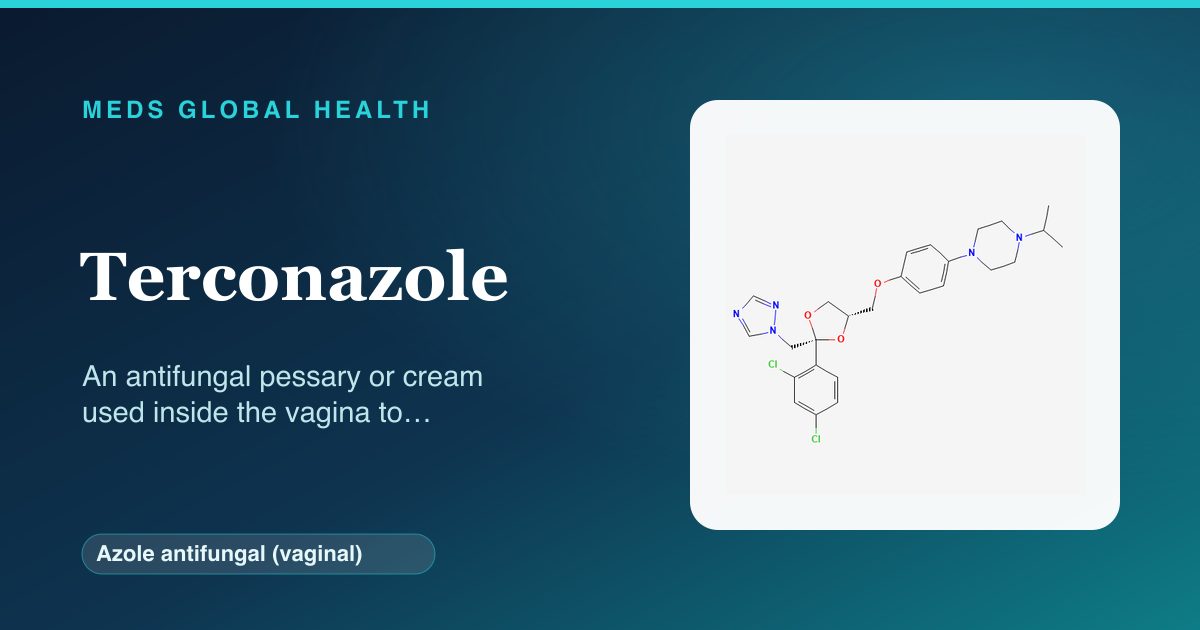
What it is
Terconazole is an antifungal medicine from the azole group, used to treat vaginal thrush, an infection caused by an overgrowth of a yeast called Candida. It is used inside the vagina as a pessary (a small insert) or as a cream, rather than taken by mouth. Thrush causes symptoms such as itching, soreness, redness and a thick white discharge, and terconazole clears the yeast responsible. It is a local treatment, so it mainly acts where it is applied, with little reaching the rest of the body.
How it works
Terconazole works by interfering with a substance the yeast needs to build its cell wall. Without a healthy wall, the yeast cells leak and die, which clears the thrush infection. Because it is used directly inside the vagina, it delivers the antifungal right where the infection is, so it works locally with little spreading through the body. This local action is why its main side effects are irritation at the site rather than the body-wide effects seen with antifungal tablets.
Company & origin
An azole antifungal used as a vaginal pessary or cream to treat vaginal thrush (a yeast infection).
Practical use
How to take Terconazole
General, dose-free guidance — always follow your prescriber's and the leaflet's specific instructions.
- Use it inside the vagina as a pessary or cream, as directed, usually at bedtime so it stays in place.
- Finish the full course even if symptoms improve, to clear the infection properly.
- Do not rely on latex condoms or a diaphragm alone for several days, as it can weaken them; use another method or take extra care.
- If you can, avoid using it during your period, as this can reduce how well it works.
- See a pharmacist or doctor if symptoms do not clear, keep coming back, or you are pregnant or unsure it is thrush.
Weighing it up
Advantages & disadvantages of Terconazole
Advantages
- An effective local treatment for vaginal thrush, acting right where the infection is.
- Used inside the vagina, so little of it reaches the rest of the body.
- Comes as a pessary or cream, giving a choice of how to use it.
Disadvantages
- Can cause local irritation such as burning, itching or soreness where it is applied.
- Can weaken latex condoms and diaphragms, making them less reliable.
- May be messy to use and is less convenient than a single antifungal tablet for some people.
Practical use
Good to know
The most useful things to know about terconazole are practical. First, the most common side effect is local irritation, such as burning, itching or soreness where it is applied, which usually settles. Second, and importantly, it can weaken latex condoms and diaphragms, making them more likely to fail, so for several days around using it you should not rely on latex barrier contraception alone and should use another method or take extra care. It is best to complete the full course even if symptoms improve, and to avoid using it during a period if you can, as this can reduce how well it works. If symptoms do not improve, keep coming back, or you are unsure it is thrush, or if you are pregnant, see a pharmacist or doctor rather than treating repeatedly on your own.
Who should not take it / use with caution
- People who have had a serious allergic reaction to terconazole or similar azole antifungals should not use it.
- It should be used on the advice of a doctor in pregnancy and in girls who have not yet started periods.
- It is not the right treatment if the symptoms are not actually due to thrush, so get checked if you are unsure.
Monitoring
- Checking that symptoms clear with the course and do not keep coming back.
- Reconsidering the diagnosis if treatment does not work, as the cause may not be thrush.
- Seeking advice for repeated infections, which may need further assessment.
Side effects
- Local burning, itching, soreness or irritation where it is applied.
- Mild discomfort or, occasionally, a headache.
- Rarely, a more troublesome irritation or allergic-type reaction, which should be reviewed.
Key interactions
- It can weaken latex condoms and diaphragms, so they may not be reliable for a few days.
- Because it is used locally with little absorbed, body-wide medicine interactions are uncommon.
- Tell your pharmacist about other vaginal treatments you are using to avoid using too many at once.
Available as: A vaginal pessary (insert) and a vaginal cream.
Answers
Terconazole: frequently asked questions
What is terconazole used for?
It is an antifungal used inside the vagina, as a pessary or cream, to treat thrush, a common yeast (Candida) infection that causes itching, soreness and discharge.
Will it affect my condoms?
Yes. Terconazole can weaken latex condoms and diaphragms, making them less reliable, so for several days you should use another method of contraception or take extra care.
Why does it sting when I use it?
Some local burning, itching or soreness where it is applied is the most common side effect and usually settles; tell your pharmacist if it is severe or does not improve.
Can I use it during my period?
It is best to avoid using it during a period if you can, as this can reduce how well it works; ask your pharmacist for advice on timing.
What if it does not work?
If symptoms do not clear, keep coming back, or you are unsure it is thrush, or if you are pregnant, see a pharmacist or doctor rather than treating again on your own.
The wider class
About Azole antifungal (vaginal)
Terconazole belongs to the azole antifungal (vaginal) class. For how the class as a whole works, its shared safety principles and monitoring, see the full guide.
Browse by body system
Authoritative sources
- BNF
- NICE CKS
Building a medicines information resource?
We create evidence-led, dose-free drug and formulary references for teams.