A triazole antifungal
Posaconazole
A triazole antifungal used to prevent and treat serious fungal infections, mainly in people with weakened immune systems.
What is Posaconazole?
Posaconazole is a triazole antifungal used to prevent and treat serious fungal infections, particularly in people with weakened immune systems such as those having chemotherapy or a transplant. It works against a broad range of fungi, including some that other antifungals miss. It interacts with many other medicines and needs liver and heart-rhythm monitoring.
Education and reference only. This is a plain-language guide to Posaconazole — it deliberately contains no doses. Doses depend on the person, the brand and the reason for treatment, and belong with your prescriber. Always check the BNF, the product labelling (SmPC) and follow medical advice.
What it is
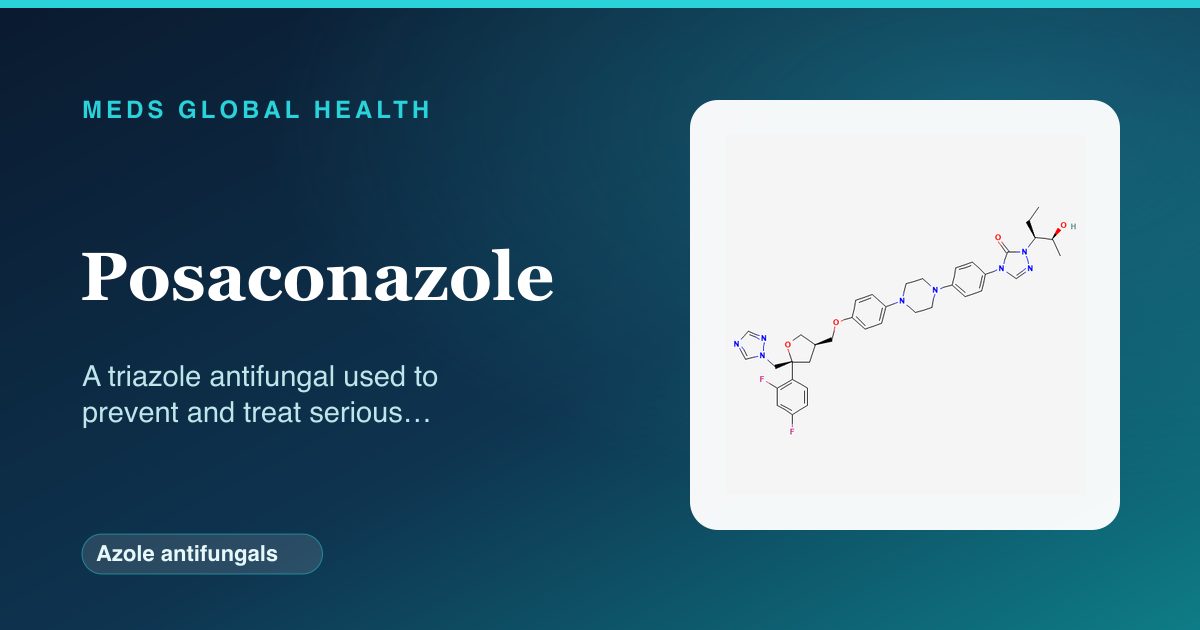
Posaconazole is a broad-spectrum triazole antifungal used to prevent and treat serious fungal infections such as aspergillosis and certain hard-to-treat moulds and yeasts. It is used mainly in people whose immune systems are weakened, for example during intensive chemotherapy, after a stem-cell or organ transplant, or with serious illnesses affecting immunity. It is also used for some stubborn fungal infections of the mouth and throat.
How it works
Posaconazole blocks an enzyme that fungi need to make ergosterol, a key part of the fungal cell membrane. Without ergosterol the membrane becomes leaky and unstable, so the fungus cannot grow and is killed or held in check. Because it acts on a fungal pathway, it spares human cells, but it can also affect liver enzymes that handle many other medicines, which is why interactions are common.
Company & origin
Originated / developed by: Developed by Schering-Plough, now part of Merck (MSD)..
A triazole antifungal approved in the mid-2000s for preventing and treating serious fungal infections in people with weakened immune systems.
Practical use
How to take Posaconazole
General, dose-free guidance — always follow your prescriber's and the leaflet's specific instructions.
- Follow the instructions for your specific form, as some are taken with food and others are not.
- Where food is advised, take it with a meal, ideally one containing some fat, to help absorption.
- Take it at the same times each day to keep levels steady.
- Do not start any new medicine, including pharmacy or herbal products, without checking for interactions first.
- Keep taking it for the full course, even once you feel well, unless your team tells you to stop.
- Report yellowing of the skin or eyes, dark urine, a fast or irregular heartbeat or fainting straight away.
Weighing it up
Advantages & disadvantages of Posaconazole
Advantages
- Active against a broad range of fungi, including some moulds that other antifungals do not cover.
- Useful both to prevent infection in high-risk people and to treat established infection.
- Available as an oral medicine and an infusion, allowing a switch as someone improves.
Disadvantages
- Interacts with a very large number of medicines, which can limit other treatment choices.
- Can affect the liver and the heart's rhythm, so monitoring is needed.
- Absorption of some forms depends on food and the gut, so blood levels are sometimes checked.
Practical use
Good to know
Some forms of posaconazole work best when taken with food or a fatty meal, while others can be taken regardless of food, so follow the specific instructions for your form. It interacts with a very wide range of medicines, so always give your team a full list of everything you take, including over-the-counter and herbal products. Liver function and heart rhythm may be monitored, and blood levels are sometimes checked to make sure the drug is working.
Who should not take it / use with caution
- People who have had a serious allergic reaction to posaconazole or another triazole antifungal.
- People taking certain medicines that must not be combined with it, including some that affect heart rhythm or are broken down the same way.
- People with significant liver disease or heart-rhythm problems need careful assessment and monitoring.
Monitoring
- Liver function before and during treatment.
- Heart rhythm (ECG) and body salts such as potassium and magnesium where there is a risk.
- Blood levels of posaconazole in some situations to confirm enough drug is present.
Side effects
- Feeling sick, being sick, diarrhoea or stomach upset.
- Headache.
- Changes in liver blood tests.
- Changes in the body's salts, such as a low potassium level.
- Heart-rhythm changes (QT prolongation), which can be serious.
Key interactions
- Many medicines broken down by the same liver pathway, whose levels can rise to harmful amounts.
- Other medicines that affect heart rhythm, increasing the risk of dangerous rhythms.
- Acid-reducing medicines and some other drugs that can lower how much posaconazole is absorbed (form dependent).
Available as: Tablets, oral suspension and injection/infusion.
Answers
Posaconazole: frequently asked questions
Should I take posaconazole with food?
It depends on the form. Some forms are best taken with food, ideally a fatty meal, to help the body absorb them, while others can be taken regardless of food. Follow the instructions for your specific product.
Why does it interact with so many medicines?
Posaconazole affects liver enzymes that process many other drugs, so it can raise their levels. Always share a full list of your medicines, including pharmacy and herbal products, with your team.
What is posaconazole used for?
It is used to prevent and treat serious fungal infections, mainly in people with weakened immune systems, and for some stubborn fungal infections of the mouth and throat.
Will it affect my heart?
It can occasionally affect the heart's rhythm, especially with other medicines or low body salts. Your team may check an ECG and your potassium and magnesium levels.
Why might I need blood tests?
Liver function is checked because posaconazole can affect the liver, and sometimes the drug level itself is measured to confirm there is enough antifungal in the blood to work.
The wider class
About Azole antifungals
Posaconazole belongs to the azole antifungals class. For how the class as a whole works, its shared safety principles and monitoring, see the full guide.
Browse by body system
Authoritative sources
- BNF
- NICE CKS
Building a medicines information resource?
We create evidence-led, dose-free drug and formulary references for teams.