An oral mucolytic that thins sticky phlegm
Mecysteine
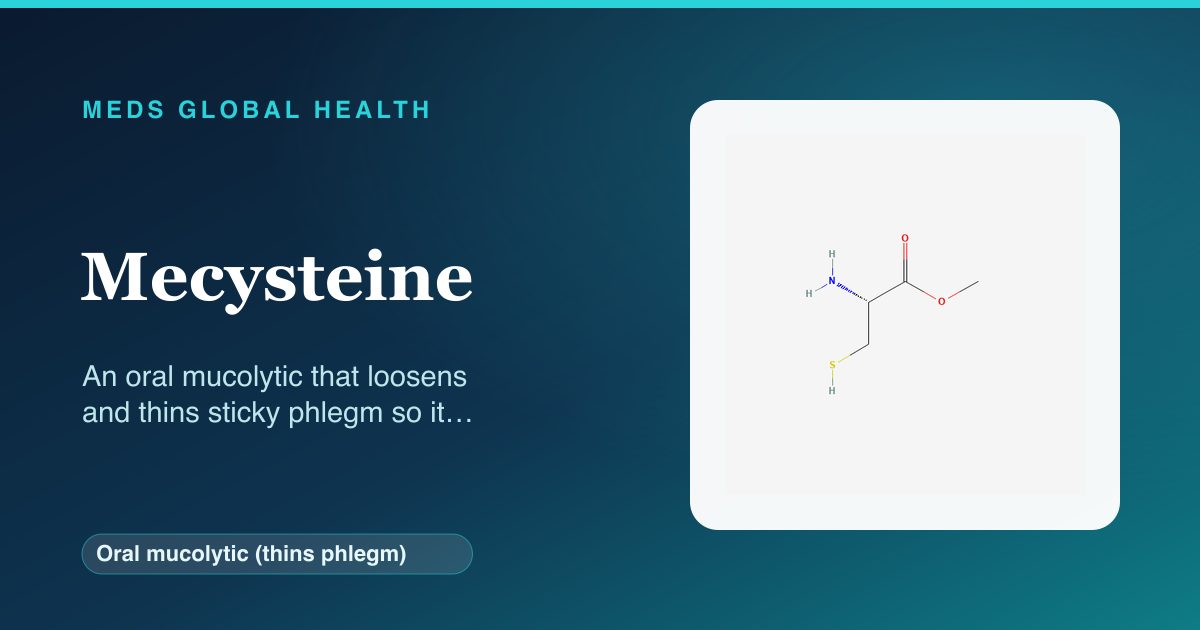
An oral mucolytic that loosens and thins sticky phlegm so it is easier to cough up.
What is Mecysteine?
Mecysteine is a mucolytic medicine taken by mouth to thin sticky phlegm in long-term chest conditions, making it easier to cough up. It works by breaking down the chemical bonds that make mucus thick. It is generally well tolerated, with occasional stomach upset being the main issue. The tablets are coated and should be swallowed whole rather than crushed or chewed. It is usually taken for a trial period to see whether it helps before deciding to continue.
Education and reference only. This is a plain-language guide to Mecysteine — it deliberately contains no doses. Doses depend on the person, the brand and the reason for treatment, and belong with your prescriber. Always check the BNF, the product labelling (SmPC) and follow medical advice.
What it is
Mecysteine is a mucolytic, a type of medicine that thins and loosens phlegm (mucus). It is used in long-term chest conditions where thick, sticky phlegm is hard to clear, helping it become looser so it can be coughed up more easily. It is taken by mouth as a coated tablet. Mucolytics like this are usually tried for a period to see whether they make a worthwhile difference to symptoms, and continued only if they help. It is a generally well-tolerated, long-established medicine.
How it works
Phlegm becomes thick and sticky partly because of chemical bonds that hold its components together. Mecysteine works by breaking these bonds, which makes the mucus thinner and less sticky. As a result, phlegm is easier to move and cough up, which can ease a chesty, congested feeling in people with long-term chest conditions. Because the benefit varies from person to person, it is usually taken for a trial period so that you and your prescriber can judge whether it is actually helping before continuing it longer term.
Company & origin
A mucolytic medicine used in the UK to thin sticky phlegm in long-term chest conditions.
Practical use
How to take Mecysteine
General, dose-free guidance — always follow your prescriber's and the leaflet's specific instructions.
- Swallow the coated tablets whole with water; do not crush or chew them.
- Take it regularly as prescribed to give it a fair chance to work.
- Give it a trial of several weeks and judge whether your phlegm is genuinely easier to clear.
- Continue it only if it is helping, and review this with your prescriber.
- Keep using your other prescribed chest treatments, as this is used alongside them.
Weighing it up
Advantages & disadvantages of Mecysteine
Advantages
- Thins sticky phlegm so it is easier to cough up in long-term chest conditions.
- Generally well tolerated, with few common side effects.
- Taken by mouth as a tablet.
Disadvantages
- Can occasionally cause stomach upset.
- The benefit varies from person to person and may be modest.
- Eases mucus rather than treating the underlying chest condition.
Practical use
Good to know
The most useful thing to know is that the tablets are coated and should be swallowed whole, not crushed or chewed, because the coating helps them work properly and reach the right place. Mecysteine is generally well tolerated; the main thing to watch for is occasional stomach upset, which is usually mild. It is normally given a fair trial of several weeks so you can judge whether your phlegm is genuinely easier to clear, and it makes sense to continue only if you notice a real benefit. It is a treatment to help clear mucus rather than a cure for the underlying condition, so it is used alongside your other chest treatments rather than instead of them.
Who should not take it / use with caution
- People who have had a serious allergic reaction to mecysteine should not take it.
- It is used with care in people with a history of stomach ulcers, as it may irritate the stomach.
- If it does not seem to help after a fair trial, it is usually stopped rather than continued.
Monitoring
- Reviewing whether phlegm is genuinely easier to clear after a fair trial.
- Deciding whether to continue based on real benefit.
- Watching for stomach upset or any allergic-type reaction.
Side effects
- Stomach upset, such as nausea or indigestion, which is usually mild.
- Occasionally, a rash or other allergic-type reaction.
- Most people tolerate it well, with few problems.
Key interactions
- It has few well-established interactions with other medicines.
- It is used alongside, not instead of, your usual chest treatments.
- Tell your prescriber about all your medicines so any unusual effects can be considered.
Available as: Coated tablets taken by mouth.
Answers
Mecysteine: frequently asked questions
What is mecysteine used for?
It is a mucolytic taken by mouth to thin sticky phlegm in long-term chest conditions, making it easier to cough up.
How do I take the tablets?
Swallow the coated tablets whole with water; do not crush or chew them, as the coating helps them work properly.
How long before I know if it helps?
It is usually given a trial of several weeks so you can judge whether your phlegm is genuinely easier to clear before deciding to continue.
Is it well tolerated?
Yes, it is generally well tolerated; the main thing to watch for is occasional, usually mild, stomach upset.
Does it cure my chest condition?
No. It helps thin and clear mucus but does not treat the underlying condition, so it is used alongside your other treatments.
The wider class
About Oral mucolytic (thins phlegm)
Mecysteine belongs to the oral mucolytic (thins phlegm) class. For how the class as a whole works, its shared safety principles and monitoring, see the full guide.
Browse by body system
Authoritative sources
- BNF
- NICE CKS
Building a medicines information resource?
We create evidence-led, dose-free drug and formulary references for teams.