A thiazide-like diuretic
Metolazone
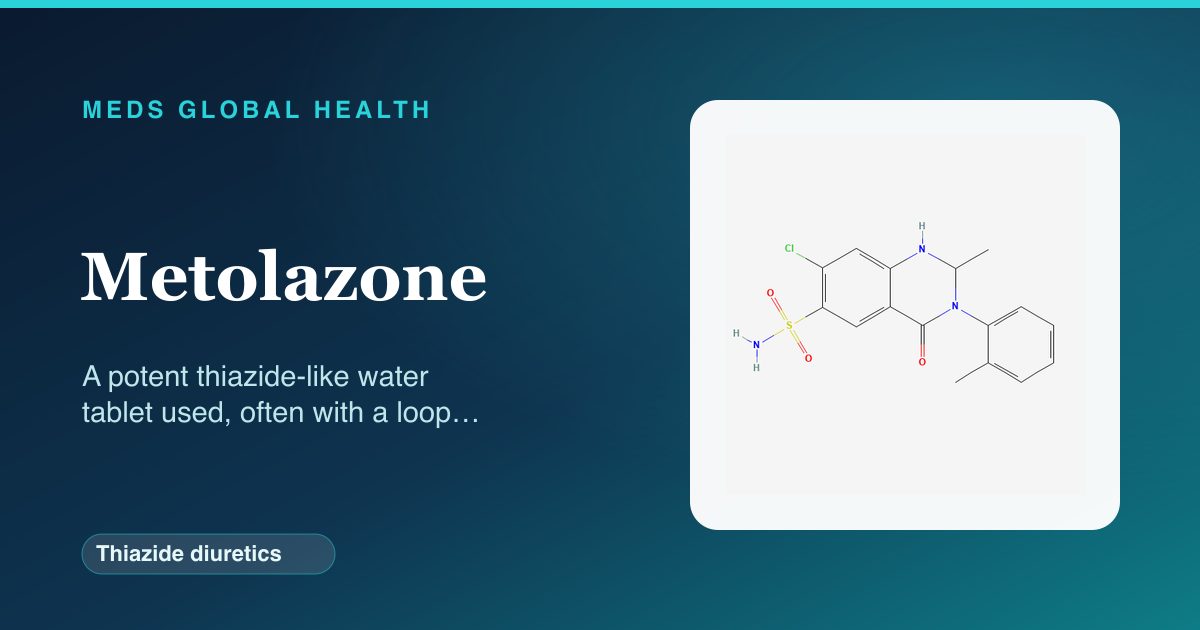
A potent thiazide-like water tablet used, often with a loop diuretic, to clear stubborn fluid.
What is Metolazone?
Metolazone is a thiazide-like diuretic (water tablet) that helps the kidneys remove excess salt and water. It is used mainly for fluid overload in heart failure and is especially powerful when combined with a loop diuretic such as furosemide. Because it causes strong fluid and salt loss, potassium, sodium and kidney function need close monitoring.
Education and reference only. This is a plain-language guide to Metolazone — it deliberately contains no doses. Doses depend on the person, the brand and the reason for treatment, and belong with your prescriber. Always check the BNF, the product labelling (SmPC) and follow medical advice.
What it is
Metolazone is a thiazide-like diuretic, or water tablet. In the UK it is used mainly to treat fluid retention (oedema), particularly in heart failure when other diuretics alone are not enough. It is well known for its strong effect when added to a loop diuretic such as furosemide, a combination used carefully to shift stubborn fluid.
How it works
Metolazone acts on the kidneys to reduce how much salt (sodium) and water they reabsorb, so more is passed out as urine. This lowers the amount of fluid in the body and eases swelling and breathlessness. When given alongside a loop diuretic, the two work at different points in the kidney and produce a much greater combined effect, which is powerful but needs careful supervision.
Company & origin
Originated / developed by: Available as a generic medicine; supply in the UK has at times been through special arrangements..
Introduced in the 1970s as a thiazide-like diuretic and used in the UK mainly for resistant fluid overload.
What it treats
Conditions Metolazone is used for
Practical use
How to take Metolazone
General, dose-free guidance — always follow your prescriber's and the leaflet's specific instructions.
- Take it in the morning so the extra trips to the toilet do not disturb your sleep.
- It is often used short-term or intermittently alongside a loop diuretic, exactly as directed.
- Have your blood tests done as arranged to check kidney function and salts.
- Report severe thirst, dizziness, cramps, confusion or very little urine promptly.
- If a dose is missed, take it when you remember unless it is late in the day, then skip it; never double up.
- Do not start or stop it without advice, as it strongly affects your fluid balance.
Weighing it up
Advantages & disadvantages of Metolazone
Advantages
- Very effective at clearing fluid, especially when added to a loop diuretic in heart failure.
- Can relieve breathlessness and swelling that other diuretics alone do not control.
- Taken by mouth and used flexibly, often just on certain days.
Disadvantages
- Powerful fluid and salt loss can cause dehydration, low potassium and low sodium.
- Needs close blood-test monitoring of kidneys and electrolytes, so is less convenient.
- Can worsen gout, raise blood sugar and lower blood pressure too much.
Practical use
Good to know
Metolazone is a strong diuretic, so it can cause large losses of fluid and salts. Your potassium, sodium and kidney function are checked closely, especially when it is used with a loop diuretic. Watch for dizziness, severe thirst, cramps or feeling very weak, which can signal dehydration or low salts. It can also raise blood sugar and trigger gout.
Who should not take it / use with caution
- People who are dehydrated or have very low sodium or potassium levels.
- People with severe kidney or liver impairment, without specialist supervision.
- People with untreated gout flares or poorly controlled diabetes should use it with caution.
Monitoring
- Potassium, sodium and kidney function with regular blood tests.
- Body weight, fluid balance and blood pressure.
- Blood sugar and signs of gout where relevant.
- When combined with a loop diuretic, blood tests (kidney function and salts) are often needed within days of starting, along with daily weights, because the combination can act powerfully and quickly.
Side effects
- Low potassium, low sodium and other salt disturbances.
- Dehydration, dizziness and low blood pressure.
- Gout flares and raised blood sugar.
- Muscle cramps, tiredness and weakness.
Key interactions
- Loop diuretics, which greatly increase the fluid and salt-lowering effect.
- Other medicines that lower potassium, and digoxin, where low potassium is risky.
- Lithium, NSAIDs and other blood-pressure-lowering medicines.
Available as: Available as tablets.
Answers
Metolazone: frequently asked questions
Why is metolazone given with furosemide?
The two diuretics work at different points in the kidney, so together they remove much more fluid than either alone. This is useful in stubborn fluid overload but needs careful monitoring.
Why do I need frequent blood tests?
Because it strongly removes salt and water, it can lower potassium and sodium and affect the kidneys. Blood tests catch these problems early so the treatment can be adjusted.
When should I take it?
Usually in the morning, so the increase in urine does not keep you awake at night. Follow the exact schedule your prescriber gives you.
Can it affect my gout or diabetes?
Yes. Like other thiazide-like diuretics it can trigger gout and raise blood sugar, so tell your prescriber if you have either condition.
How will I know if I am losing too much fluid?
Signs include severe thirst, dizziness, muscle cramps, confusion, very dark urine or passing little urine. Report these promptly so your treatment can be reviewed.
The wider class
About Thiazide diuretics
Metolazone belongs to the thiazide diuretics class. For how the class as a whole works, its shared safety principles and monitoring, see the full guide.
Browse by body system
Authoritative sources
- BNF
- NICE CKS
Building a medicines information resource?
We create evidence-led, dose-free drug and formulary references for teams.