A thiazide-like diuretic
Xipamide
A thiazide-like water tablet that helps the body lose salt and water to lower blood pressure.
What is Xipamide?
Xipamide is a thiazide-like diuretic, or water tablet, used to lower high blood pressure and to treat fluid retention. It works by helping the kidneys remove salt and water, which reduces the volume in the blood vessels. It is taken in the morning, and blood tests check the body's salts.
Education and reference only. This is a plain-language guide to Xipamide — it deliberately contains no doses. Doses depend on the person, the brand and the reason for treatment, and belong with your prescriber. Always check the BNF, the product labelling (SmPC) and follow medical advice.
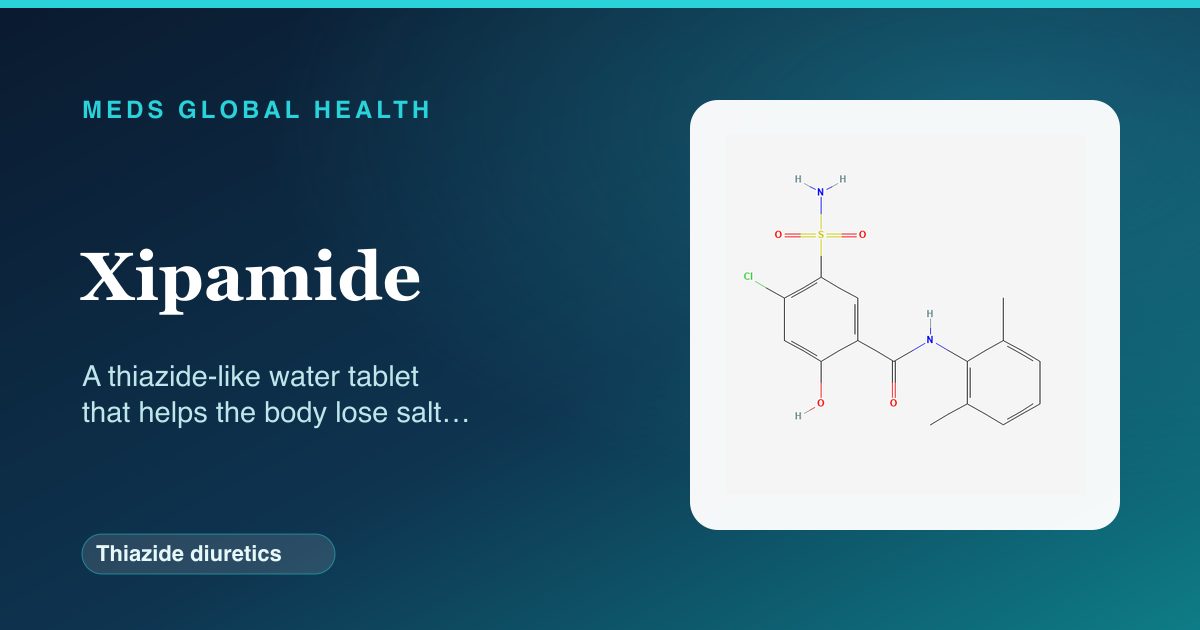
What it is
Xipamide is a thiazide-like diuretic (a water tablet) related to medicines such as indapamide and chlortalidone. In the UK it is used to treat high blood pressure and to relieve fluid build-up (oedema). Thiazide-like diuretics are a well-established treatment for blood pressure and are often combined with other blood-pressure medicines.
How it works
Xipamide acts on the kidneys to reduce how much salt (sodium) and water they reabsorb, so more is passed out in the urine. With less fluid in the circulation, the volume the heart has to pump falls, and over time the blood vessels also relax a little. Both effects help to lower blood pressure.
Company & origin
Originated / developed by: Originally developed by Beiersdorf; available in the UK as a branded and generic medicine..
Introduced in the 1970s as a thiazide-like (sulfonamide) diuretic and used in the UK for high blood pressure and fluid retention.
What it treats
Conditions Xipamide is used for
Practical use
How to take Xipamide
General, dose-free guidance — always follow your prescriber's and the leaflet's specific instructions.
- Take it in the morning so the extra need to pass urine does not disturb your sleep.
- Swallow the tablet with a drink of water; it can be taken with or without food.
- Keep up your usual fluids unless told otherwise, and get advice if you become unwell with vomiting or diarrhoea.
- Use sun protection, as your skin may become more sensitive to sunlight.
- If a dose is missed, take it in the morning when you remember, but skip it if it is already late in the day; never double up.
- Do not stop without advice, and report muscle cramps, severe tiredness or a very dry mouth.
Weighing it up
Advantages & disadvantages of Xipamide
Advantages
- Effectively lowers blood pressure and reduces fluid retention.
- Taken once a day, usually in the morning, and available as a low-cost medicine.
- Works well in combination with other blood-pressure medicines.
Disadvantages
- Can lower potassium and sodium, so blood tests are needed.
- May raise uric acid and trigger gout, and can nudge up blood sugar.
- Increases sensitivity to sunlight and can cause more frequent urination.
Practical use
Good to know
Xipamide is best taken in the morning so the extra trips to the toilet do not disturb your sleep. Because it changes the body's salts, blood tests check your sodium and potassium, and a low potassium can occur. It can raise uric acid and trigger gout, and may nudge up blood sugar. It can also make the skin more sensitive to sunlight, so sun protection is sensible.
Who should not take it / use with caution
- People with severe kidney or liver problems, or very low blood salts, without specialist advice.
- People with gout, who may find attacks become more frequent.
- Women who are pregnant, unless specifically advised by a specialist.
Monitoring
- Blood pressure
- Kidney function and blood salts, especially potassium and sodium
- Uric acid or blood sugar if relevant
Side effects
- Passing more urine, especially early on, and sometimes dizziness or cramps.
- Low potassium or sodium on blood tests, which can cause tiredness, weakness or cramps.
- Raised uric acid that may trigger gout, a small rise in blood sugar, and increased sensitivity to sunlight.
Key interactions
- Other medicines that lower potassium, and digoxin, whose effects are altered by a low potassium.
- Anti-inflammatory painkillers (NSAIDs) can reduce its effect and strain the kidneys.
- Lithium levels can rise, and care is needed alongside other blood-pressure medicines.
Available as: Tablets.
Answers
Xipamide: frequently asked questions
When should I take xipamide?
Take it in the morning. As a water tablet it makes you pass more urine, and a morning dose means this happens during the day rather than disturbing your sleep.
Why do I need blood tests on xipamide?
Water tablets can lower the body's salts, particularly potassium and sodium, and affect kidney function. Blood tests check these around starting and from time to time afterwards.
Can xipamide cause gout?
It can raise the level of uric acid in the blood, which may trigger a gout attack in people who are prone to it. Tell your prescriber if you have gout or get a painful, swollen joint.
Does xipamide make me sensitive to the sun?
It can make your skin more sensitive to sunlight. Using sun protection and avoiding strong midday sun is sensible while you take it.
Will I need the toilet more often?
Yes, especially when you first start, because it is a water tablet. This usually settles, and taking it in the morning helps avoid being woken at night.
The wider class
About Thiazide diuretics
Xipamide belongs to the thiazide diuretics class. For how the class as a whole works, its shared safety principles and monitoring, see the full guide.
Browse by body system
Authoritative sources
- BNF
- NICE CKS
Building a medicines information resource?
We create evidence-led, dose-free drug and formulary references for teams.