A tricyclic antidepressant — widely used at low intensity for pain and prevention
Amitriptyline
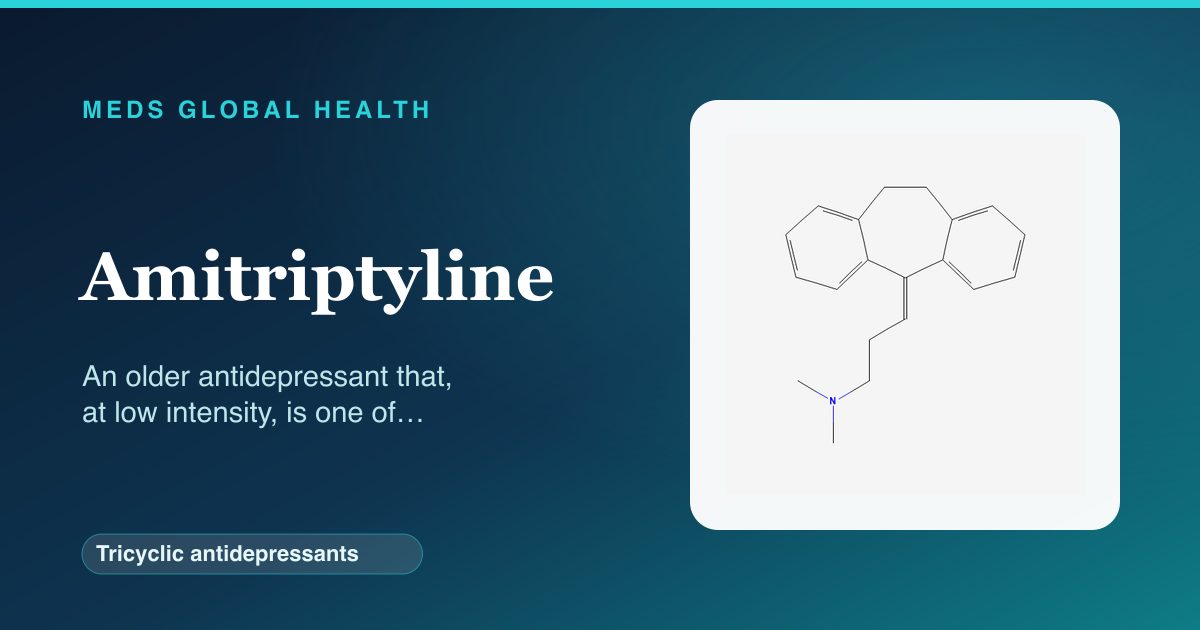
An older antidepressant that, at low intensity, is one of the most useful treatments for nerve pain, migraine prevention, irritable bowel symptoms and disturbed sleep — used here for its pain and prevention effects, not only for depression.
What is Amitriptyline?
Amitriptyline is a long-established tricyclic antidepressant, but in modern UK practice it is most often used at low intensity for nerve pain, migraine prevention or to help with sleep. At higher levels it can still be used to treat depression.
Education and reference only. This is a plain-language guide to Amitriptyline — it deliberately contains no doses. Doses depend on the person, the brand and the reason for treatment, and belong with your prescriber. Always check the BNF, the product labelling (SmPC) and follow medical advice.
What it is
Amitriptyline is a long-established tricyclic antidepressant, but in modern UK practice it is most often used at low intensity for reasons other than depression. At these lower levels it is a mainstay treatment for nerve (neuropathic) pain, for preventing migraine and tension-type headaches, for the cramping and pain of irritable bowel syndrome, and for helping sleep when pain disturbs it. It is important to understand that being prescribed amitriptyline for pain or migraine does not mean your problem is "all in the mind" — it is used at low intensity for its direct effects on pain pathways and prevention, quite separately from its antidepressant role.
How it works
Amitriptyline increases the levels of the natural chemicals serotonin and noradrenaline in the nervous system. These chemicals are part of the body's own pain-damping pathways that run down the spinal cord, so boosting them turns down the volume on pain signals — which is why it helps nerve pain and headaches even when mood is fine. It also blocks several other receptors, which produces calming and sleep-promoting effects (useful at night) but also the dry mouth, constipation and drowsiness that are its typical nuisances. Its pain and prevention benefits often appear at far lower intensity than is needed to treat depression.
Company & origin
Originated / developed by: Merck & Co..
Amitriptyline is a tricyclic antidepressant discovered by scientists at Merck & Co. in the United States in the late 1950s. It received US FDA approval in 1961 and was originally marketed as Elavil.
What it treats
Conditions Amitriptyline is used for
Practical use
How to take Amitriptyline
General, dose-free guidance — always follow your prescriber's and the leaflet's specific instructions.
- Often taken in the evening or before bed, as it can cause drowsiness that may also help with sleep.
- It usually takes a few weeks to build up its full effect for pain or mood, so keep taking it even if you notice little at first.
- Do not stop it suddenly after regular use; reduce gradually with advice to avoid withdrawal effects.
- Be aware of next-morning drowsiness and avoid driving if you feel affected, and limit alcohol.
- If you miss a dose, skip it and take the next at the usual time rather than doubling up.
Weighing it up
Advantages & disadvantages of Amitriptyline
Advantages
- Useful for nerve pain and migraine prevention, not just depression.
- Can improve sleep when this is part of the problem.
- Long-established with extensive clinical experience.
- Taken once a day, usually at night.
Disadvantages
- Commonly causes drowsiness, dry mouth, constipation and blurred vision.
- Can cause dizziness on standing and is more troublesome in older people.
- Must be tapered rather than stopped suddenly.
- Can be dangerous in overdose and needs caution with certain heart conditions.
Practical use
Good to know
For pain, migraine prevention and IBS, amitriptyline is started low and built up slowly, and it is usually taken in the evening because it can cause drowsiness — taken a couple of hours before bed, that drowsiness often helps sleep and has worn off by morning. The benefit builds over weeks rather than days, so patience is needed and it should not be judged too early. Anticholinergic effects such as dry mouth and constipation are common but often settle. It must never be stopped suddenly after regular use, and it is dangerous in overdose, so it is kept safely away from anyone at risk.
Who should not take it / use with caution
- People who have recently had a heart attack, or who have certain heart rhythm problems or significant heart disease — it is used with particular caution where the heart may be vulnerable.
- People with severe liver disease, untreated narrow-angle glaucoma, or an enlarged prostate causing urinary difficulty (its anticholinergic effects can worsen these).
- Used with caution in older people (more sensitive to its sedating and anticholinergic effects and to falls) and in anyone at risk of overdose, as it is dangerous in excess.
Monitoring
- Response and tolerability over the first weeks
- Heart health considered before starting where relevant
- Mood and any thoughts of self-harm where it is used for mood, especially in younger adults
Side effects
- Drowsiness, dry mouth and constipation — the most common effects, often easing over time.
- Dizziness or light-headedness on standing, blurred vision, weight gain and difficulty passing urine.
- Less commonly, a fast or irregular heartbeat, confusion (especially in older people), and effects on heart rhythm that make it dangerous in overdose.
Key interactions
- It adds to the drowsiness of alcohol, opioids, sedatives and antihistamines, and to the anticholinergic load of other "drying" medicines.
- It must not be combined with MAOI antidepressants, and care is needed with other medicines that raise serotonin or that can affect heart rhythm (including some antibiotics and antipsychotics).
- Certain medicines change its levels in the body, and combining it with other antidepressants needs medical oversight.
Available as: Tablets and an oral solution (liquid) for those who prefer or need it.
Answers
Amitriptyline: frequently asked questions
Why have I been given an antidepressant for pain or migraine?
Amitriptyline is an old antidepressant, but at low intensity it is one of the best-established treatments for nerve pain, migraine prevention and IBS. It works directly on the body's pain-damping pathways, so it helps these problems regardless of mood. Being prescribed it does not mean your pain is imagined — it is being used at low intensity for its pain and prevention effects.
Why do I take it in the evening?
Amitriptyline often causes drowsiness, so taking it a couple of hours before bed turns a side effect into an advantage — it can help you fall asleep, and the sleepiness has usually faded by morning. If you still feel groggy when you wake, your prescriber may suggest taking it a little earlier in the evening.
How long until it helps my pain or headaches?
Unlike a quick painkiller, amitriptyline builds its effect gradually, usually over several weeks, and it is often started low and increased slowly. It is worth giving it a fair trial before deciding whether it works. If you notice no benefit after an adequate period, your prescriber can review the plan rather than you simply stopping.
Can I stop amitriptyline whenever I want?
No — after taking it regularly you should not stop suddenly, as this can cause withdrawal-type symptoms such as nausea, headache and feeling unwell. If you want to come off it, your prescriber will usually reduce it gradually. Always discuss stopping rather than just halting it.
Is amitriptyline dangerous in overdose?
Yes — tricyclic antidepressants like amitriptyline are dangerous if taken in excess, mainly because of effects on the heart. This is why it is prescribed thoughtfully, kept safely, and avoided where overdose risk is a concern. If you ever take more than intended, or have thoughts of harming yourself, seek urgent medical help straight away.
The wider class
About Tricyclic antidepressants
Amitriptyline belongs to the tricyclic antidepressants class. For how the class as a whole works, its shared safety principles and monitoring, see the full guide.
Browse by body system
Authoritative sources
- BNF: Amitriptyline hydrochloride.
- electronic Medicines Compendium (SmPC): Amitriptyline.
- NICE CKS: Amitriptyline for pain and migraine.
- NICE NG193: Chronic pain - amitriptyline.
Building a medicines information resource?
We create evidence-led, dose-free drug and formulary references for teams.