A tricyclic antidepressant
Dosulepin
An older tricyclic antidepressant that is effective but particularly dangerous in overdose, so it is now usually only continued in people already stable on it.
What is Dosulepin?
Dosulepin is an older tricyclic antidepressant used for depression. It can be effective, but it is particularly dangerous and toxic to the heart in overdose, so it is now usually only continued in people who are already stable on it rather than started in new patients. It can cause anticholinergic effects such as dry mouth and constipation, and it should not be stopped suddenly.
Education and reference only. This is a plain-language guide to Dosulepin — it deliberately contains no doses. Doses depend on the person, the brand and the reason for treatment, and belong with your prescriber. Always check the BNF, the product labelling (SmPC) and follow medical advice.
What it is
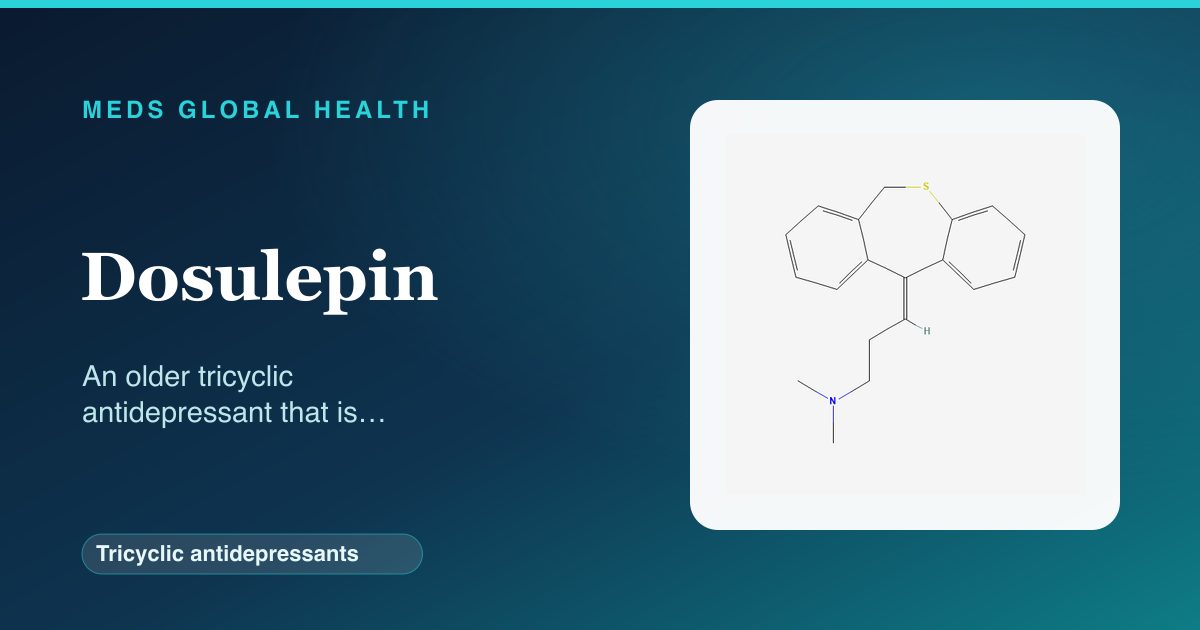
Dosulepin (also known as dothiepin) is an older tricyclic antidepressant that has been used in the UK to treat depression. While it can be effective, it is recognised as particularly dangerous and toxic to the heart in overdose, which is why current guidance is to avoid starting it in new patients and generally only to continue it in people who are already taking it and doing well. Newer antidepressants are usually preferred when starting treatment because they are safer if too much is taken.
How it works
Dosulepin works by increasing the levels of certain chemical messengers in the brain — mainly serotonin and noradrenaline — which are involved in mood. Over a few weeks this helps lift mood and ease the symptoms of depression. Like other tricyclics it also blocks several other receptors, which is why it can cause anticholinergic effects such as dry mouth, constipation and blurred vision, as well as effects on the heart's rhythm that make it dangerous in overdose.
Company & origin
Originated / developed by: Also known internationally as dothiepin..
Dosulepin (also called dothiepin) is an older tricyclic antidepressant that has been used in the UK for many years; because of its danger in overdose it is now usually only continued in people already stable on it rather than started in new patients.
What it treats
Conditions Dosulepin is used for
Practical use
How to take Dosulepin
General, dose-free guidance — always follow your prescriber's and the leaflet's specific instructions.
- Take it regularly as prescribed; it usually takes a few weeks before you feel the full benefit, so keep going even if it seems slow.
- Expect possible drowsiness, dry mouth, constipation and blurred vision, especially at first.
- Never take more than prescribed — it is particularly dangerous in overdose, and keep it safely away from others.
- Avoid alcohol, which adds to the drowsiness.
- Do not stop it suddenly; speak to your prescriber, who will reduce it gradually to avoid withdrawal symptoms.
Weighing it up
Advantages & disadvantages of Dosulepin
Advantages
- It can be an effective antidepressant for people who are already stable and tolerating it well.
- Its sedating nature can help where sleep is disturbed by depression.
- It is a long-established medicine with familiar effects for those who have used it for years.
Disadvantages
- It is particularly dangerous and toxic to the heart in overdose, so it is generally not started in new patients.
- Anticholinergic effects such as dry mouth, constipation and blurred vision are common.
- It should not be stopped suddenly and needs caution in people with heart disease.
Practical use
Good to know
Dosulepin is taken regularly, and it usually takes a few weeks before the full benefit is felt, so it is important not to give up too early. It commonly causes anticholinergic effects such as dry mouth, constipation, blurred vision and drowsiness. Because it is dangerous in overdose, the amount supplied may be limited, and it is important not to take more than prescribed. It should not be stopped suddenly, as this can cause withdrawal-type symptoms; any change is made gradually. It is used with caution in people with heart disease.
Who should not take it / use with caution
- People who have recently had a heart attack, or who have certain heart-rhythm problems or significant heart disease.
- People at risk of overdose, in whom a safer antidepressant is generally preferred.
- People with certain types of glaucoma, an enlarged prostate causing urinary difficulty, or severe liver problems, unless carefully assessed.
Monitoring
- Review of mood, benefit and side effects, particularly in the first weeks.
- Caution and assessment in people with heart disease, including consideration of heart-rhythm effects.
- Watching for thoughts of self-harm, especially early in treatment, and gradual reduction rather than abrupt stopping.
Side effects
- Dry mouth, constipation, blurred vision and difficulty passing urine (anticholinergic effects).
- Drowsiness, dizziness on standing, and weight gain.
- Effects on the heart's rhythm, which are the main reason it is dangerous in overdose.
- Withdrawal-type symptoms if it is stopped suddenly after regular use.
Key interactions
- Other sedating medicines and alcohol add to drowsiness.
- Other medicines that affect the heart's rhythm can increase the risk when combined.
- It must not be taken with, or close to, an MAOI antidepressant; a gap of about two weeks is needed between stopping an MAOI and starting dosulepin, and vice versa. Tell your prescriber about all your medicines.
Available as: Tablets and capsules.
Answers
Dosulepin: frequently asked questions
Why is dosulepin not usually started anymore?
Dosulepin is particularly dangerous and toxic to the heart if too much is taken in overdose. Because newer antidepressants are safer in this respect, guidance is generally to avoid starting it and only to continue it in people already stable on it.
How long does dosulepin take to work?
It usually takes a few weeks before the full benefit on mood is felt, although some effects such as drowsiness or dry mouth appear sooner. It is important not to stop early just because it seems slow.
Can I stop dosulepin suddenly?
No — stopping suddenly can cause withdrawal-type symptoms. If you want to stop, speak to your prescriber, who will reduce it gradually over time.
Why do I get a dry mouth and constipation on dosulepin?
These are anticholinergic effects, common with tricyclic antidepressants. Sipping water, good oral care and dietary fibre can help; tell your prescriber if they are troublesome.
Is dosulepin safe if I have heart problems?
It is used with caution in people with heart disease because of its effects on the heart's rhythm. Your prescriber will weigh this up carefully, and a different antidepressant may be safer.
The wider class
About Tricyclic antidepressants
Dosulepin belongs to the tricyclic antidepressants class. For how the class as a whole works, its shared safety principles and monitoring, see the full guide.
Browse by body system
Authoritative sources
- BNF
- NICE CKS
Building a medicines information resource?
We create evidence-led, dose-free drug and formulary references for teams.