Penicillins
Ampicillin
A broad-spectrum penicillin antibiotic used to treat a range of bacterial infections.
What is Ampicillin?
Ampicillin is a broad-spectrum penicillin antibiotic used to treat various bacterial infections, such as some chest, ear and urinary infections. It works by killing the bacteria that cause the infection. As a penicillin, it is not suitable for people with a penicillin allergy, and the full course should always be completed.
Education and reference only. This is a plain-language guide to Ampicillin — it deliberately contains no doses. Doses depend on the person, the brand and the reason for treatment, and belong with your prescriber. Always check the BNF, the product labelling (SmPC) and follow medical advice.
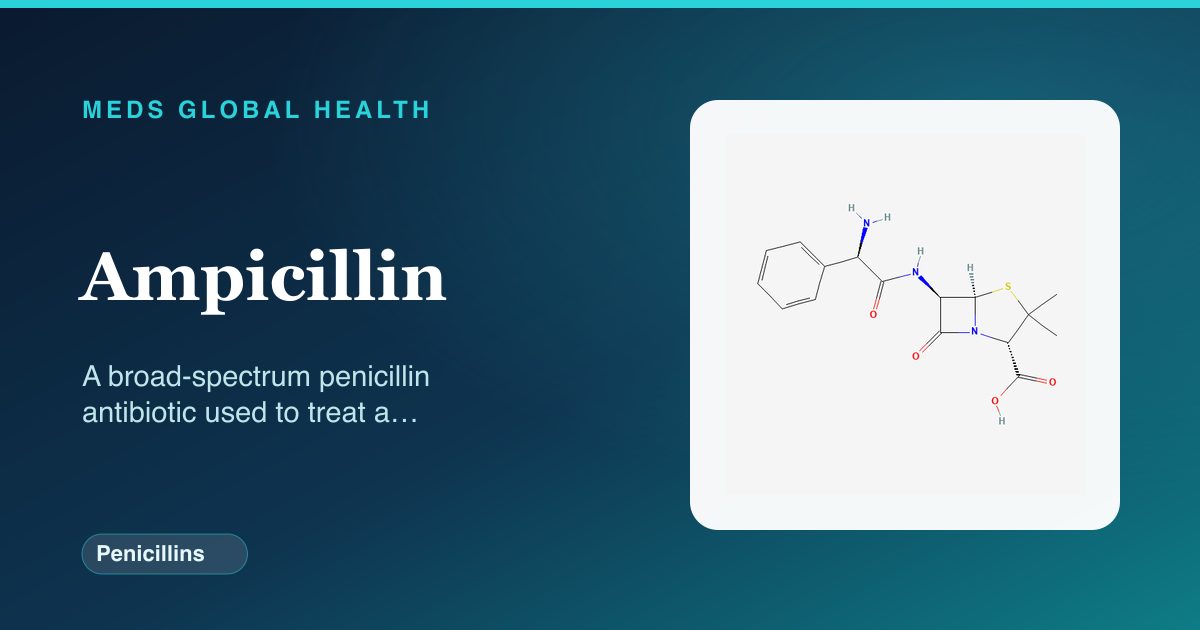
What it is
Ampicillin is a penicillin-type antibiotic that works against a broader range of bacteria than the earlier penicillins. It is used to treat a number of bacterial infections, and is often given in hospital. A closely related medicine, amoxicillin, is more commonly used in general practice because it is better absorbed when taken by mouth.
How it works
Ampicillin works by interfering with the way bacteria build their cell walls. Bacteria need a strong cell wall to survive; by stopping them from building it properly, ampicillin causes the bacteria to break down and die. This clears the infection. It is described as 'broad-spectrum' because it is active against a fairly wide range of bacteria.
Company & origin
Ampicillin is a broad-spectrum penicillin antibiotic introduced in the early 1960s. It was an important advance because it worked against a wider range of bacteria than the original penicillins.
Practical use
How to take Ampicillin
General, dose-free guidance — always follow your prescriber's and the leaflet's specific instructions.
- Take it on an empty stomach, usually before food, as food reduces absorption.
- Space the doses evenly through the day as directed.
- Take it with a glass of water.
- Complete the whole course, even if you start to feel better.
- If you miss a dose, take it when you remember unless it is nearly time for the next one — do not double up.
Weighing it up
Advantages & disadvantages of Ampicillin
Advantages
- It is active against a fairly broad range of bacteria.
- It is a long-established, well-understood antibiotic.
- It can be given by injection in hospital when someone cannot take medicines by mouth.
Disadvantages
- It is less well absorbed by mouth than amoxicillin, so amoxicillin is often preferred in general practice.
- It cannot be used by anyone with a penicillin allergy.
- It commonly causes a rash if given to someone with glandular fever, so it is avoided in that situation.
Practical use
Good to know
Ampicillin is best taken on an empty stomach, usually before food, as food reduces how well it is absorbed. As it is a penicillin, it must not be taken by anyone with a penicillin allergy. Always finish the full course, even if you feel better, to clear the infection fully. One particular point: if ampicillin is given to someone who actually has glandular fever, it commonly causes a widespread rash, so it is generally avoided when glandular fever is suspected.
Who should not take it / use with caution
- Anyone who is allergic to penicillin or other beta-lactam antibiotics.
- People with glandular fever (infectious mononucleosis), because of the risk of a widespread rash.
- People who have had a severe reaction to a cephalosporin antibiotic should tell their prescriber.
Monitoring
- No routine blood tests are usually needed for a short course.
- Your symptoms should improve over a few days — seek advice if they do not.
Side effects
- Feeling sick, stomach upset or diarrhoea.
- Thrush (a fungal infection), as with other antibiotics.
- Rash; rarely, a serious allergic reaction.
Key interactions
- Some women's contraceptive advice may apply if you have sickness or diarrhoea — ask your pharmacist.
- Allopurinol (used for gout) can increase the chance of a rash.
- Methotrexate levels may be affected, so tell your prescriber if you take it.
Available as: capsules, liquid and injection
Answers
Ampicillin: frequently asked questions
What is ampicillin used for?
It is a broad-spectrum penicillin used to treat a range of bacterial infections, such as some chest, ear and urinary infections. It is often used in hospital.
Should I take ampicillin with food?
No. It is best taken on an empty stomach, usually before food, because food reduces how well it is absorbed.
How is it different from amoxicillin?
They are closely related penicillins. Amoxicillin is better absorbed when taken by mouth, so it is usually preferred in general practice, while ampicillin is more often used in hospital.
Why is it avoided in glandular fever?
If ampicillin is given to someone with glandular fever, it very commonly causes a widespread rash. For this reason it is avoided when glandular fever is suspected.
Can I take it if I am allergic to penicillin?
No. Ampicillin is a penicillin, so it must not be taken by anyone with a penicillin allergy. Tell your prescriber or pharmacist about any allergy.
The wider class
About Penicillins
Ampicillin belongs to the penicillins class. For how the class as a whole works, its shared safety principles and monitoring, see the full guide.
Browse by body system
Authoritative sources
- BNF
- NICE CKS
Building a medicines information resource?
We create evidence-led, dose-free drug and formulary references for teams.