An anti-pseudomonal penicillin antibiotic
Ticarcillin
An injectable penicillin antibiotic, often combined with clavulanate, used in hospital for serious infections.
What is Ticarcillin?
Ticarcillin is a penicillin antibiotic given by injection, usually in hospital, for serious infections. It is described as anti-pseudomonal because it works against Pseudomonas, a difficult bacterium, and it is often combined with clavulanate to widen its activity. Like all penicillins, it must not be used by people who are allergic to penicillin, as reactions can include life-threatening anaphylaxis. It contains a lot of sodium and can affect platelets and bleeding, so it is given and monitored by hospital teams.
Education and reference only. This is a plain-language guide to Ticarcillin — it deliberately contains no doses. Doses depend on the person, the brand and the reason for treatment, and belong with your prescriber. Always check the BNF, the product labelling (SmPC) and follow medical advice.
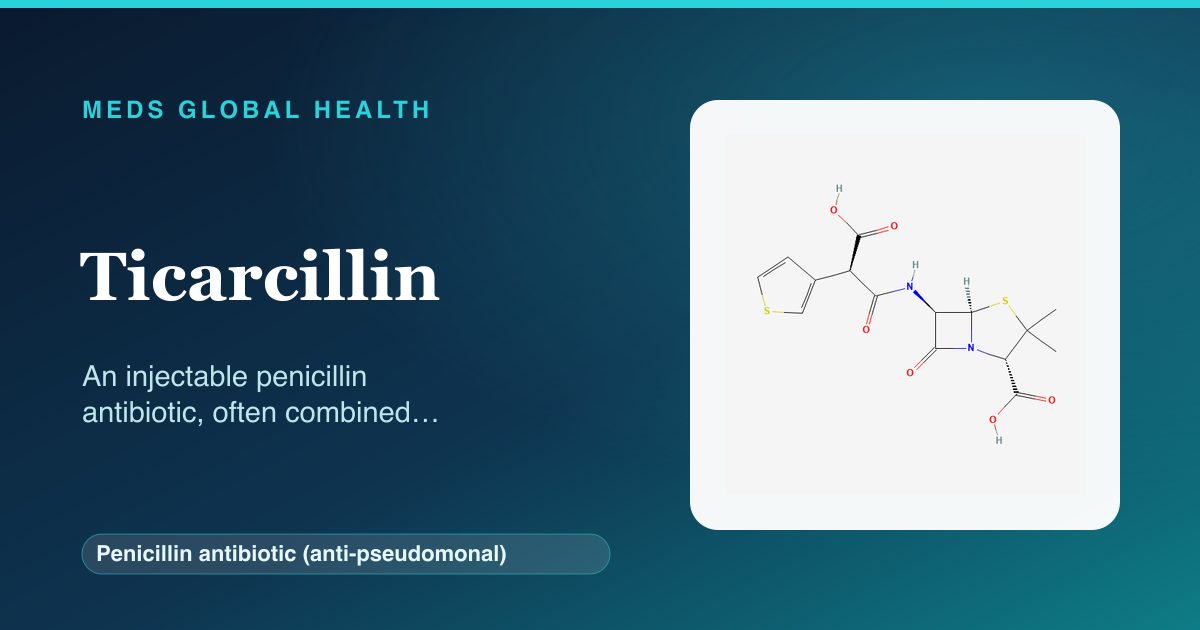
What it is
Ticarcillin is an antibiotic from the penicillin family, given by injection into a vein. It is used for serious infections, often in hospital, and is particularly valued for working against Pseudomonas, a bacterium that can be hard to treat. It is frequently combined with clavulanate, a partner medicine that protects it from being broken down by some bacteria and so widens the range of infections it can treat. It is a specialist, hospital-based treatment given under close supervision.
How it works
Ticarcillin, like other penicillins, kills bacteria by stopping them building their cell walls, which they need to survive; without a proper wall the bacteria break apart and die. It is designed to reach and act against tougher bacteria such as Pseudomonas. When combined with clavulanate, the partner medicine blocks an enzyme that some bacteria use to destroy penicillins, so ticarcillin keeps working against bacteria that would otherwise resist it. Because it is given into a vein, it reaches high levels quickly to tackle serious infections.
Company & origin
An injectable penicillin antibiotic, often combined with clavulanate, used in hospital for serious infections including those caused by Pseudomonas.
Practical use
How to take Ticarcillin
General, dose-free guidance — always follow your prescriber's and the leaflet's specific instructions.
- It is given as an injection into a vein by hospital staff, not taken at home.
- Tell the team straight away about any allergy to penicillin or other antibiotics before it is given.
- Report any rash, swelling, wheezing or difficulty breathing immediately, as these can signal a serious allergic reaction.
- Let the team know if you have heart or kidney problems, as the medicine contains a lot of sodium.
- Tell the team about any bruising or unusual bleeding, as it can affect blood clotting.
Weighing it up
Advantages & disadvantages of Ticarcillin
Advantages
- Works against serious infections, including those caused by the difficult bacterium Pseudomonas.
- Combining it with clavulanate widens the range of bacteria it can treat.
- Given into a vein, so it reaches high levels quickly for serious infections.
Disadvantages
- Must not be used by people allergic to penicillin, in whom reactions can be life-threatening.
- Contains a large amount of sodium, which can be a problem for people who must limit salt.
- Can affect platelets and bleeding, and is a hospital-only injectable treatment.
Practical use
Good to know
The most important safety point with ticarcillin is penicillin allergy: anyone who has had an allergic reaction to penicillin must not be given it, because reactions can be severe and include life-threatening anaphylaxis, so always tell the team about any antibiotic allergy. Two other practical points matter for a hospital medicine like this. It contains a large amount of sodium (salt), which can be a concern for people with heart or kidney problems or those who need to limit salt, so the team takes this into account. It can also affect platelets and blood clotting, which may increase the risk of bleeding, so this is monitored, especially in people who are unwell or having procedures. It is always given and supervised by hospital staff.
Who should not take it / use with caution
- People who are allergic to penicillins must not be given it, as reactions can include life-threatening anaphylaxis.
- It is used with care in people with heart or kidney problems because of its high sodium content.
- It is used with care in people at risk of bleeding, as it can affect platelets and clotting.
Monitoring
- Watching closely for any sign of an allergic reaction, especially when first given.
- Checking kidney function, salt balance and blood clotting during treatment.
- Reviewing the infection's response and adjusting treatment as needed.
Side effects
- Allergic reactions, ranging from rash to, rarely, life-threatening anaphylaxis.
- Diarrhoea or other stomach upset, and reactions where the injection is given.
- Effects on platelets and blood clotting, which may increase the risk of bleeding, and a high salt load.
Key interactions
- It can affect platelets, so care is needed with blood-thinning medicines that increase bleeding risk.
- Its high sodium content is taken into account alongside medicines for heart failure or high blood pressure.
- Tell the team about all your medicines, as several can interact with antibiotics.
Available as: A powder made up into a solution for injection into a vein, often combined with clavulanate.
Answers
Ticarcillin: frequently asked questions
What is ticarcillin used for?
It is a penicillin antibiotic given by injection in hospital for serious infections, and is particularly useful against the difficult bacterium Pseudomonas.
Why is it combined with clavulanate?
Clavulanate blocks an enzyme that some bacteria use to destroy penicillins, so combining it with ticarcillin widens the range of infections that can be treated.
Can I have it if I am allergic to penicillin?
No. Ticarcillin is a penicillin, so it must not be given to anyone allergic to penicillin, because reactions can be severe and include life-threatening anaphylaxis.
Why does its salt content matter?
Ticarcillin contains a large amount of sodium, which can be a concern for people with heart or kidney problems or those who need to limit salt, so the team takes this into account.
How is it given?
It is given as an injection into a vein by hospital staff, under close supervision, rather than being taken at home.
The wider class
About Penicillin antibiotic (anti-pseudomonal)
Ticarcillin belongs to the penicillin antibiotic (anti-pseudomonal) class. For how the class as a whole works, its shared safety principles and monitoring, see the full guide.
Browse by body system
Authoritative sources
- BNF
- NICE CKS
Building a medicines information resource?
We create evidence-led, dose-free drug and formulary references for teams.