A penicillinase-resistant penicillin antibiotic given by injection
Nafcillin
An injected penicillin antibiotic used mainly to treat infections caused by staph bacteria.
What is Nafcillin?
Nafcillin is a penicillin-type antibiotic given by injection, used mainly to treat infections caused by staphylococcus (staph) bacteria, including skin, bloodstream and bone infections. It is designed to resist an enzyme that many staph bacteria use to break down ordinary penicillin. Because it is a penicillin, the most important safety point is the risk of an allergic reaction, which can rarely be severe (anaphylaxis), so anyone with a penicillin allergy should not have it. It is given into a vein, and it can irritate the vein or, if it leaks out, damage the surrounding tissue. In the UK, flucloxacillin is the closely related medicine used for the same job.
Education and reference only. This is a plain-language guide to Nafcillin — it deliberately contains no doses. Doses depend on the person, the brand and the reason for treatment, and belong with your prescriber. Always check the BNF, the product labelling (SmPC) and follow medical advice.
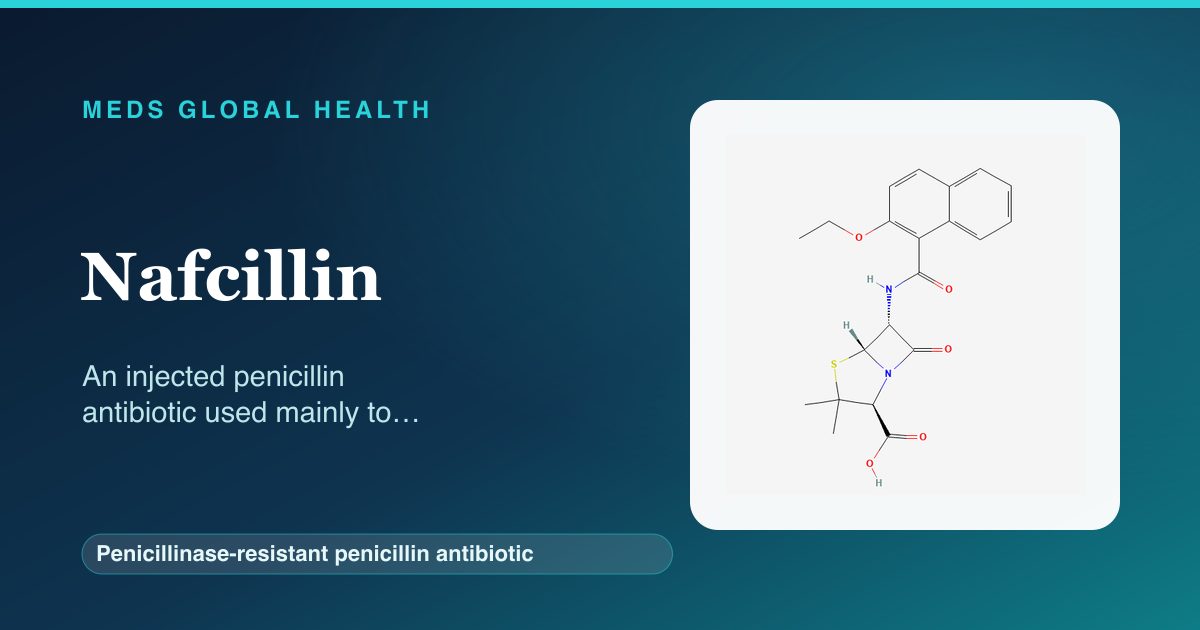
What it is
Nafcillin is an antibiotic that belongs to the penicillin family. It is a special type of penicillin that resists being broken down by an enzyme (penicillinase) that many staphylococcus bacteria produce, which is why it is useful against staph infections that ordinary penicillin would not clear. It is given by injection, usually into a vein, in hospital, for infections such as serious skin and soft-tissue infections, bloodstream infections and bone infections. It is largely a US medicine; in the UK, the very similar antibiotic flucloxacillin is used for the same kinds of infection.
How it works
Nafcillin kills bacteria by stopping them building their cell walls, so the bacteria break apart and die. Unlike ordinary penicillin, it is built to withstand the penicillinase enzyme that many staph bacteria use to destroy penicillins, which is why it stays effective against those bacteria. It is given by injection so that enough of the antibiotic reaches the blood and tissues to treat serious infections. Because it works against bacteria specifically, it does nothing against viral illnesses such as colds or flu.
Company & origin
A penicillin-type antibiotic given by injection for staph infections; broadly the US equivalent of flucloxacillin used in the UK.
Practical use
How to take Nafcillin
General, dose-free guidance — always follow your prescriber's and the leaflet's specific instructions.
- It is given by a nurse or doctor as an injection into a vein, usually in hospital, so you do not take it yourself.
- Tell the team straight away about any allergy to penicillin or other antibiotics before treatment starts.
- Report any pain, redness or swelling around the drip site, as the medicine can irritate the vein or surrounding tissue.
- Complete the full course of treatment even if you start to feel better, to clear the infection properly.
- Tell the team about all your other medicines so any interactions can be checked.
Weighing it up
Advantages & disadvantages of Nafcillin
Advantages
- Effective against staph bacteria that break down ordinary penicillin.
- A well-established option for serious skin, bloodstream and bone infections caused by staph.
- Targets bacteria specifically, with the closely related flucloxacillin used for the same purpose in the UK.
Disadvantages
- Can cause allergic reactions, which are occasionally severe, in people allergic to penicillin.
- Must be given by injection in hospital rather than taken by mouth at home.
- Can irritate the vein and cause tissue damage if it leaks out of the vein.
Practical use
Good to know
The most important thing to know about nafcillin is that it is a penicillin, so anyone who has had an allergic reaction to penicillin should not be given it; reactions can range from a rash to, rarely, a severe whole-body reaction (anaphylaxis) that is a medical emergency. Always tell the team about any previous reaction to penicillins or other antibiotics before treatment. Because it is given into a vein, it can irritate the vein, and if it leaks out of the vein into the surrounding tissue it can cause irritation or tissue damage, so the drip site is watched carefully. As with all antibiotics, it is important to complete the full course as advised, even if you feel better, to clear the infection fully and reduce the chance of resistance. In the UK this medicine is uncommon, and flucloxacillin is generally used instead for the same infections.
Who should not take it / use with caution
- People who are allergic to penicillins must not have it, as reactions can be severe.
- It is used with caution in people who have had reactions to other antibiotics such as cephalosporins.
- It is used with care in people with liver problems, under medical guidance.
Monitoring
- Watching the drip site for irritation, redness or swelling.
- Checking how the infection responds to treatment.
- Blood tests during longer courses to check the kidneys, liver and blood cells.
Side effects
- Irritation, pain or inflammation of the vein where it is given, or tissue damage if it leaks out.
- Allergic reactions, from rash and itching to, rarely, a severe whole-body reaction (anaphylaxis).
- Diarrhoea or stomach upset, as with many antibiotics.
- Rarely, effects on the kidneys or blood cells, which monitoring is designed to catch.
Key interactions
- It may affect how some other medicines work, so tell the team everything you take.
- As with other penicillins, it can interact with certain other antibiotics, which the team will consider.
- It can occasionally affect blood tests, so the lab should know you are receiving it.
Available as: A solution for injection into a vein, given in hospital.
Answers
Nafcillin: frequently asked questions
What is nafcillin used for?
It is a penicillin-type antibiotic given by injection, used mainly to treat infections caused by staph bacteria, such as serious skin, bloodstream and bone infections.
Can I have it if I am allergic to penicillin?
No. Nafcillin is a penicillin, so anyone who has had an allergic reaction to penicillin should not have it because of the risk of a serious reaction.
Why is it given into a vein?
It is used for serious infections and is given into a vein so that enough antibiotic reaches the blood and tissues; it is not taken by mouth.
Is it used in the UK?
It is largely a US medicine; in the UK the very similar antibiotic flucloxacillin is generally used for the same kinds of staph infection.
Why is the drip site watched so carefully?
Nafcillin can irritate the vein and, if it leaks out into the surrounding tissue, can cause tissue damage, so the team checks the site and you should report any pain or swelling.
The wider class
About Penicillinase-resistant penicillin antibiotic
Nafcillin belongs to the penicillinase-resistant penicillin antibiotic class. For how the class as a whole works, its shared safety principles and monitoring, see the full guide.
Browse by body system
Authoritative sources
- BNF
- NICE CKS
Building a medicines information resource?
We create evidence-led, dose-free drug and formulary references for teams.