A penicillinase-resistant penicillin antibiotic
Dicloxacillin
A penicillin antibiotic used to treat infections caused by staph bacteria, working much like flucloxacillin.
What is Dicloxacillin?
Dicloxacillin is a penicillin antibiotic that is resistant to being broken down by an enzyme (penicillinase) made by staphylococcus ('staph') bacteria, so it is used to treat staph infections such as skin and soft-tissue infections. It works in much the same way as flucloxacillin, which is the more usual choice in the UK. The most important safety point is penicillin allergy: anyone who has had a serious allergic reaction to a penicillin, including anaphylaxis, must not take it. It commonly causes stomach upset such as nausea and diarrhoea. It is taken by mouth as a course of treatment.
Education and reference only. This is a plain-language guide to Dicloxacillin — it deliberately contains no doses. Doses depend on the person, the brand and the reason for treatment, and belong with your prescriber. Always check the BNF, the product labelling (SmPC) and follow medical advice.
What it is
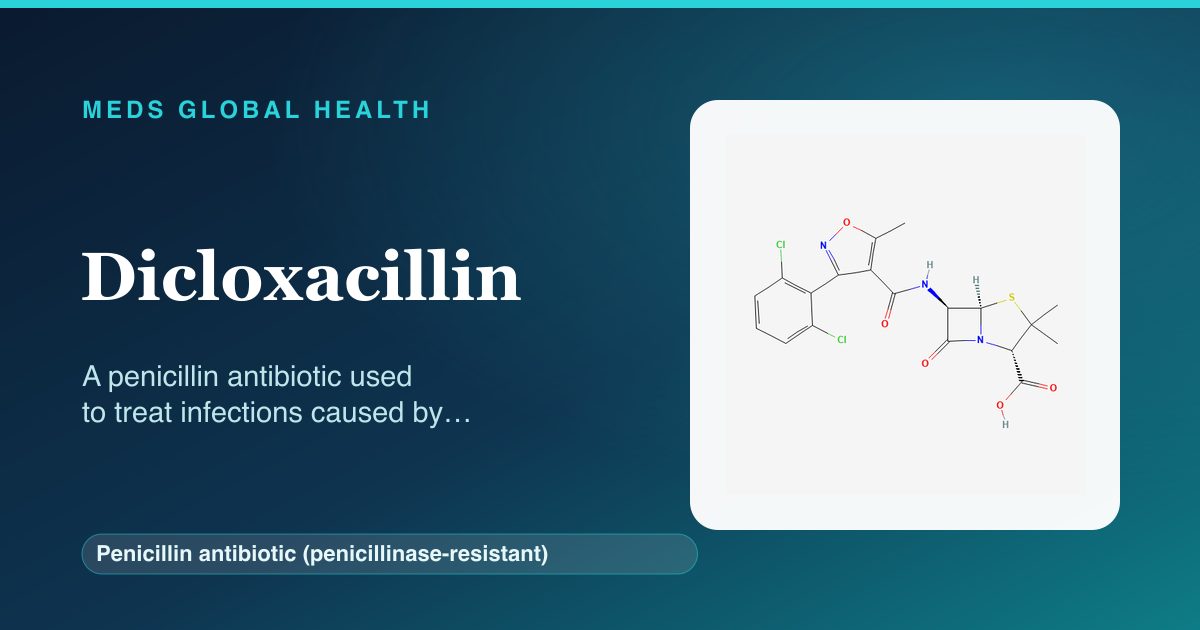
Dicloxacillin is an antibiotic belonging to the penicillin family. It is a penicillinase-resistant penicillin, meaning it is not broken down by an enzyme that staphylococcus ('staph') bacteria make to destroy ordinary penicillins. This makes it useful for treating staph infections, such as infections of the skin and soft tissues. It works in much the same way as flucloxacillin, which is the more commonly used medicine of this type in the UK. It is taken by mouth as a course. As with all penicillins, it is not suitable for people who are allergic to penicillin.
How it works
Dicloxacillin kills bacteria by stopping them building their cell walls, which they need to survive, so the bacteria break down and die. What makes it particularly useful is that it resists being destroyed by penicillinase, an enzyme that staph bacteria produce to inactivate ordinary penicillins. This means it stays effective against many staph infections that plain penicillin would not clear. Because it targets the bacteria's cell wall, which human cells do not have, it acts against the infection while leaving the body's own cells largely unaffected.
Company & origin
A penicillin antibiotic resistant to being broken down by staph bacteria; used much like flucloxacillin, though flucloxacillin is the usual choice in the UK.
Practical use
How to take Dicloxacillin
General, dose-free guidance — always follow your prescriber's and the leaflet's specific instructions.
- Take it by mouth as a course, at evenly spaced times, usually on an empty stomach as directed.
- Finish the whole course even if you feel better, to clear the infection and help prevent resistance.
- Tell your prescriber if you have ever had an allergic reaction to penicillin before taking it.
- Stop and seek medical advice if you develop a rash, itching, swelling or difficulty breathing.
- Tell your prescriber about other medicines you take, so any interactions can be considered.
Weighing it up
Advantages & disadvantages of Dicloxacillin
Advantages
- Effective against staph infections, including skin and soft-tissue infections.
- Resists being broken down by the enzyme staph bacteria use against ordinary penicillins.
- Taken by mouth and works much like the familiar antibiotic flucloxacillin.
Disadvantages
- Cannot be used by people with penicillin allergy.
- Commonly causes stomach upset such as nausea and diarrhoea.
- In the UK, flucloxacillin is usually the preferred medicine of this type.
Practical use
Good to know
The single most important thing with dicloxacillin, as with all penicillins, is allergy: anyone who has had a serious allergic reaction to a penicillin, particularly anaphylaxis (a severe whole-body reaction with swelling, breathing difficulty or collapse), must not take it. It is also worth knowing it is closely related to flucloxacillin and used in similar situations, so in the UK flucloxacillin is usually chosen. The most common side effects are stomach-related, such as nausea, diarrhoea or tummy upset. As with any antibiotic, it should be taken for the full course even once you feel better, both to clear the infection fully and to help prevent resistance. If you develop a rash, itching, swelling or any sign of an allergic reaction, stop and seek medical advice, and tell any prescriber about your penicillin allergy in future.
Who should not take it / use with caution
- People who have had a serious allergic reaction to penicillin, including anaphylaxis, must not take it.
- It is used with caution in people with a history of allergy to other antibiotics, under medical advice.
- It is used with care in people with liver problems, who may need monitoring.
Monitoring
- Reviewing how well the infection responds to treatment.
- Watching for any signs of an allergic reaction.
- Checking liver function during longer courses where appropriate.
Side effects
- Nausea, diarrhoea or other stomach upset.
- Rash or itching, which can sometimes be a sign of allergy and should be checked.
- Rarely, a serious allergic reaction (anaphylaxis), or liver problems, which need urgent attention.
Key interactions
- It can affect some other medicines, so tell your prescriber everything you take.
- Antibiotics can, rarely, reduce how well some other medicines work, which the prescriber considers.
- Tell your prescriber about any history of antibiotic allergy before starting.
Available as: Capsules and liquid taken by mouth.
Answers
Dicloxacillin: frequently asked questions
What is dicloxacillin used for?
It is a penicillin antibiotic used to treat infections caused by staph bacteria, such as skin and soft-tissue infections, working much like flucloxacillin.
Can I take it if I am allergic to penicillin?
No. As a penicillin, it must not be taken by anyone who has had a serious allergic reaction to penicillin, including anaphylaxis.
How is it different from flucloxacillin?
It is closely related and used in similar staph infections; in the UK flucloxacillin is usually the preferred medicine of this type.
Do I need to finish the course?
Yes. Finish the whole course even once you feel better, to clear the infection fully and help prevent antibiotic resistance.
What are the common side effects?
The most common are stomach-related, such as nausea and diarrhoea; report any rash, swelling or breathing difficulty straight away as these can signal allergy.
The wider class
About Penicillin antibiotic (penicillinase-resistant)
Dicloxacillin belongs to the penicillin antibiotic (penicillinase-resistant) class. For how the class as a whole works, its shared safety principles and monitoring, see the full guide.
Browse by body system
Authoritative sources
- BNF
- NICE CKS
Building a medicines information resource?
We create evidence-led, dose-free drug and formulary references for teams.