An inhaled vasodilator, historically used for angina and in cyanide-poisoning kits
Amyl nitrite
An old inhaled medicine that widens blood vessels, once used for angina and in cyanide-poisoning kits.
What is Amyl nitrite?
Amyl nitrite is an old, fast-acting inhaled medicine that widens blood vessels. In the past it was used to relieve angina (chest pain from the heart), and it is sometimes included in emergency kits for treating cyanide poisoning. It works quickly when breathed in but causes a sudden drop in blood pressure, which can lead to dizziness or fainting, as well as headache and flushing. It can also cause a blood problem called methaemoglobinaemia, where the blood carries oxygen less well. It is highly flammable, and misuse of similar products ("poppers") carries its own risks.
Education and reference only. This is a plain-language guide to Amyl nitrite — it deliberately contains no doses. Doses depend on the person, the brand and the reason for treatment, and belong with your prescriber. Always check the BNF, the product labelling (SmPC) and follow medical advice.
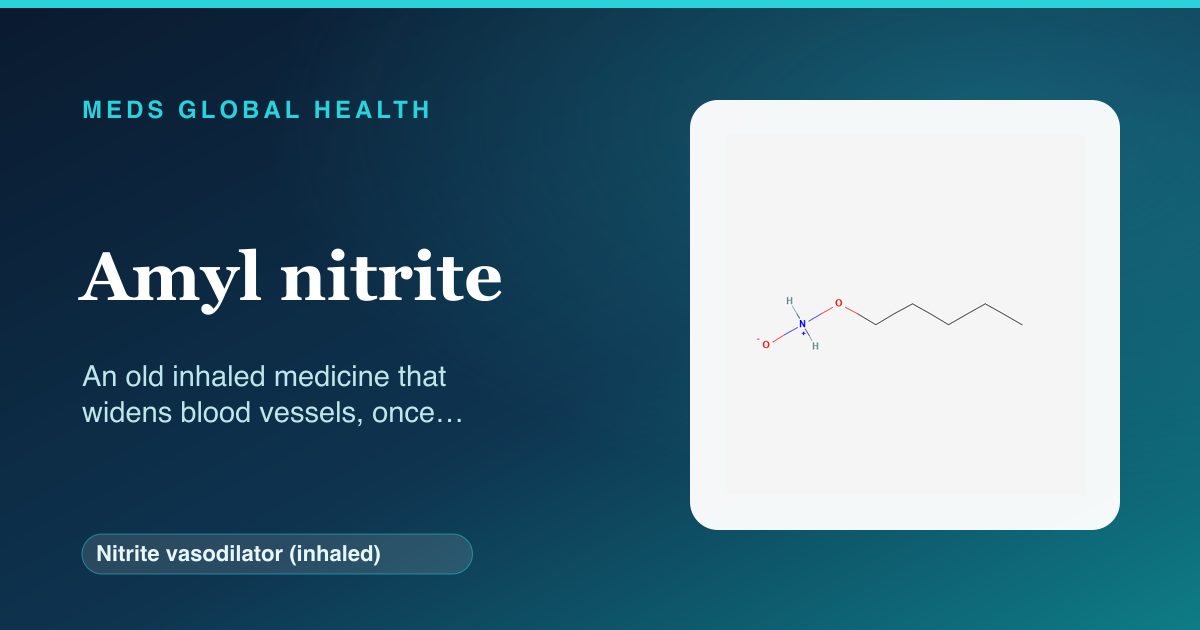
What it is
Amyl nitrite is one of the oldest heart medicines, a liquid that gives off a vapour which is breathed in. It belongs to the nitrate/nitrite family, which relaxes and widens blood vessels. Historically it was used to relieve attacks of angina, but it has largely been replaced by safer, easier-to-control nitrate medicines. It still appears in some emergency kits for cyanide poisoning. Related nitrites are misused recreationally as "poppers". It is rarely part of routine UK prescribing today.
How it works
Amyl nitrite releases nitric oxide, a natural signal that relaxes the muscle in blood vessel walls, causing the vessels to widen. This lowers the workload on the heart and can ease angina, and it acts very quickly because it is inhaled. In cyanide poisoning, it works differently: it changes some of the blood's haemoglobin into methaemoglobin, which binds the cyanide and helps move it away from the body's cells. The same effect on blood, and the strong widening of blood vessels, explains its main risks of low blood pressure and reduced oxygen-carrying.
Company & origin
A very old inhaled medicine that was once used for angina and is sometimes included in emergency kits for cyanide poisoning; rarely used in routine UK practice today.
Practical use
How to take Amyl nitrite
General, dose-free guidance — always follow your prescriber's and the leaflet's specific instructions.
- Use it only as directed, and be sitting down when you do, because it can cause a sudden drop in blood pressure and fainting.
- Keep it well away from flames, cigarettes and heat, as the vapour is highly flammable.
- Do not use it with erectile-dysfunction medicines such as sildenafil, as the combination can dangerously lower blood pressure.
- Seek urgent help if you become very breathless, your lips or skin look blue, or you feel faint and do not recover quickly.
- Do not misuse it or related "poppers", as this carries serious health risks.
Weighing it up
Advantages & disadvantages of Amyl nitrite
Advantages
- Acts very quickly when inhaled to widen blood vessels.
- Has a place in some emergency kits for treating cyanide poisoning.
- A long-established medicine with a well-known mode of action.
Disadvantages
- Causes a sudden drop in blood pressure that can lead to dizziness or fainting.
- Can cause throbbing headache, flushing and a blood problem called methaemoglobinaemia.
- Highly flammable, hard to control, and largely replaced by safer nitrates; misuse carries serious risks.
Practical use
Good to know
The most important things to know about amyl nitrite are its sudden, powerful effects. Because it widens blood vessels quickly, it can cause a sharp fall in blood pressure with dizziness, throbbing headache, flushing and even fainting, so people are usually advised to be sitting down when using it. It can also cause methaemoglobinaemia, a condition where the blood carries oxygen less effectively, which can make a person look blue and feel breathless. The vapour is highly flammable and must be kept away from flames and heat. It should never be combined with erectile-dysfunction medicines such as sildenafil, as together they can cause a dangerous drop in blood pressure. Misuse of related nitrites as "poppers" carries serious risks, including to the eyes and from the same blood and blood-pressure effects. Today it is rarely used in routine practice, with much safer nitrate options available.
Who should not take it / use with caution
- People who have had a serious reaction to nitrites should not use it.
- It must not be used with erectile-dysfunction medicines such as sildenafil because of the risk of a dangerous fall in blood pressure.
- It is avoided in people with very low blood pressure, certain heart conditions, severe anaemia or raised pressure in the head, and is used with great caution in pregnancy.
Monitoring
- Watching for low blood pressure, dizziness or fainting after use.
- In emergency or cyanide-poisoning use, monitoring oxygen levels and for methaemoglobinaemia.
- Reviewing whether a safer, modern nitrate would be more appropriate.
Side effects
- A sudden drop in blood pressure causing dizziness, light-headedness or fainting.
- Throbbing headache, flushing and a fast heartbeat.
- Methaemoglobinaemia, where the blood carries oxygen less well, which can cause breathlessness and a bluish colour.
Key interactions
- Erectile-dysfunction medicines such as sildenafil can cause a dangerous drop in blood pressure when combined.
- Other blood-pressure-lowering medicines add to its effect on blood pressure.
- Alcohol can worsen the fall in blood pressure and the dizziness it causes.
Available as: A volatile liquid whose vapour is inhaled.
Answers
Amyl nitrite: frequently asked questions
What is amyl nitrite used for?
It is an old inhaled medicine that widens blood vessels, historically used for angina and sometimes included in emergency kits for cyanide poisoning.
Why does it make me feel faint?
It widens blood vessels quickly, which can cause a sudden drop in blood pressure leading to dizziness or fainting, so it is best used while sitting down.
What is methaemoglobinaemia?
It is a blood condition that amyl nitrite can cause, where the blood carries oxygen less effectively, which can make a person feel breathless and look bluish.
Can I use it with erectile-dysfunction tablets?
No. Combining it with medicines such as sildenafil can cause a dangerous drop in blood pressure and must be avoided.
Is it still commonly used?
No. It has largely been replaced by safer, easier-to-control nitrate medicines, and is highly flammable, so it is rarely used in routine practice today.
The wider class
About Nitrite vasodilator (inhaled)
Amyl nitrite belongs to the nitrite vasodilator (inhaled) class. For how the class as a whole works, its shared safety principles and monitoring, see the full guide.
Browse by body system
Authoritative sources
- BNF
- NICE CKS
Building a medicines information resource?
We create evidence-led, dose-free drug and formulary references for teams.