A long-acting nitrate
Isosorbide mononitrate
A long-acting nitrate taken regularly to prevent angina (chest pain) rather than to treat a sudden attack.
What is Isosorbide mononitrate?
Isosorbide mononitrate is a long-acting nitrate used to prevent angina chest pain in people with coronary heart disease. It is taken on a regular daily schedule to keep angina at bay, but because it works for hours it is not the medicine to reach for during a sudden attack — a fast-acting GTN spray or tablet is used for that.
Education and reference only. This is a plain-language guide to Isosorbide mononitrate — it deliberately contains no doses. Doses depend on the person, the brand and the reason for treatment, and belong with your prescriber. Always check the BNF, the product labelling (SmPC) and follow medical advice.
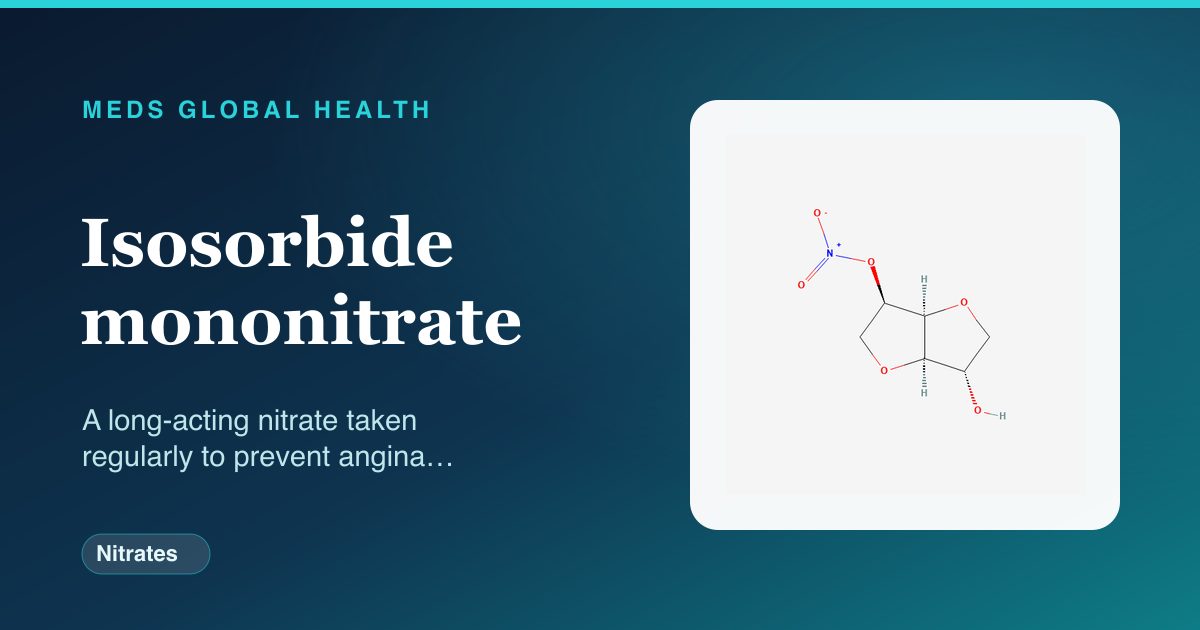
What it is
Isosorbide mononitrate is a long-acting nitrate used to prevent the chest pain of angina in people with narrowed heart arteries (coronary heart disease). Unlike glyceryl trinitrate (GTN), which acts within seconds to relieve an attack, isosorbide mononitrate is taken regularly as a preventer to reduce how often angina happens and to help people do more before pain comes on. It is taken as tablets, including modified-release forms designed to give a steady effect through the day.
How it works
In the body, isosorbide mononitrate releases nitric oxide, the same signalling molecule the lining of healthy blood vessels makes naturally. Nitric oxide relaxes and widens blood vessels, particularly the veins, which reduces how hard the heart has to work and lowers its demand for oxygen. It also helps widen the coronary arteries themselves. The overall effect is to rebalance the heart's oxygen supply and demand, which is what eases and prevents angina.
Company & origin
Originated / developed by: Schwarz Pharma (an active metabolite of isosorbide dinitrate, developed in the 1970s-1980s).
Isosorbide mononitrate is the main active breakdown product of the older nitrate isosorbide dinitrate. It was developed as a medicine in its own right during the 1970s and 1980s because, unlike the dinitrate, it is not heavily broken down on first pass through the liver, giving it a more predictable and longer-lasting effect.
Practical use
How to take Isosorbide mononitrate
General, dose-free guidance — always follow your prescriber's and the leaflet's specific instructions.
- Take it on a regular schedule arranged to leave a nitrate-free period (usually overnight) so the medicine does not lose its effect over time — follow the timing your prescriber gives exactly.
- Headaches are common in the first days or weeks and usually ease as your body gets used to it; simple painkillers can help in the meantime.
- Modified-release tablets should be swallowed whole with water — do not crush or chew them, as this releases the medicine too quickly.
- Do not stop taking it suddenly, even if you feel well, as this can bring on a rebound worsening of angina; any change is made gradually with your prescriber.
- This is a preventer, not a rescue medicine — keep a fast-acting GTN spray or tablet to hand for a sudden angina attack.
- Stand up slowly, especially at first, as nitrates can cause dizziness or light-headedness from a drop in blood pressure.
Weighing it up
Advantages & disadvantages of Isosorbide mononitrate
Advantages
- A convenient long-acting preventer that can reduce how often angina occurs and help people stay active.
- Modified-release forms give a steady, predictable effect with a simple once-daily routine for many people.
- Well-established, widely used and inexpensive, with decades of clinical experience behind it.
Disadvantages
- The body develops tolerance if exposed continuously, so dosing must be arranged to allow a nitrate-free period each day.
- Headaches and light-headedness are common, especially when starting.
- It is not a rescue treatment — a separate fast-acting nitrate is still needed for sudden attacks.
- It must never be combined with PDE5 medicines for erectile dysfunction (such as sildenafil or tadalafil), as the combination can cause a dangerous fall in blood pressure.
Practical use
Good to know
Nitrates lose their effect if the body is exposed to them around the clock — this is called tolerance. To avoid it, the dosing pattern is arranged to leave a nitrate-free period each day (often overnight), so the medicine keeps working over the long term. Headaches are common when first starting and usually settle as the body adjusts. It is a preventer, not a rescue medicine, so a separate fast-acting GTN is still needed for sudden attacks. It should not be stopped abruptly, as this can trigger a rebound in angina.
Who should not take it / use with caution
- People taking a PDE5 inhibitor for erectile dysfunction or pulmonary hypertension (such as sildenafil, tadalafil or vardenafil) — the combination can cause a severe, potentially dangerous drop in blood pressure.
- People with very low blood pressure, certain heart-valve or heart-muscle conditions, or recent significant blood loss, where further widening of blood vessels could be harmful.
- Used with caution in people prone to fainting, low blood pressure, severe anaemia, or raised pressure in the brain (raised intracranial pressure).
Monitoring
- Symptom control (how often angina occurs)
- Blood pressure and any dizziness or fainting
- That a nitrate-free period is maintained to preserve the effect
Side effects
- Headache is the most common effect, especially early on, and usually settles with time.
- Light-headedness, dizziness or flushing, and feeling faint on standing up, from the blood-pressure-lowering effect.
- Occasionally a fast or pounding heartbeat or nausea; rarely, fainting if blood pressure falls too far.
Key interactions
- Never with PDE5 medicines for erectile dysfunction or pulmonary hypertension (sildenafil, tadalafil, vardenafil) — risk of a dangerous fall in blood pressure.
- Adds to the effect of other blood-pressure-lowering medicines, alcohol and some antidepressants, increasing dizziness.
- Care alongside riociguat and other vasodilators that can lower blood pressure further.
Available as: Tablets, including standard and modified-release (slow-release) tablets designed to give a steady effect through the day.
Answers
Isosorbide mononitrate: frequently asked questions
Can I use isosorbide mononitrate to stop a sudden angina attack?
No — it is a long-acting preventer that works over hours, not seconds. For a sudden attack you need a fast-acting nitrate such as a GTN spray or tablet under the tongue. Keep that to hand at all times even when you take isosorbide mononitrate regularly.
Why do I have to take it at certain times of day?
Nitrates stop working if the body is exposed to them constantly, a problem called tolerance. Spacing the doses to leave a nitrate-free gap each day, usually overnight, lets the medicine keep working in the long run. Follow the exact timing your prescriber gives.
Why does it give me a headache?
Nitrates widen blood vessels, including those in the head, which commonly causes headache when you first start. It usually settles within a week or two as your body adjusts, and a simple painkiller can help in the meantime. Tell your prescriber if it is severe or does not ease.
Can I take it with tablets for erectile dysfunction?
No. Nitrates must never be combined with PDE5 medicines such as sildenafil (Viagra) or tadalafil, because together they can cause a sudden, dangerous fall in blood pressure. Tell any prescriber that you take a nitrate before being given anything for erectile dysfunction.
Can I stop it if my angina has been fine?
Do not stop it suddenly, as this can trigger a rebound worsening of angina. If your angina is well controlled, your prescriber may review your treatment, but any change should be made gradually under their guidance rather than on your own.
The wider class
About Nitrates
Isosorbide mononitrate belongs to the nitrates class. For how the class as a whole works, its shared safety principles and monitoring, see the full guide.
Browse by body system
Authoritative sources
- BNF: Isosorbide mononitrate.
- NICE CKS: Isosorbide mononitrate.
- electronic Medicines Compendium (SmPC): Isosorbide mononitrate.
Building a medicines information resource?
We create evidence-led, dose-free drug and formulary references for teams.