An add-on medicine for angina chest pain
Ranolazine
An add-on angina medicine that eases chest pain without mainly lowering heart rate or blood pressure.
What is Ranolazine?
Ranolazine is an anti-anginal medicine used to prevent the chest pain of stable angina. Unlike most angina treatments, it works without mainly slowing the heart or lowering blood pressure. In the UK it is usually added on when standard angina medicines are not enough or are not tolerated.
Education and reference only. This is a plain-language guide to Ranolazine — it deliberately contains no doses. Doses depend on the person, the brand and the reason for treatment, and belong with your prescriber. Always check the BNF, the product labelling (SmPC) and follow medical advice.
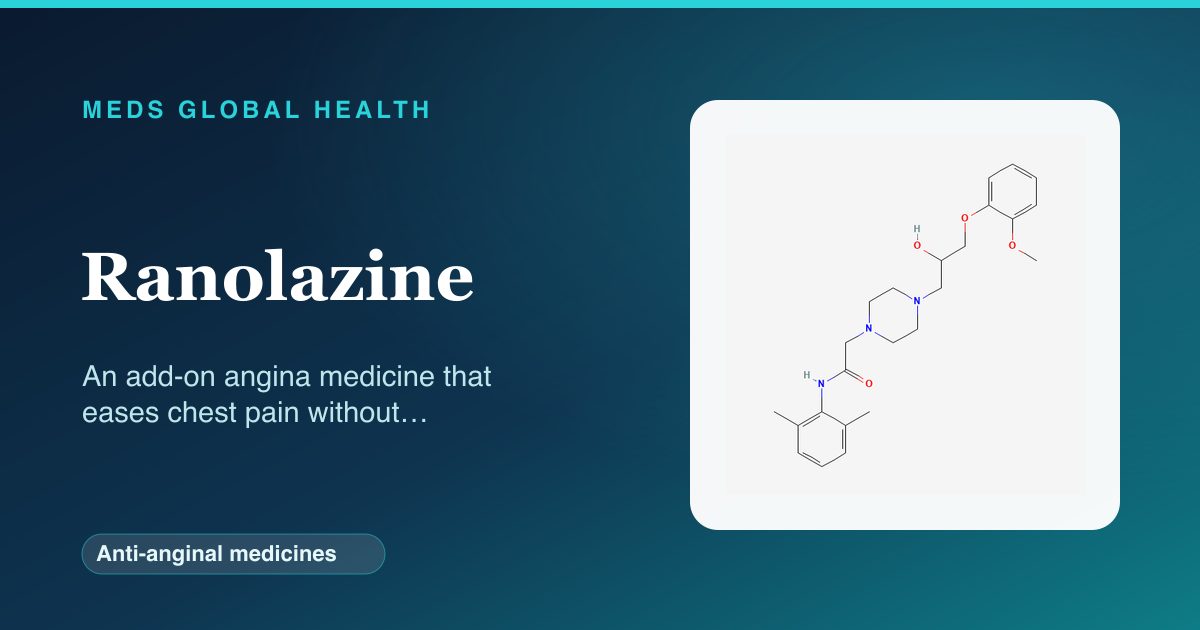
What it is
Ranolazine is a tablet used to reduce the frequency of angina (heart-related chest pain). It is taken regularly rather than to relieve a sudden attack. Because it does not rely on lowering heart rate or blood pressure, it is a useful add-on for people who cannot increase or tolerate other angina medicines.
How it works
Ranolazine acts on a "late" sodium current in heart-muscle cells. By reducing this current, it lessens calcium overload in the cells, which helps the heart muscle relax and use oxygen more efficiently during stress. This eases the supply-and-demand imbalance that causes angina, with little direct effect on heart rate or blood pressure.
Company & origin
Originated / developed by: CV Therapeutics (originator).
A late-sodium-current inhibitor introduced in the 2000s as an add-on treatment for chronic stable angina.
Practical use
How to take Ranolazine
General, dose-free guidance — always follow your prescriber's and the leaflet's specific instructions.
- Take it regularly at the same times each day, with or without food.
- Swallow the slow-release tablets whole — do not crush, break or chew them.
- Avoid grapefruit and grapefruit juice, which can raise its levels.
- Use it to prevent angina — it is not a reliever for a sudden attack.
- If you miss a dose, take it when you remember unless it is nearly time for the next one — do not double up.
Weighing it up
Advantages & disadvantages of Ranolazine
Advantages
- Reduces angina without mainly slowing the heart or lowering blood pressure.
- Useful when heart rate or blood pressure is already low and limits other medicines.
- Can be combined with standard angina treatments as an add-on.
Disadvantages
- Commonly causes dizziness, constipation, nausea or tiredness.
- Can lengthen the heart's QT interval, limiting use with some other medicines.
- Levels are affected by grapefruit and several common medicines.
Practical use
Good to know
Ranolazine is taken regularly to prevent angina and is not a reliever for an attack. The tablets are slow-release and should be swallowed whole, not crushed or chewed. Grapefruit and grapefruit juice should be avoided, as they can raise its levels. It can affect the heart's electrical rhythm (the QT interval), so it is used carefully alongside certain other medicines, and dizziness, constipation and nausea are fairly common.
Who should not take it / use with caution
- People with severe kidney impairment or moderate-to-severe liver disease.
- People taking certain medicines that strongly affect its breakdown or the QT interval.
- Used with caution in older people and those at risk of heart-rhythm problems.
Monitoring
- Kidney and liver function before and during treatment as advised.
- Heart rhythm (ECG) in people at risk of QT problems.
- Frequency and severity of angina symptoms.
Side effects
- Dizziness, headache or tiredness.
- Constipation, nausea or other digestive upset.
- Rarely, changes to the heart's electrical rhythm (QT prolongation).
Key interactions
- Grapefruit juice and strong CYP3A4 inhibitors (some antifungals, certain antibiotics) raise its levels.
- Other medicines that lengthen the QT interval increase the risk of rhythm problems.
- It can raise levels of some other heart and statin medicines, needing dose review.
Available as: Slow-release (prolonged-release) tablets.
Answers
Ranolazine: frequently asked questions
How is ranolazine different from other angina medicines?
Most angina treatments work by slowing the heart or lowering blood pressure. Ranolazine works on a sodium current inside heart cells instead, so it can ease angina without those effects. This makes it useful when your heart rate or blood pressure is already low.
Can I crush ranolazine tablets?
No. They are slow-release tablets designed to work gradually, so they must be swallowed whole. Crushing or chewing them releases the medicine too quickly. If you cannot swallow tablets, ask your pharmacist for advice.
Why must I avoid grapefruit with ranolazine?
Grapefruit and grapefruit juice block an enzyme that breaks ranolazine down, which can raise its levels and increase side effects, including effects on heart rhythm. It is best to avoid them while taking it.
Is ranolazine a reliever for chest pain?
No. It is taken regularly to prevent angina, not to stop a sudden attack. For acute chest pain you should use your prescribed reliever, such as a GTN spray, and seek help if it does not settle.
Will ranolazine lower my blood pressure?
It has little direct effect on blood pressure or heart rate, which is one of its advantages. That said, it is still combined with other treatments, so your overall blood pressure and symptoms are monitored by your team.
The wider class
About Anti-anginal medicines
Ranolazine belongs to the anti-anginal medicines class. For how the class as a whole works, its shared safety principles and monitoring, see the full guide.
Browse by body system
Authoritative sources
- BNF
- NICE CKS
Building a medicines information resource?
We create evidence-led, dose-free drug and formulary references for teams.