A medicine that widens blood vessels to prevent angina
Nicorandil
A blood-vessel-widening medicine used to prevent angina chest pain, carrying an important risk of serious ulcers.
What is Nicorandil?
Nicorandil is a vasodilator used to prevent angina (heart-related chest pain). It widens both the arteries and veins, easing the heart's workload and improving its blood supply. It is usually added when other angina medicines such as beta-blockers or calcium-channel blockers are not enough, and it carries an important risk of serious ulcers.
Education and reference only. This is a plain-language guide to Nicorandil — it deliberately contains no doses. Doses depend on the person, the brand and the reason for treatment, and belong with your prescriber. Always check the BNF, the product labelling (SmPC) and follow medical advice.
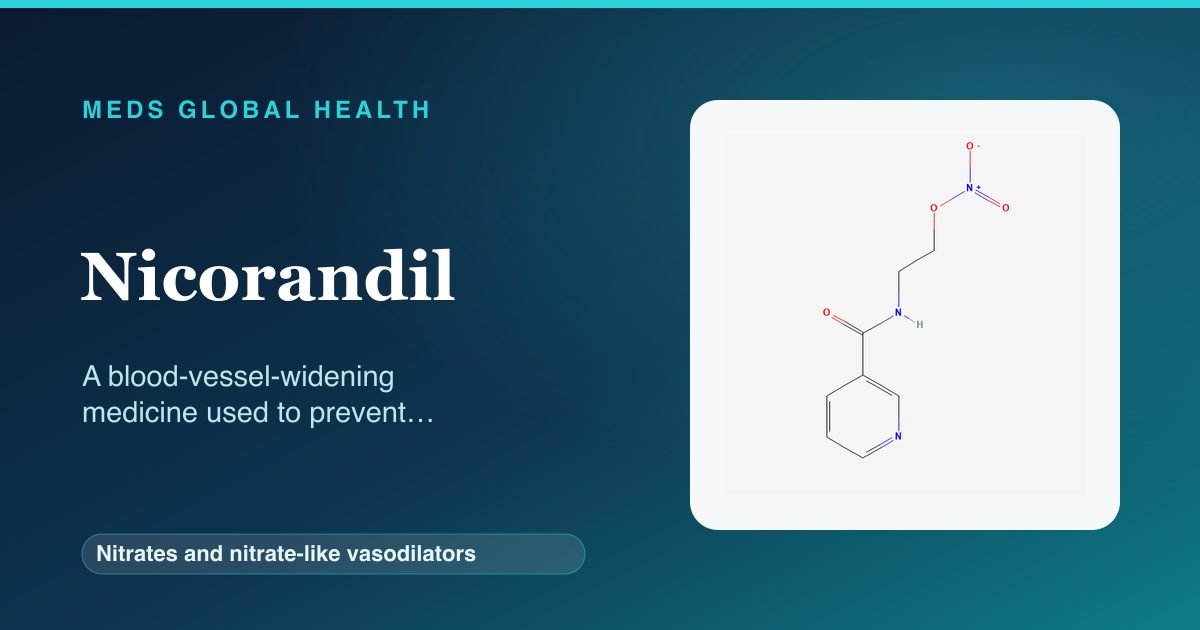
What it is
Nicorandil is a tablet used to prevent the chest pain of angina. It is not a quick-relief treatment for an attack but is taken regularly to reduce how often angina occurs. In the UK it is generally used as an add-on when first-line angina medicines are insufficient or not tolerated.
How it works
Nicorandil has two actions: it opens potassium channels in blood-vessel walls and also acts like a nitrate. Together these relax and widen both arteries and veins, which lowers the pressure the heart pumps against and improves blood flow to the heart muscle. This reduces the imbalance between the heart's oxygen demand and supply that causes angina.
Company & origin
Originated / developed by: Chugai / Aventis (originator).
A potassium-channel-opening vasodilator with a nitrate-like action, introduced in the 1990s for the prevention of angina.
Practical use
How to take Nicorandil
General, dose-free guidance — always follow your prescriber's and the leaflet's specific instructions.
- Take it regularly at the same times each day, with or without food.
- Use it to prevent angina — it is not a reliever for a sudden attack.
- Keep tablets in their original packaging and protected from moisture.
- Report any mouth, skin, eye, genital or back-passage ulcers promptly.
- If you miss a dose, take it when you remember unless it is nearly time for the next one — do not double up.
Weighing it up
Advantages & disadvantages of Nicorandil
Advantages
- Reduces how often angina occurs when other medicines are not enough.
- Widens both arteries and veins, easing the heart's workload and improving its blood supply.
- Can be combined with other angina treatments such as beta-blockers.
Disadvantages
- Can cause serious, slow-healing ulcers that only heal once the medicine is stopped.
- Often causes headaches, especially when first starting.
- Must not be used with erectile-dysfunction medicines such as sildenafil.
Practical use
Good to know
An important safety point is that nicorandil can cause serious, slow-healing ulcers — most often in the mouth, but also in the gut, around the back passage, on the skin, in the eyes or genitals. Any persistent or painful ulcer should be reported promptly, as it usually only heals once the medicine is stopped. Headaches are common when starting and often settle. Like nitrates, it should not be combined with erectile-dysfunction medicines such as sildenafil because of a risk of a dangerous drop in blood pressure.
Who should not take it / use with caution
- People with very low blood pressure, severe heart failure or cardiogenic shock.
- People taking medicines for erectile dysfunction (sildenafil, tadalafil, vardenafil).
- People with a history of, or current, mouth, gut or other ulceration linked to nicorandil.
Monitoring
- Watch for and report any persistent ulcers (mouth, skin, gut, eyes, genitals).
- Blood pressure and any dizziness or fainting.
- Frequency and severity of angina symptoms.
Side effects
- Headache, especially in the first days or weeks, which often settles.
- Flushing, dizziness, low blood pressure or a faster heartbeat.
- Serious, slow-healing ulcers of the mouth, gut, skin, eyes or genitals — report any promptly.
Key interactions
- Erectile-dysfunction medicines (sildenafil, tadalafil, vardenafil) can cause a dangerous fall in blood pressure.
- Other blood-pressure-lowering medicines and nitrates add to its effect.
- Drugs that can cause ulceration, such as NSAIDs and steroids, may increase the ulcer risk.
Available as: Tablets.
Answers
Nicorandil: frequently asked questions
Can I use nicorandil to relieve an angina attack?
No. Nicorandil is taken regularly to prevent angina, not to stop an attack that is already happening. For sudden chest pain you should use your prescribed reliever, such as a GTN spray or tablet, as advised.
Why do I keep getting mouth ulcers on nicorandil?
Nicorandil can cause serious, slow-healing ulcers, and the mouth is the most common site. These usually only heal once the medicine is stopped, so any persistent or painful ulcer should be reported to your team promptly rather than waited out.
Why does nicorandil give me a headache?
Like nitrates, nicorandil widens blood vessels, which can cause headaches, particularly in the first days or weeks. They often ease as your body adjusts; tell your team if they are severe or do not settle.
Can I take erectile-dysfunction tablets with nicorandil?
No. Medicines such as sildenafil, tadalafil and vardenafil combined with nicorandil can cause a dangerous drop in blood pressure. Tell your doctor or pharmacist you take nicorandil before using any such treatment.
What should I do if I get an ulcer anywhere on my body?
Report it to your GP or pharmacist promptly and mention you take nicorandil. Ulcers linked to this medicine can occur in the mouth, gut, back passage, skin, eyes or genitals and usually need the medicine to be reviewed or stopped to heal.
The wider class
About Nitrates and nitrate-like vasodilators
Nicorandil belongs to the nitrates and nitrate-like vasodilators class. For how the class as a whole works, its shared safety principles and monitoring, see the full guide.
Browse by body system
Authoritative sources
- BNF
- NICE CKS
Building a medicines information resource?
We create evidence-led, dose-free drug and formulary references for teams.