GTN
Glyceryl trinitrate
A fast-acting nitrate spray or tablet used under the tongue to relieve or prevent a sudden angina (chest pain) attack.
What is Glyceryl trinitrate?
Glyceryl trinitrate, or GTN, is a fast-acting nitrate used to relieve a sudden attack of angina chest pain. It is sprayed or placed under the tongue, where it works within minutes by widening blood vessels and easing the heart's workload. It can also be used just before activity known to bring on angina.
Education and reference only. This is a plain-language guide to Glyceryl trinitrate — it deliberately contains no doses. Doses depend on the person, the brand and the reason for treatment, and belong with your prescriber. Always check the BNF, the product labelling (SmPC) and follow medical advice.
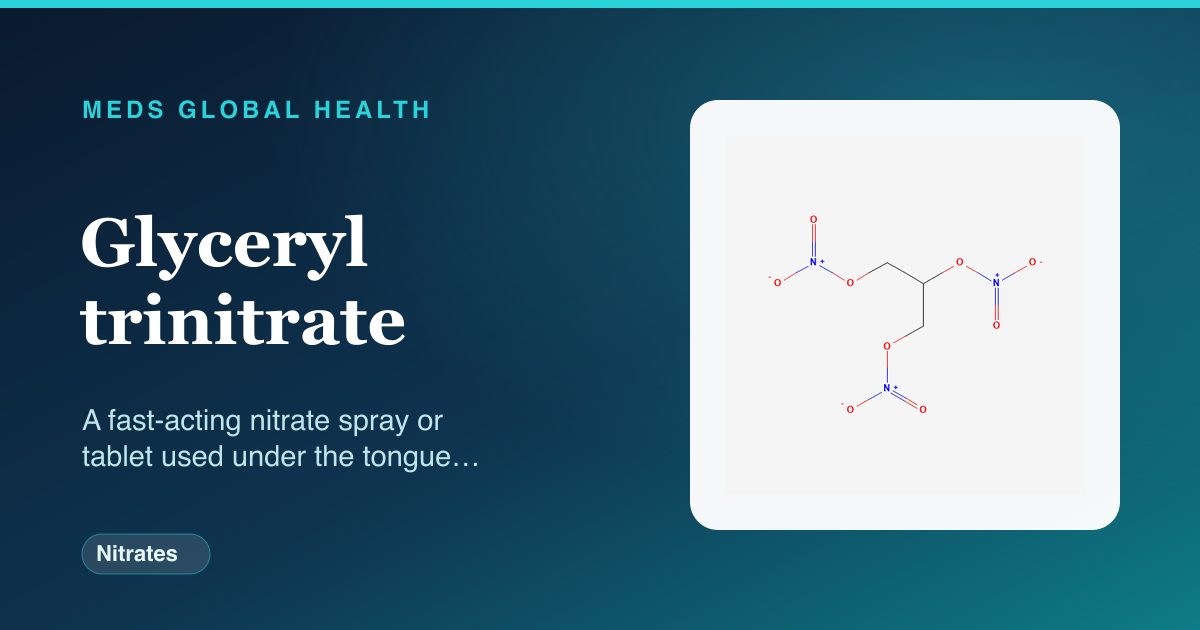
What it is
Glyceryl trinitrate (GTN) is a fast-acting nitrate used as a rescue treatment for the chest pain of angina. Given as a spray or a small tablet under the tongue, it is absorbed straight into the bloodstream and acts within minutes. It can be used to relieve an attack when it happens, or taken in advance of something likely to bring on angina, such as climbing stairs or exertion in cold weather.
How it works
GTN releases nitric oxide, the natural signalling molecule that relaxes the muscle in blood-vessel walls. This widens the veins and arteries, reducing the amount of blood returning to the heart and the resistance it pumps against, so the heart needs less oxygen. It also helps open the coronary arteries. Because it is absorbed under the tongue, it bypasses the gut and liver and reaches the heart quickly, which is why it works so fast.
Company & origin
Originated / developed by: First used medically in the late nineteenth century.
Glyceryl trinitrate (also the explosive nitroglycerin) was found to relieve angina by the physician William Murrell, who reported its use in the early 1880s. It remains one of the oldest medicines still in everyday clinical use.
Practical use
How to take Glyceryl trinitrate
General, dose-free guidance — always follow your prescriber's and the leaflet's specific instructions.
- Use it for an angina attack: stop and sit or rest down first, as GTN can make you dizzy, then spray under the tongue or place a tablet under the tongue and let it dissolve — do not swallow it.
- If the pain is not gone a few minutes after the first dose, take a second dose; if it is still there a few minutes after the second dose, call 999 — it could be a heart attack.
- It can also be used a few minutes before an activity you know brings on angina, such as exertion or going out in the cold.
- Learn the spray technique: prime a new spray before first use and spray under, not over, the tongue; close the mouth briefly afterwards.
- Discard old sublingual tablets and replace them as advised, because they lose their strength once the bottle has been opened — the spray keeps longer.
- Never use GTN with PDE5 medicines for erectile dysfunction (such as sildenafil or tadalafil), as the combination can cause a dangerous fall in blood pressure.
Weighing it up
Advantages & disadvantages of Glyceryl trinitrate
Advantages
- Works within minutes to relieve a sudden angina attack — one of the fastest-acting heart medicines available.
- Easy to carry and use, and can be taken in advance to prevent angina before known triggers.
- Very long track record, inexpensive, and a key part of recognising whether chest pain is angina.
Disadvantages
- Often causes a brief headache, flushing or light-headedness after a dose.
- Sublingual tablets lose potency once opened and must be replaced regularly to stay effective.
- It treats attacks rather than reducing how often they occur, so a separate long-acting preventer may also be needed.
- Must never be combined with PDE5 medicines for erectile dysfunction, as the combination can dangerously drop blood pressure.
Practical use
Good to know
GTN is kept on a person at all times so it is ready during an attack. When angina strikes, the advice is to sit or rest down first, because GTN can cause dizziness, then use the spray or tablet under the tongue. If the pain is not gone a few minutes after the first dose, take a second dose; if it is still there a few minutes after the second dose, call 999 — it could be a heart attack. Sublingual tablets lose strength once the bottle is opened and should be discarded and replaced as advised; the spray has a longer shelf life. A brief headache or flushing after a dose is normal.
Who should not take it / use with caution
- People taking a PDE5 inhibitor (such as sildenafil, tadalafil or vardenafil) for erectile dysfunction or pulmonary hypertension — the combination can cause a severe, potentially dangerous drop in blood pressure.
- People with very low blood pressure, certain heart-valve or heart-muscle conditions, or severe anaemia, where further vessel widening could be harmful.
- Used with caution in those prone to fainting or with raised pressure in the head; chest pain that does not respond may be a heart attack needing emergency care.
Monitoring
- How well attacks are relieved and how often they occur
- That the spray or tablets are in date and the technique is correct
- Any need to call emergency help when pain does not settle
Side effects
- Headache, flushing and a feeling of warmth shortly after a dose are common.
- Light-headedness, dizziness or feeling faint, especially if standing — which is why you should sit or rest down to take it.
- Occasionally a fast or pounding heartbeat or nausea; rarely fainting if blood pressure falls sharply.
Key interactions
- Never with PDE5 medicines for erectile dysfunction or pulmonary hypertension (sildenafil, tadalafil, vardenafil) — risk of a dangerous fall in blood pressure.
- Adds to the effect of other blood-pressure-lowering medicines and alcohol, increasing dizziness and fainting.
- Care alongside riociguat and other vasodilators.
Available as: A spray and small tablets used under the tongue (sublingual). Slow-release patches, an ointment and a hospital injection of the same medicine also exist.
Answers
Glyceryl trinitrate: frequently asked questions
How quickly does GTN work?
Used under the tongue, GTN usually starts to relieve angina within a few minutes. If the pain is not gone a few minutes after the first dose, take a second dose; if it is still there a few minutes after the second dose, call 999, because the pain may be due to a heart attack rather than ordinary angina.
Should I sit or stand to use it?
Sit or rest down before using GTN. It can lower your blood pressure and make you feel dizzy or faint, so being seated is safer. Once the attack has passed and you no longer feel light-headed, you can get up slowly.
Why do GTN tablets stop working and need replacing?
Sublingual GTN tablets lose their strength once the bottle has been opened and exposed to air, so they should be discarded and replaced as advised — otherwise they may not work in an emergency. The GTN spray keeps its effect for much longer.
Can I use GTN with tablets for erectile dysfunction?
No. GTN and other nitrates must never be combined with PDE5 medicines such as sildenafil (Viagra) or tadalafil, as together they can cause a sudden and dangerous fall in blood pressure. Always tell prescribers you carry GTN before being given anything for erectile dysfunction.
Can I use GTN before exercise to prevent angina?
Yes. As well as treating an attack, GTN can be used a few minutes before an activity you know brings on angina, such as walking uphill or going out in the cold, to help prevent the pain. Your prescriber can advise on using it this way.
The wider class
About Nitrates
Glyceryl trinitrate belongs to the nitrates class. For how the class as a whole works, its shared safety principles and monitoring, see the full guide.
Browse by body system
Authoritative sources
- BNF: Glyceryl trinitrate.
- NICE CKS: Glyceryl trinitrate (GTN).
- electronic Medicines Compendium (SmPC): Glyceryl trinitrate.
Building a medicines information resource?
We create evidence-led, dose-free drug and formulary references for teams.