A beta-blocker used in heart failure
Carvedilol
A beta-blocker used mainly in heart failure (started low and built up slowly) and for high blood pressure — never to be stopped abruptly.
What is Carvedilol?
Carvedilol is a beta-blocker used mainly to treat heart failure with a reduced pumping function, and also high blood pressure and angina. It works by slowing the heart and reducing the strain on it, and is one of the beta-blockers proven to help the failing heart over time.
Education and reference only. This is a plain-language guide to Carvedilol — it deliberately contains no doses. Doses depend on the person, the brand and the reason for treatment, and belong with your prescriber. Always check the BNF, the product labelling (SmPC) and follow medical advice.
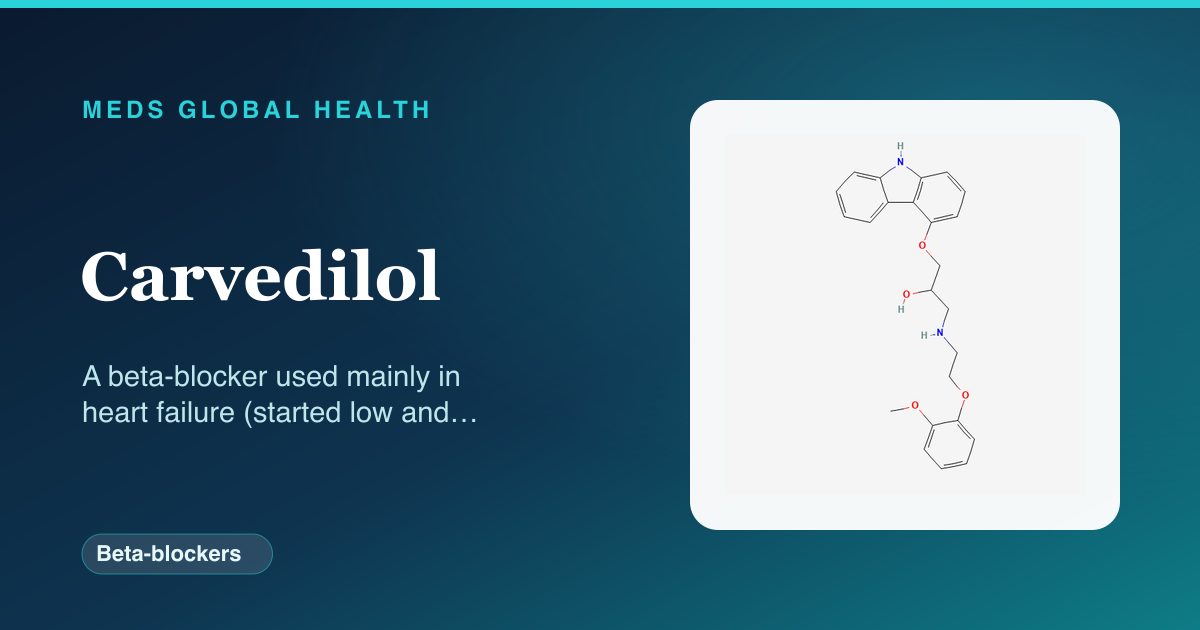
What it is
Carvedilol is a beta-blocker that is used particularly in heart failure with a reduced pumping function, where it is one of the proven medicines that help the heart over the long term. It is also used for high blood pressure and after a heart attack. Unlike some beta-blockers it also relaxes blood vessels a little, which adds to its blood-pressure-lowering effect. In the UK it has been sold as Eucardic; in the US the equivalent brand is Coreg. It is taken as a long-term, regular tablet.
How it works
Carvedilol blocks beta receptors that the stress hormones adrenaline and noradrenaline act on, which slows the heart rate and reduces the force of each beat, lowering the heart's workload and blood pressure. It also gently relaxes blood vessels, which lowers pressure further. In heart failure, calming this constant stress-hormone drive protects the heart muscle over time — but because the failing heart is sensitive to too much "slowing" too quickly, it is started at a low level and increased gradually so the heart can adjust.
Company & origin
Originated / developed by: Boehringer Mannheim.
Carvedilol was discovered by Boehringer Mannheim in Germany in the early 1980s (compound patent issued 1985) and reached market in the late 1980s/early 1990s; in the US it was later developed and marketed as Coreg by SmithKline Beecham, with FDA approval in 1995.
What it treats
Conditions Carvedilol is used for
Practical use
How to take Carvedilol
General, dose-free guidance — always follow your prescriber's and the leaflet's specific instructions.
- Take it regularly at the times your prescriber recommends, and take carvedilol with food to slow its absorption and reduce dizziness.
- Do not stop carvedilol suddenly, as this can cause a rebound worsening of angina, blood pressure or heart symptoms; any change should be made gradually and on medical advice.
- Stand up slowly, especially when you first start or when the dose is changed, as light-headedness is common early on.
- Be aware that beta-blockers can mask the warning signs of low blood sugar, such as a fast heartbeat, which matters if you have diabetes.
- Tell your prescriber if you develop marked breathlessness, swelling of the ankles, a very slow pulse or persistent tiredness.
Weighing it up
Advantages & disadvantages of Carvedilol
Advantages
- One of the beta-blockers with strong evidence for improving survival and symptoms in heart failure with reduced pumping function.
- Also effective for high blood pressure and angina, so it can address more than one problem at once.
- Blocks both alpha and beta receptors, which can give useful blood-pressure lowering.
- Long clinical track record and widely widely available in the UK.
Disadvantages
- Must never be stopped abruptly because of the risk of rebound worsening of heart and blood-pressure symptoms.
- Commonly causes tiredness, dizziness and cold hands or feet.
- Can mask the early warning signs of low blood sugar in people with diabetes.
- Not suitable for some people with asthma or certain slow-heart-rhythm problems.
Practical use
Good to know
In heart failure, carvedilol is deliberately started low and built up slowly over weeks, and it is normal to feel a little more tired or dizzy at first before the benefit settles in — so it should not be judged on the early days alone. It is best taken with food, which slows its absorption and reduces dizziness. Crucially, beta-blockers must never be stopped suddenly: stopping abruptly can cause a rebound with a racing heart, rising blood pressure or chest pain, so any change is made by tapering down. It is used cautiously in people with asthma.
Who should not take it / use with caution
- People with asthma or certain other reactive airway conditions, where beta-blockers can trigger breathing problems.
- People with certain slow or abnormal heart rhythms (such as some heart blocks), very low blood pressure, or unstable/decompensated heart failure.
- Used with caution in significant liver disease, and care in diabetes (it can mask some warning signs of a hypo) and in poor circulation.
Monitoring
- Heart rate and blood pressure, especially when starting and after increases
- Symptoms of heart failure (breathlessness, swelling, weight)
- Tolerability during slow up-titration
Side effects
- Tiredness, dizziness or light-headedness (especially when starting or increasing the dose), and cold hands and feet.
- A slow heart rate, low blood pressure, or worsening breathlessness in some people.
- Less commonly, vivid dreams or sleep disturbance, low mood, or masking of the warning signs of low blood sugar in people with diabetes.
Key interactions
- Other heart-rate-slowing or blood-pressure-lowering medicines (such as some calcium-channel blockers like diltiazem and verapamil, or digoxin) can add to its effects and need care.
- It can affect blood-sugar control and mask hypo warning signs alongside diabetes medicines, including insulin.
- Care with medicines for the heart rhythm and with anything that lowers blood pressure further — tell your pharmacist your full list.
Available as: Tablets (several strengths). A modified-release capsule form exists in some countries.
Answers
Carvedilol: frequently asked questions
Why is carvedilol started at a low level and built up slowly?
In heart failure the heart is sensitive, so beta-blockers are introduced gently and increased step by step over weeks to let the heart adjust. You may feel a little more tired or dizzy at first; this usually settles, and the real benefit builds over the longer term.
Can I stop carvedilol if I feel fine?
No — never stop a beta-blocker suddenly. Stopping abruptly can cause a rebound with a fast heart rate, rising blood pressure or chest pain. If it needs to be stopped, it is reduced gradually under medical guidance.
Why should I take it with food?
Taking carvedilol with food slows down how quickly it is absorbed, which helps reduce dizziness and light-headedness. Taking it consistently with meals makes its effect steadier.
I have asthma — can I take it?
Beta-blockers like carvedilol can tighten the airways and are generally avoided or used very cautiously in asthma. Always tell your prescriber about any asthma or breathing condition so a safer option can be considered if needed.
What is the difference between carvedilol and Eucardic or Coreg?
They are the same medicine — carvedilol is the generic (active-ingredient) name, Eucardic is a UK brand and Coreg is the US brand. The active ingredient is identical.
The wider class
About Beta-blockers
Carvedilol belongs to the beta-blockers class. For how the class as a whole works, its shared safety principles and monitoring, see the full guide.
Browse by body system
Authoritative sources
- BNF: Carvedilol.
- electronic Medicines Compendium (SmPC): Carvedilol.
- NICE NG106: Chronic heart failure in adults.
Building a medicines information resource?
We create evidence-led, dose-free drug and formulary references for teams.